
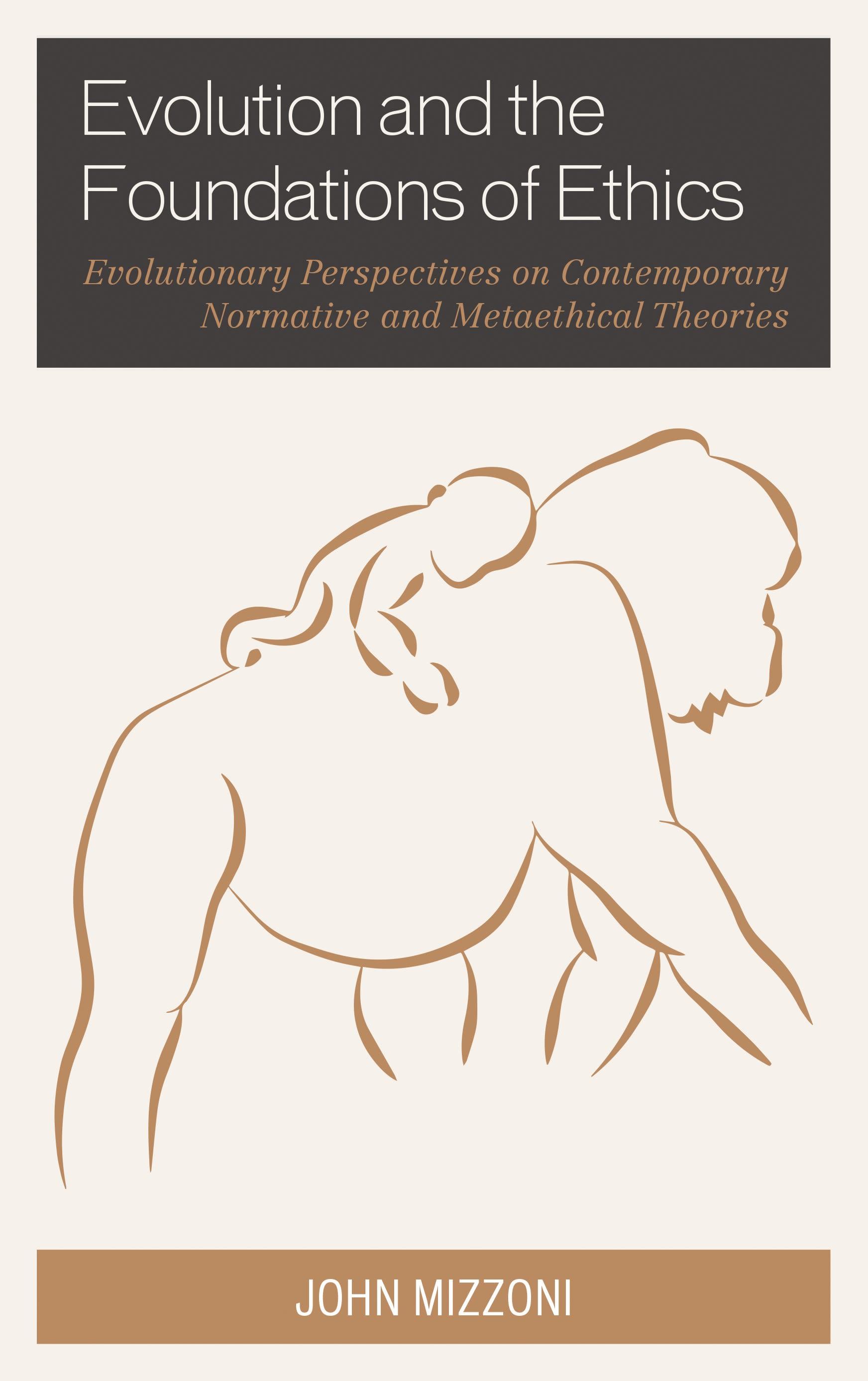
If human biological evolution is part of our worldview, then how do commonplace notions of ethics fit in? To ask the question, “what does evolution imply about ethics?” we must first be clear about what we mean by evolution. Evolution and the Foundations of Ethics discusses four models of evolution, represented by Darwin, Dawkins, Gould, and Haught. We must also be clear about what we mean by ethics. Do we mean metaethics? If so, which variety? With metaethical theories (such as Error Theory, Expressivism, Moral Relativism, and Moral Realism), theorists are attempting to explain the general nature, status, and origins of ethics.
In the first four chapters of this book (Part I), John Mizzoni examines how metaethical theories fit with evolution. Next, in asking about the implications of evolution for ethics,do we mean normative ethics? Theorists who work with normative ethical theories—such as Virtue Ethics, Natural Law Ethics, Social Contract Ethics, Utilitarian Ethics, Deontological Ethics, and Ethics of Care)—articulate and defend a normative ethics that people can and do use in a practical way when deliberating about specific actions, rules, and policies. The next six chapters (Part II) look at how normative ethical theories fit with evolution. A full reckoning of ethics and evolution demands that we consider the range of ethical elements, both metaethical and normative. Thus, this book looks at what several different models of evolution imply about four metaethical theories and six normative ethical theories.
This book will be of interest to scholars interested in the intersection of evolutionary theory and ethical theory.
In the first four chapters of this book (Part I), John Mizzoni examines how metaethical theories fit with evolution. Next, in asking about the implications of evolution for ethics,do we mean normative ethics? Theorists who work with normative ethical theories—such as Virtue Ethics, Natural Law Ethics, Social Contract Ethics, Utilitarian Ethics, Deontological Ethics, and Ethics of Care)—articulate and defend a normative ethics that people can and do use in a practical way when deliberating about specific actions, rules, and policies. The next six chapters (Part II) look at how normative ethical theories fit with evolution. A full reckoning of ethics and evolution demands that we consider the range of ethical elements, both metaethical and normative. Thus, this book looks at what several different models of evolution imply about four metaethical theories and six normative ethical theories.
This book will be of interest to scholars interested in the intersection of evolutionary theory and ethical theory.
Betala smidigt med kort, Klarna, Apple Pay eller Google Pay. Är du inte nöjd har du alltid 14 dagars ångerrätt. Läs mer i våra villkor. Har du några frågor, mejla oss på hello@memmo.org.
Memmo gör det enklare att plugga – var du än är i världen. Hos oss samlar du kursböcker och smarta studieverktyg på ett och samma ställe: sammanfattningar, quiz, poddar och flashcards. Och så Ted, din studiekompis som svarar på allt du undrar. Över 50 000 studenter pluggar redan här – byggt för att du ska lära dig snabbare och stressa mindre.