
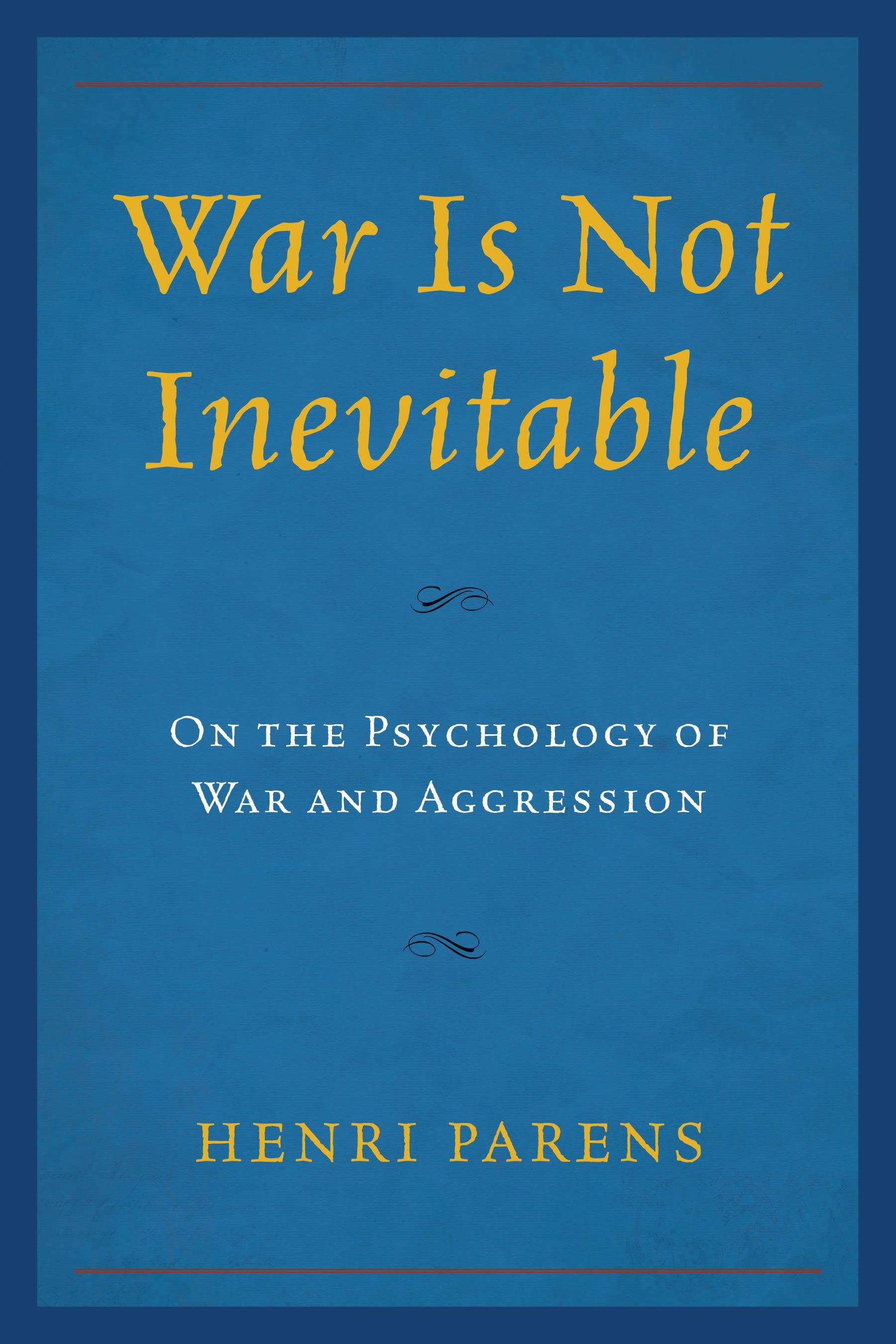
In 1932 Einstein asked Freud, ‘Is there any way of delivering mankind from the menace of war?’ Freud answered that war is inevitable because humans have an instinct to self-destroy, a death instinct which we must externalize to survive. But nearly four decades of study of aggression reveal that rather than being an inborn drive, destructiveness is generated in us by experiences of excessive psychic pain. In War is Not Inevitable: On the Psychology of War and Aggression, Henri Parens argues that the death-instinct based model of aggression can neither be proved nor disproved as Freud’s answer is untestable. By contrast, the ‘multi-trends theory of aggression’ is provable and has greater heuristic value than does a death-instinct based model of aggression.
When we look for causes for war we turn to history as well as national, ethnic, territorial, and or political issues, among many others, but we also tend to ignore the psychological factors that play a large role. Parens discusses such psychological factors that seem to lead large groups into conflict. Central among these are the psychodynamics of large-group narcissism. Interactional conditions stand out: hyper-narcissistic large-groups have, in history, caused much narcissistic injury to those they believe they are superior to. But this is commonly followed by the narcissistically injured group’s experiencing high level hostile destructiveness toward their injury-perpetrator which, in time, will compel them to revenge. Among groups that have been engaged in serial conflicts, wars have followed from this psychodynamic narcissism-based cyclicity.
Parens details some of the psychodynamics that led from World War I to World War II and their respective aftermath, and he addresses how major factors that gave rise to these wars must, can, and have been counteracted. In doing so, Parens considers strategies by which civilization has and is constructively preventing wars, as well as the need for further innovative efforts to achieve that end.
When we look for causes for war we turn to history as well as national, ethnic, territorial, and or political issues, among many others, but we also tend to ignore the psychological factors that play a large role. Parens discusses such psychological factors that seem to lead large groups into conflict. Central among these are the psychodynamics of large-group narcissism. Interactional conditions stand out: hyper-narcissistic large-groups have, in history, caused much narcissistic injury to those they believe they are superior to. But this is commonly followed by the narcissistically injured group’s experiencing high level hostile destructiveness toward their injury-perpetrator which, in time, will compel them to revenge. Among groups that have been engaged in serial conflicts, wars have followed from this psychodynamic narcissism-based cyclicity.
Parens details some of the psychodynamics that led from World War I to World War II and their respective aftermath, and he addresses how major factors that gave rise to these wars must, can, and have been counteracted. In doing so, Parens considers strategies by which civilization has and is constructively preventing wars, as well as the need for further innovative efforts to achieve that end.
Betala smidigt med kort, Klarna, Apple Pay eller Google Pay. Är du inte nöjd har du alltid 14 dagars ångerrätt. Läs mer i våra villkor. Har du några frågor, mejla oss på hello@memmo.org.
Memmo gör det enklare att plugga – var du än är i världen. Hos oss samlar du kursböcker och smarta studieverktyg på ett och samma ställe: sammanfattningar, quiz, poddar och flashcards. Och så Ted, din studiekompis som svarar på allt du undrar. Över 50 000 studenter pluggar redan här – byggt för att du ska lära dig snabbare och stressa mindre.