
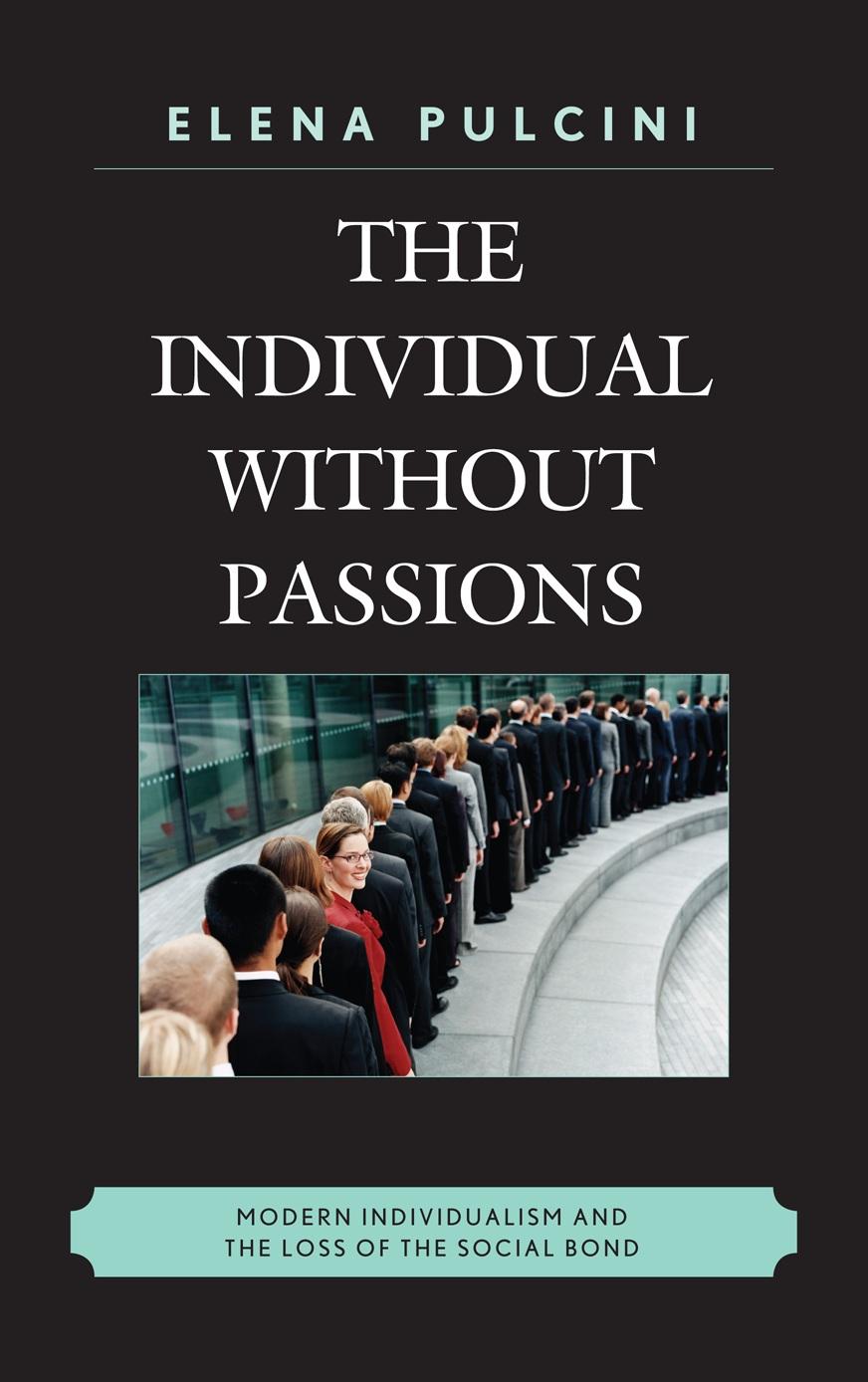
The Individual without Passions: Modern Individualism and the Loss of the Social Bond offers an innovative look at an extremely timely and important issue—individualism—from the point of view of a theory of passions. This book underlines the importance of the problem of the passions in both forming individual identity and building the social bond. Drawing inspiration from classic authors that represent fundamental milestones along the route of modern individualism—from Montaigne to Hobbes, from Locke to Smith, from Rousseau to Tocqueville—The Individual without Passions puts forward new hypotheses that contrast with the consolidated views of contemporary reflection, both modern and postmodern.
Elena Pulcini argues that passions are crucial not only when they are strong (homo oeconomicus), but also when absent or weak (homo democraticus), in both cases producing pathological effects on the Self and the social bond. Finally, this book underlines that the image of the modern individual does not end with the egoistical passions and that it is possible to reactivate empathetic and solidaristic passions; furthermore, it proposes the hypothesis that the solidaristic passions go to fight the egoistical passions. This hypothesis seems confirmed and is most evident in the phenomenon of the gift (as interpreted by Marcel Mauss and his contemporary heirs), the “hidden” testimony of a desire for belonging which enables us to propose a new figure of the individual—homo reciprocus.
Elena Pulcini argues that passions are crucial not only when they are strong (homo oeconomicus), but also when absent or weak (homo democraticus), in both cases producing pathological effects on the Self and the social bond. Finally, this book underlines that the image of the modern individual does not end with the egoistical passions and that it is possible to reactivate empathetic and solidaristic passions; furthermore, it proposes the hypothesis that the solidaristic passions go to fight the egoistical passions. This hypothesis seems confirmed and is most evident in the phenomenon of the gift (as interpreted by Marcel Mauss and his contemporary heirs), the “hidden” testimony of a desire for belonging which enables us to propose a new figure of the individual—homo reciprocus.
Betala smidigt med kort, Klarna, Apple Pay eller Google Pay. Är du inte nöjd har du alltid 14 dagars ångerrätt. Läs mer i våra villkor. Har du några frågor, mejla oss på hello@memmo.org.
Memmo gör det enklare att plugga – var du än är i världen. Hos oss samlar du kursböcker och smarta studieverktyg på ett och samma ställe: sammanfattningar, quiz, poddar och flashcards. Och så Ted, din studiekompis som svarar på allt du undrar. Över 50 000 studenter pluggar redan här – byggt för att du ska lära dig snabbare och stressa mindre.