
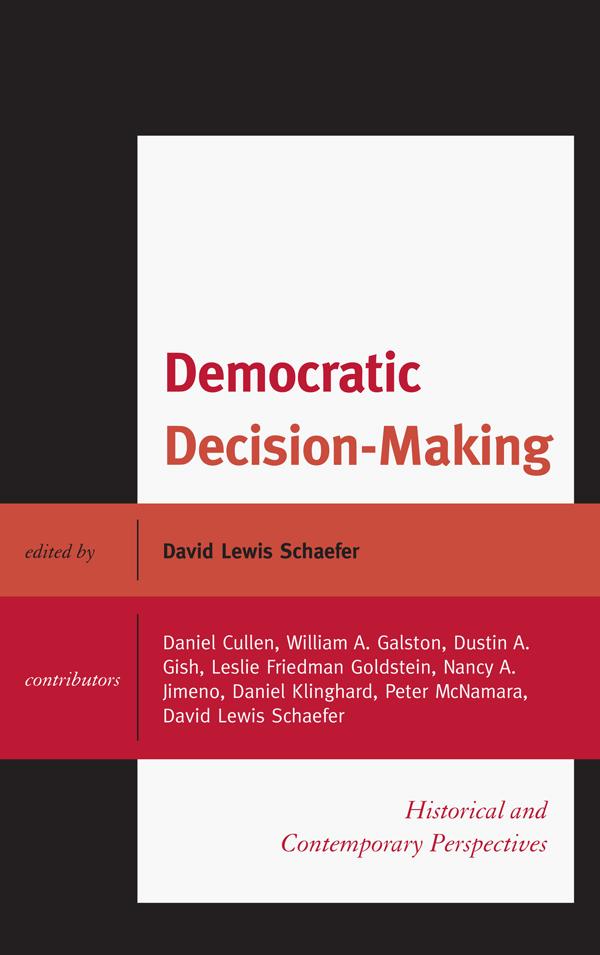
Democratic Decision-Making: Historical and Contemporary Perspectives contains eight essays by political scientists addressing various aspects of the democratic decision-making process. The book is divided into four parts: democratic statesmanship, the extent to which limitations of the democratic principle of majority rule are desirable, the contemporary doctrine of “deliberative democracy,” and informal modes of democratic decision-making.
Under these four headings, the contributors discuss a wide variety of issues, including the practice of “political opportunism” by such statesmen as Hamilton and Madison; the historical development of legal restraints on democracy in America ranging from judicial review (during the colonial period) to the filibuster; the operation of classical Athenian democracy, the defects of which may have been exaggerated by the American Founders; the significance of the reflections of Tammany Hall boss George Washington Plunkitt for the development of the American party system; the relation of deliberative-democracy theory to the thought of Rousseau; and the means by which cooperative land-use agreements have been arrived at in California, eliciting the voluntary consent of the affected parties instead of relying on judicial or bureaucratic dictates. The book is well-suited for use in courses on American political thought, democratic theory, American political development, and related subjects.
Under these four headings, the contributors discuss a wide variety of issues, including the practice of “political opportunism” by such statesmen as Hamilton and Madison; the historical development of legal restraints on democracy in America ranging from judicial review (during the colonial period) to the filibuster; the operation of classical Athenian democracy, the defects of which may have been exaggerated by the American Founders; the significance of the reflections of Tammany Hall boss George Washington Plunkitt for the development of the American party system; the relation of deliberative-democracy theory to the thought of Rousseau; and the means by which cooperative land-use agreements have been arrived at in California, eliciting the voluntary consent of the affected parties instead of relying on judicial or bureaucratic dictates. The book is well-suited for use in courses on American political thought, democratic theory, American political development, and related subjects.
Betala smidigt med kort, Klarna, Apple Pay eller Google Pay. Är du inte nöjd har du alltid 14 dagars ångerrätt. Läs mer i våra villkor. Har du några frågor, mejla oss på hello@memmo.org.
Memmo gör det enklare att plugga – var du än är i världen. Hos oss samlar du kursböcker och smarta studieverktyg på ett och samma ställe: sammanfattningar, quiz, poddar och flashcards. Och så Ted, din studiekompis som svarar på allt du undrar. Över 50 000 studenter pluggar redan här – byggt för att du ska lära dig snabbare och stressa mindre.