
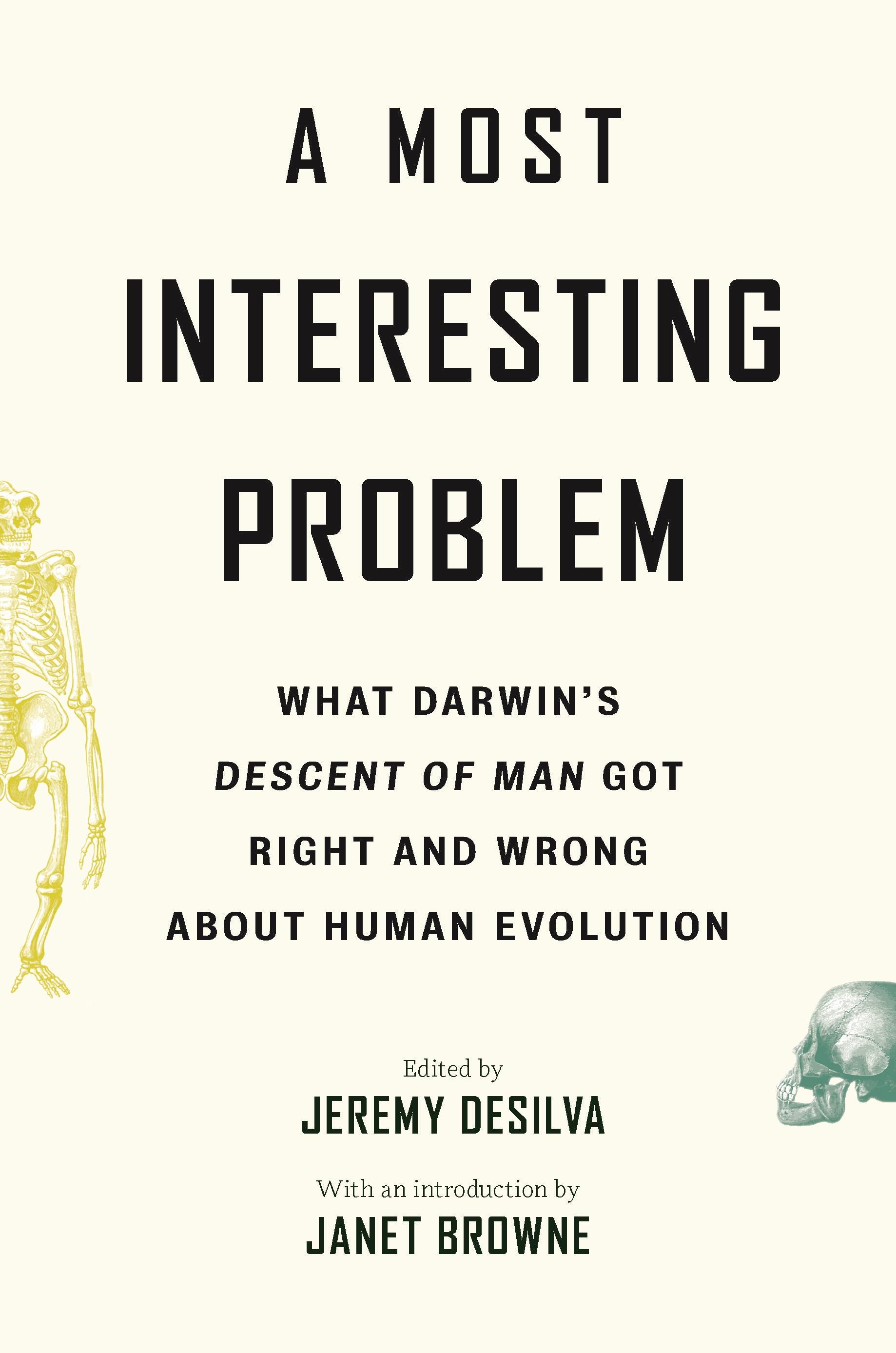
Leading scholars take stock of Darwin's ideas about human evolution in the light of modern science
In 1871, Charles Darwin published The Descent of Man, a companion to Origin of Species in which he attempted to explain human evolution, a topic he called "the highest and most interesting problem for the naturalist." A Most Interesting Problem brings together twelve world-class scholars and science communicators to investigate what Darwin got right—and what he got wrong—about the origin, history, and biological variation of humans.
Edited by Jeremy DeSilva and with an introduction by acclaimed Darwin biographer Janet Browne, A Most Interesting Problem draws on the latest discoveries in fields such as genetics, paleontology, bioarchaeology, anthropology, and primatology. This compelling and accessible book tackles the very subjects Darwin explores in Descent, including the evidence for human evolution, our place in the family tree, the origins of civilization, human races, and sex differences.
A Most Interesting Problem is a testament to how scientific ideas are tested and how evidence helps to structure our narratives about human origins, showing how some of Darwin's ideas have withstood more than a century of scrutiny while others have not.
A Most Interesting Problem features contributions by Janet Browne, Jeremy DeSilva, Holly Dunsworth, Agustín Fuentes, Ann Gibbons, Yohannes Haile-Selassie, Brian Hare, John Hawks, Suzana Herculano-Houzel, Kristina Killgrove, Alice Roberts, and Michael J. Ryan.
Betala smidigt med kort, Klarna, Apple Pay eller Google Pay. Är du inte nöjd har du alltid 14 dagars ångerrätt. Läs mer i våra villkor. Har du några frågor, mejla oss på hello@memmo.org.
Memmo gör det enklare att plugga – var du än är i världen. Hos oss samlar du kursböcker och smarta studieverktyg på ett och samma ställe: sammanfattningar, quiz, poddar och flashcards. Och så Ted, din studiekompis som svarar på allt du undrar. Över 75 000 studenter pluggar redan här – byggt för att du ska lära dig snabbare och stressa mindre.