
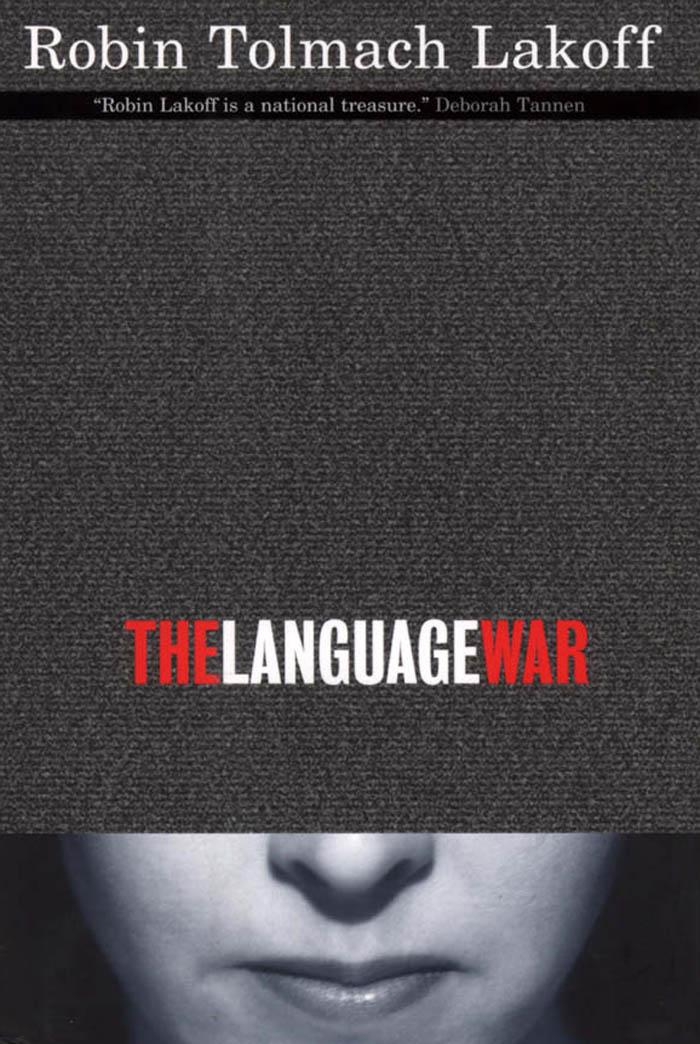
Robin Lakoff gets to the heart of one of the most fascinating and pressing issues in American society today: who holds power and how they use it, keep it, or lose it. In a brilliant and vastly entertaining discussion of news events that have occupied an enormous amount of media space--political correctness, the Anita Hill/Clarence Thomas hearings, Hillary Rodham Clinton as First Lady, O. J. Simpson's murder trial, the Ebonics controversy, and the Clinton sex scandal--Lakoff shows that the struggle for power and status at the end of the century is being played out as a war over language. Controlling language is a basis for all power, she says, and therefore it is worth fighting for. As a result, newly emergent groups, especially blacks and women, are contending with middle- to upper-class white men for a share in "language rights."
Lakoff's introduction to linguistic theories and the philosophy of language lays the groundwork for an exploration of news stories that meet what she calls the UAT (Undue Attention Test). As the stories became the subject of talk-show debates, late-night comedy routines, Web sites, and magazine articles, they were embroidered with additional meanings, depending on who was telling the story. Race, gender, or both are at the heart of these stories, and each one is about the right to construct meanings from languagein short, to possess power. Because language tells us how we are connected to one another, who has power and who does not, the stories reflect the language war.
We use language to analyze what we call "reality," the author argues, but we mistrust how language is used today--witness the "politics of personal destruction" following the Clinton impeachment. Yet Lakoff sees in the struggle over language a positive goal: equality in the creation of our national discourse. Her writing is accessible and witty, and her excerpts from the media are used to great effect.
Lakoff's introduction to linguistic theories and the philosophy of language lays the groundwork for an exploration of news stories that meet what she calls the UAT (Undue Attention Test). As the stories became the subject of talk-show debates, late-night comedy routines, Web sites, and magazine articles, they were embroidered with additional meanings, depending on who was telling the story. Race, gender, or both are at the heart of these stories, and each one is about the right to construct meanings from languagein short, to possess power. Because language tells us how we are connected to one another, who has power and who does not, the stories reflect the language war.
We use language to analyze what we call "reality," the author argues, but we mistrust how language is used today--witness the "politics of personal destruction" following the Clinton impeachment. Yet Lakoff sees in the struggle over language a positive goal: equality in the creation of our national discourse. Her writing is accessible and witty, and her excerpts from the media are used to great effect.
Betala smidigt med kort, Klarna, Apple Pay eller Google Pay. Är du inte nöjd har du alltid 14 dagars ångerrätt. Läs mer i våra villkor. Har du några frågor, mejla oss på hello@memmo.org.
Memmo gör det enklare att plugga – var du än är i världen. Hos oss samlar du kursböcker och smarta studieverktyg på ett och samma ställe: sammanfattningar, quiz, poddar och flashcards. Och så Ted, din studiekompis som svarar på allt du undrar. Över 50 000 studenter pluggar redan här – byggt för att du ska lära dig snabbare och stressa mindre.
Du kanske också gillar
Köp boken0