
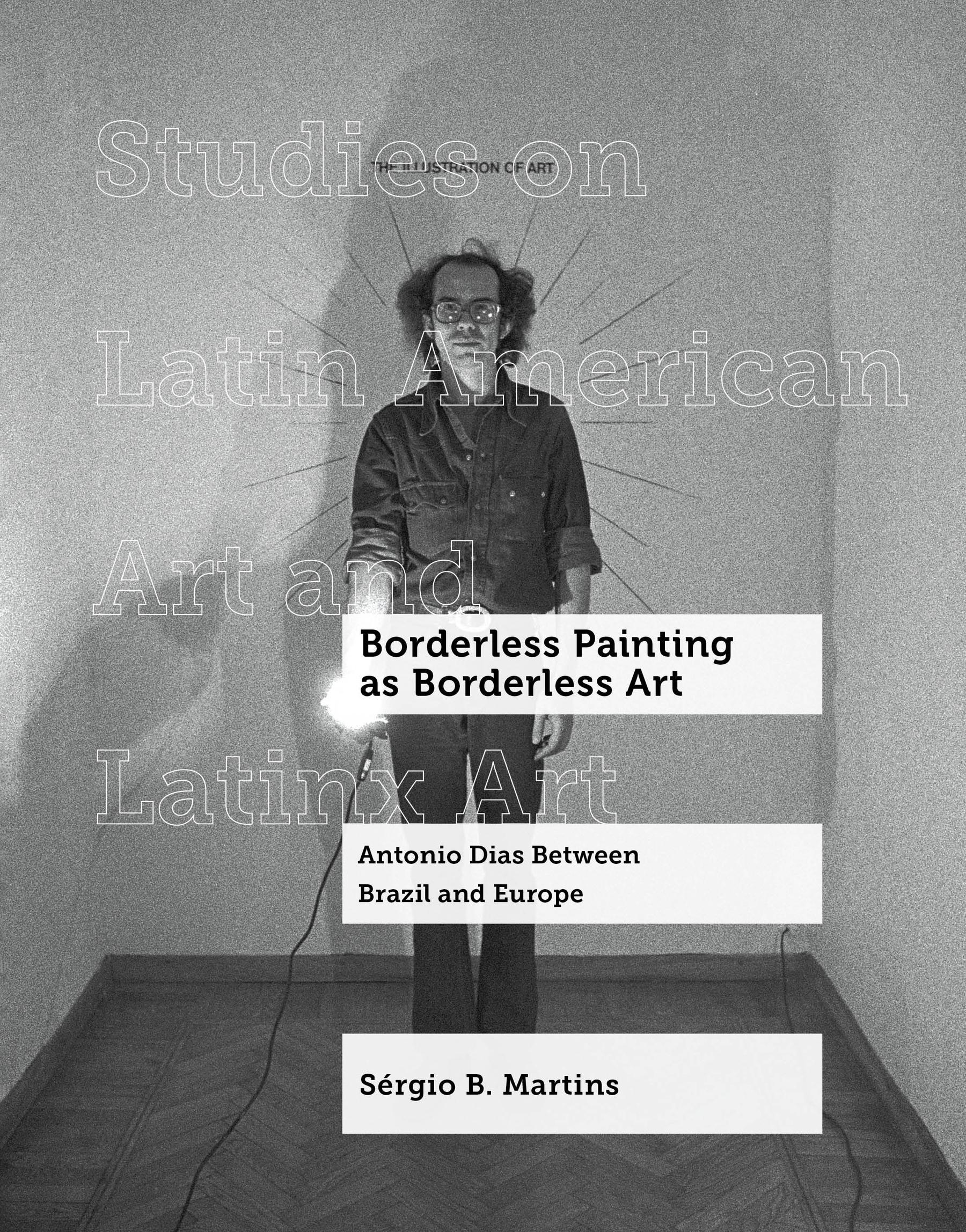
The artwork of Antonio Dias (1944–2018) uniquely captures the interwoven histories of Brazilian postwar realism and of European conceptualism in the 1960s and 1970s. By tracking Dias’s ever-shifting works and circulation as he moved from Rio de Janeiro to Paris, and then to Milan, Borderless Painting as Borderless Art provides the first in-depth study of the artist.
Sérgio B. Martins uses Dias’s trajectory as a lens to explore different approaches to avant-gardism and its crisis in Brazil, France, and northern Italy, weaving in the perspectives of figures such as Hélio Oiticica, Harald Szeemann, Pierre Restany, Giulio Paolini, and Tommaso Trini, as well as the Fluxus movement. The book ultimately argues that Dias pitted his formation in a semi-peripheral avant-garde against a post–avant-gardist milieu where commodity culture and market relations were far more pervasive and determinant vis-à-vis the arts scene.
Sérgio B. Martins uses Dias’s trajectory as a lens to explore different approaches to avant-gardism and its crisis in Brazil, France, and northern Italy, weaving in the perspectives of figures such as Hélio Oiticica, Harald Szeemann, Pierre Restany, Giulio Paolini, and Tommaso Trini, as well as the Fluxus movement. The book ultimately argues that Dias pitted his formation in a semi-peripheral avant-garde against a post–avant-gardist milieu where commodity culture and market relations were far more pervasive and determinant vis-à-vis the arts scene.
Betala smidigt med kort, Klarna, Apple Pay eller Google Pay. Är du inte nöjd har du alltid 14 dagars ångerrätt. Läs mer i våra villkor. Har du några frågor, mejla oss på hello@memmo.org.
Memmo gör det enklare att plugga – var du än är i världen. Hos oss samlar du kursböcker och smarta studieverktyg på ett och samma ställe: sammanfattningar, quiz, poddar och flashcards. Och så Ted, din studiekompis som svarar på allt du undrar. Över 50 000 studenter pluggar redan här – byggt för att du ska lära dig snabbare och stressa mindre.
Du kanske också gillar
Köp boken0