
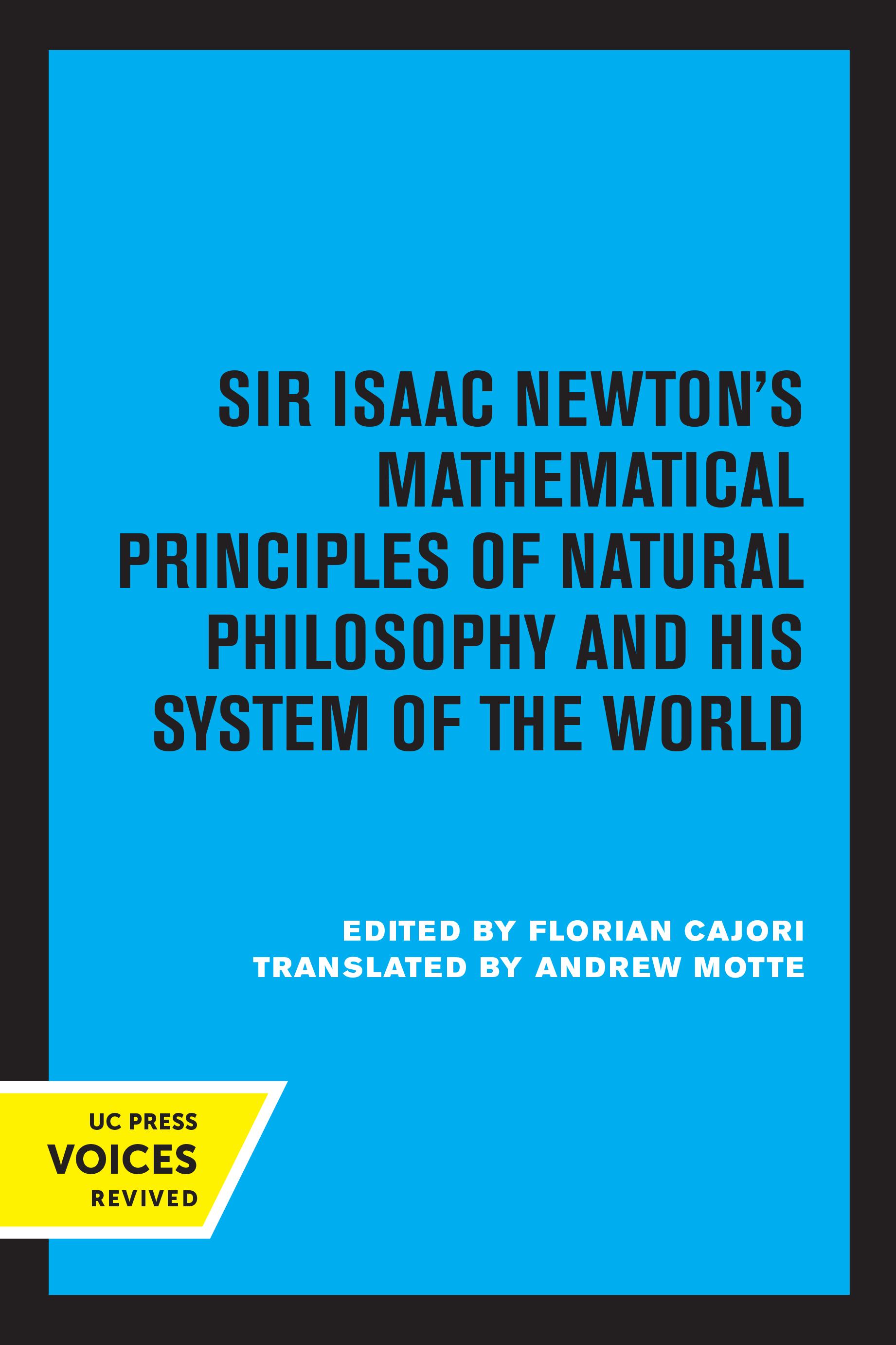
This edition presents Andrew Motte's 1729 English translation of Newton's Philosophiæ Naturalis Principia Mathematica, thoroughly revised and annotated by historian Florian Cajori (with R. T. Crawford stewarding the final publication after Cajori's death in 1930). It opens with a portrait and Halley's celebratory ode, then the prefaces to the first three Latin editions, where Newton defines "rational mechanics" as the mathematical study of motion and forces, and declares his program: from phenomena infer forces, then from forces deduce further phenomena. Book I develops the mathematical tools (limits, conics, central forces, apsidal motion, pendula), proving that orbits with equal-areas law imply centripetal attraction. Book II treats motion in resisting media—drag proportional to velocity or its square, hydrostatics, pendular resistance, and waves—bridging ideal dynamics and real fluids. Book III applies the theory to the heavens, stating "Rules of Reasoning," listing "Phenomena," and deriving universal gravitation, lunar nodes, tides, precession, cometary paths, and the *General Scholium*. A separate "System of the World" offers a more synthetic exposition. Cajori's extensive appendix supplies historical and explanatory notes throughout. Cotes's preface to the second edition champions Newton's experimental philosophy against scholastic "occult qualities" and Cartesian vortices. He argues from terrestrial gravitation and pendulum experiments to mutual attraction, then by Keplerian area and period–distance laws to centripetal forces inversely as the square of distance, unifying moon, planets, and comets under a single gravitational principle. The prefaces chronicle Newton's method (analysis from phenomena; synthesis to prediction), Halley's role in pressing publication, and later refinements to lunar theory, precession, comet orbits, and fluid resistance. Altogether, the volume frames the *Principia* as both a mathematical edifice and a philosophical watershed: geometry and experiment joined to reveal a world governed not by speculative mechanisms but by demonstrable universal laws. This title is part of UC Press's Voices Revived program, which commemorates University of California Press's mission to seek out and cultivate the brightest minds and give them voice, reach, and impact. Drawing on a backlist dating to 1893, Voices Revived makes high-quality, peer-reviewed scholarship accessible once again using print-on-demand technology. This title was originally published in 1934.
Many titles in the Voices Revived program are also newly available as books, offered at a discounted price to support wider access to scholarly work.
Many titles in the Voices Revived program are also newly available as books, offered at a discounted price to support wider access to scholarly work.
Betala smidigt med kort, Klarna, Apple Pay eller Google Pay. Är du inte nöjd har du alltid 14 dagars ångerrätt. Läs mer i våra villkor. Har du några frågor, mejla oss på hello@memmo.org.
Memmo gör det enklare att plugga – var du än är i världen. Hos oss samlar du kursböcker och smarta studieverktyg på ett och samma ställe: sammanfattningar, quiz, poddar och flashcards. Och så Ted, din studiekompis som svarar på allt du undrar. Över 50 000 studenter pluggar redan här – byggt för att du ska lära dig snabbare och stressa mindre.
Du kanske också gillar
Köp boken0