
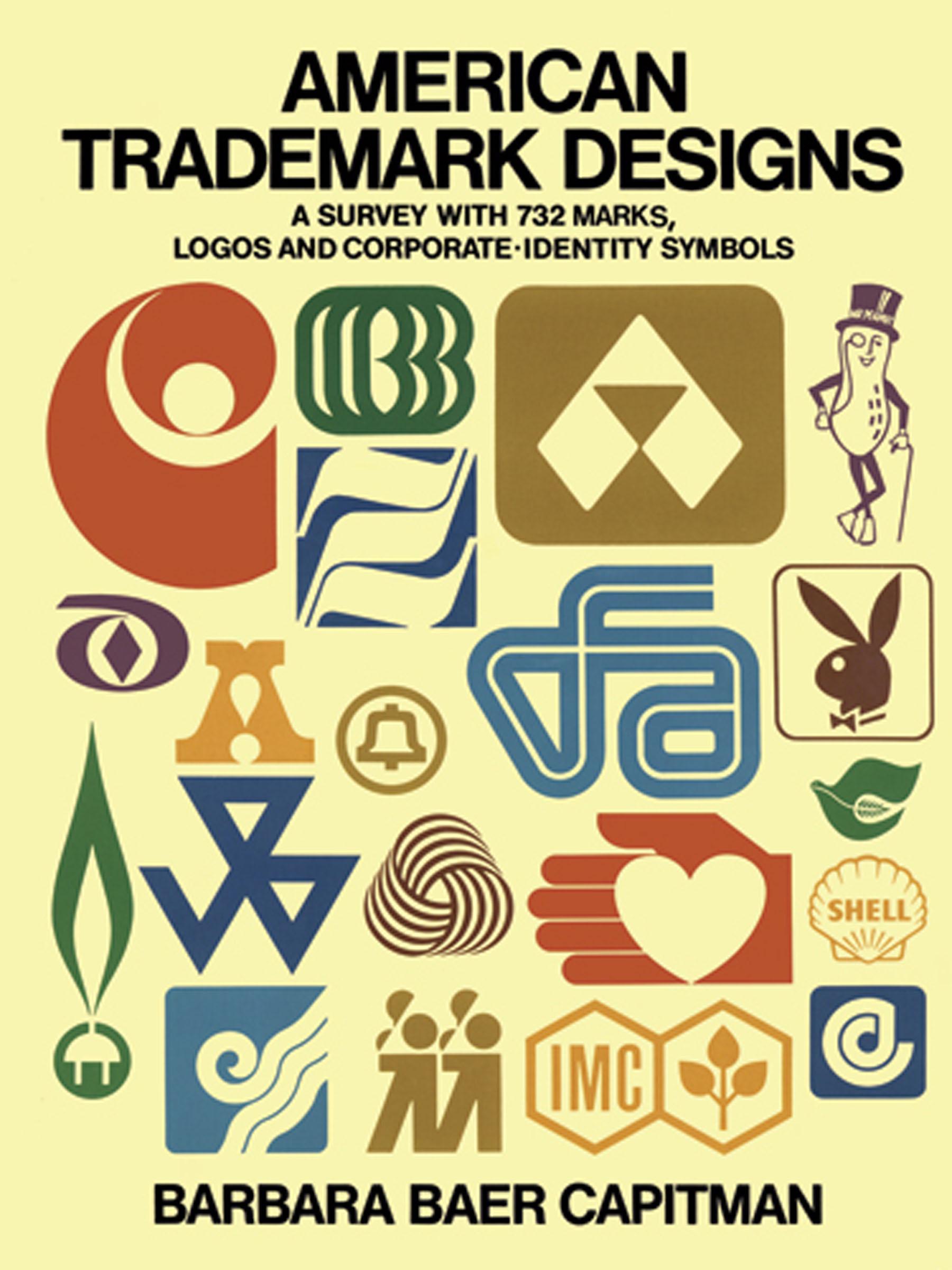
This collection of 732 American trademarks and symbols is widely representative of major past and current trends in American trademark design. The marks are arranged in categories that include entertainment, education, real estate, insurance, food and beverage, retailing, transportation, utilities, heavy industry, and others, and are chosen from local and internationally known examples.
Reprinted in black-and-white, the marks appear here in their standard form on signs, letterheads, book bindings, T-shirts, sugar bags, household appliances, bank checks, drinking cups, coasters, screened commercials and printed ads, ashtrays, clothing labels, shopping bags, awnings, and so on. For several current trademarks, earlier versions are also illustrated and dated, tracing trademark genealogies of possible interest both as history and design. Captions identify the trademarks, giving year of design, and, when known, the name of the designer. The editor in her introduction describes the development of American trademarks from Ralston Purina's homespun "checkerboard square" to the Cities Service corporate "triangle." Notes on the specialized uses and requirements of various kinds of marks introduce each section.
This is a remarkable sourcebook for graphic artists, students, and commercial designers. Social psychologists, market researchers, and others interested in group behavior may find it the starting point of ideas and experiments. This book also has a curious fascination as browsing, illustrating at a glance how familiar, memorable, and widespread trademarks seem to be.
Reprinted in black-and-white, the marks appear here in their standard form on signs, letterheads, book bindings, T-shirts, sugar bags, household appliances, bank checks, drinking cups, coasters, screened commercials and printed ads, ashtrays, clothing labels, shopping bags, awnings, and so on. For several current trademarks, earlier versions are also illustrated and dated, tracing trademark genealogies of possible interest both as history and design. Captions identify the trademarks, giving year of design, and, when known, the name of the designer. The editor in her introduction describes the development of American trademarks from Ralston Purina's homespun "checkerboard square" to the Cities Service corporate "triangle." Notes on the specialized uses and requirements of various kinds of marks introduce each section.
This is a remarkable sourcebook for graphic artists, students, and commercial designers. Social psychologists, market researchers, and others interested in group behavior may find it the starting point of ideas and experiments. This book also has a curious fascination as browsing, illustrating at a glance how familiar, memorable, and widespread trademarks seem to be.
Betala smidigt med kort, Klarna, Apple Pay eller Google Pay. Är du inte nöjd har du alltid 14 dagars ångerrätt. Läs mer i våra villkor. Har du några frågor, mejla oss på hello@memmo.org.
Memmo gör det enklare att plugga – var du än är i världen. Hos oss samlar du kursböcker och smarta studieverktyg på ett och samma ställe: sammanfattningar, quiz, poddar och flashcards. Och så Ted, din studiekompis som svarar på allt du undrar. Över 75 000 studenter pluggar redan här – byggt för att du ska lära dig snabbare och stressa mindre.
Du kanske också gillar
Köp boken0