
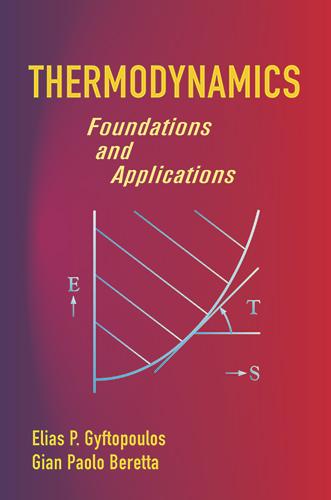
Designed for both undergraduate and graduate students, this authoritative milestone in the foundational development of thermodynamics provides a unique reference for all physicists and engineers. Basic concepts and applications are discussed in complete detail with attention to generality and logical consistency, removing ambiguities and limitations of traditional presentations. Worked-out examples and end-of-chapter problems illustrate the use of energy and entropy balances as powerful analytical keystones in physics and engineering.
The text provides material for undergraduate and graduate courses. At the introductory level, it covers heat engines, stable-equilibrium-state models for ideal-gas, incompressible-fluid and solid behaviors, heat, work and bulk-flow interactions, thermodynamic efficiency, energy conversion systems, energy, and availability/ At the intermediate level, it covers ideal and nonideal mixtures, chemical reactions, chemical equilibrium, and combustion.
At the advanced level, the unique non-traditional order of exposition of the basic concepts and principles (system, property, state, process, first law, energy, equilibrium, stable equilibrium, second law, entropy) allows rigorous general definitions of energy and entropy valid for all systems (large and small, few- and many- particles) and all states (stable and non-stable equilibrium, as well as non-equilibrium). In particular, entropy is defined before and independently of the definitions of temperature and heat, and of the simple-system model for many-particle systems.
The text provides material for undergraduate and graduate courses. At the introductory level, it covers heat engines, stable-equilibrium-state models for ideal-gas, incompressible-fluid and solid behaviors, heat, work and bulk-flow interactions, thermodynamic efficiency, energy conversion systems, energy, and availability/ At the intermediate level, it covers ideal and nonideal mixtures, chemical reactions, chemical equilibrium, and combustion.
At the advanced level, the unique non-traditional order of exposition of the basic concepts and principles (system, property, state, process, first law, energy, equilibrium, stable equilibrium, second law, entropy) allows rigorous general definitions of energy and entropy valid for all systems (large and small, few- and many- particles) and all states (stable and non-stable equilibrium, as well as non-equilibrium). In particular, entropy is defined before and independently of the definitions of temperature and heat, and of the simple-system model for many-particle systems.
Betala smidigt med kort, Klarna, Apple Pay eller Google Pay. Är du inte nöjd har du alltid 14 dagars ångerrätt. Läs mer i våra villkor. Har du några frågor, mejla oss på hello@memmo.org.
Memmo gör det enklare att plugga – var du än är i världen. Hos oss samlar du kursböcker och smarta studieverktyg på ett och samma ställe: sammanfattningar, quiz, poddar och flashcards. Och så Ted, din studiekompis som svarar på allt du undrar. Över 50 000 studenter pluggar redan här – byggt för att du ska lära dig snabbare och stressa mindre.
Du kanske också gillar
Köp boken0