
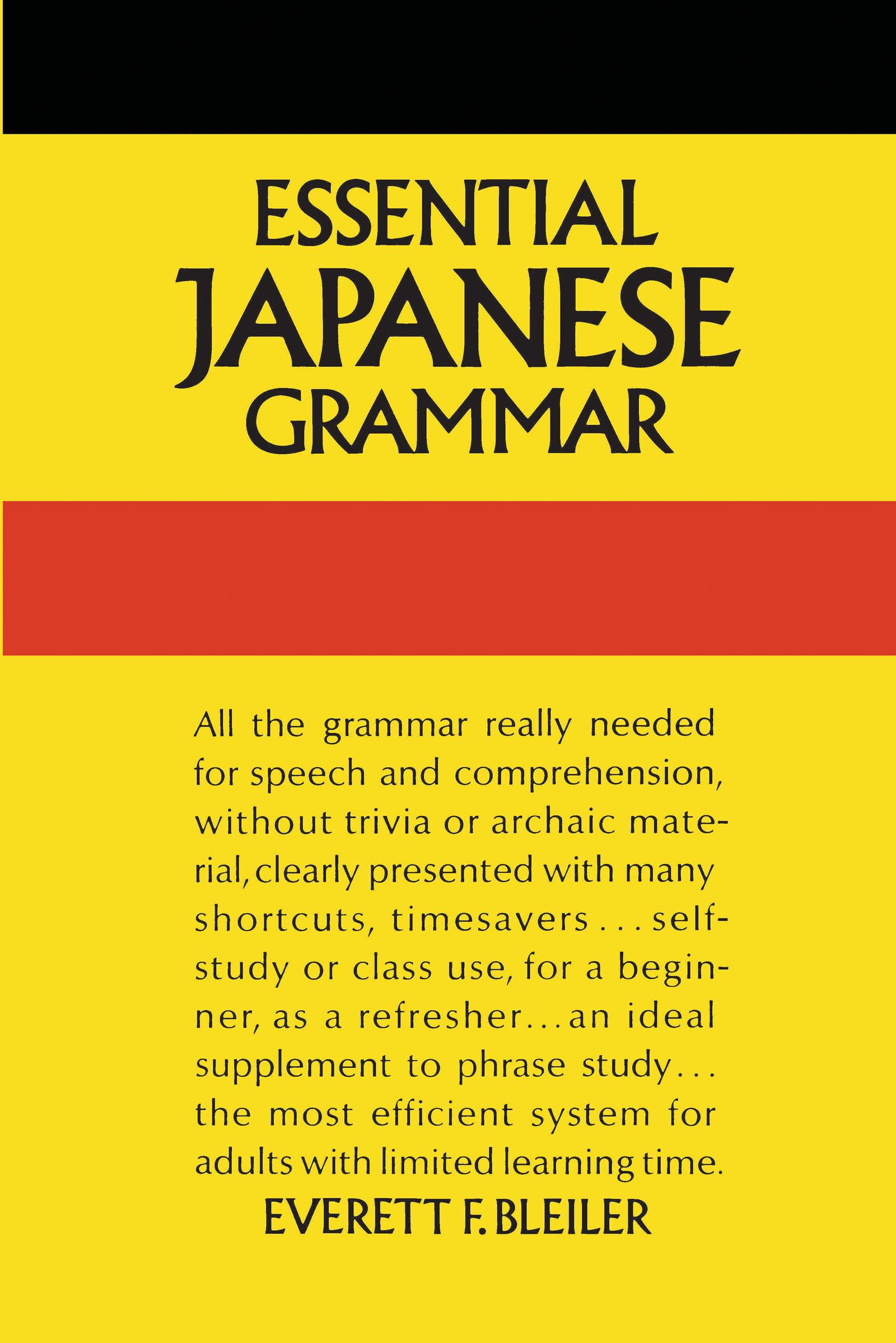
Although not a member of the Indo-European language family, Japanese is not too difficult grammatically for an English speaker. It is astonishingly regular in its formations — exceptions and irregularities can usually be numbered on one's fingers — and once the student masters a few conventions of linguistic classifications of experience, he will find that he can express most of his wants.
This is the first Japanese grammar written for the adult with a limited objective in studying Japanese: to express oneself orally with reasonable accuracy; to understand simple material addressed to oneself; and to be able to analyze, understand, and enlarge material in a phrase approach.
The author has limited this book to modern colloquial Japanese, and does not overburden the student with literary language, rarely used alternate forms, unnecessary abrupt forms, causatives and direct conditionals, and similar forms that might be required for a full knowledge of the written language. On the other hand, this book is not simplified Japanese, nor baby Japanese, nor kitchen Japanese. It is the full idiomatic language, with thorough treatments of the material you really need: the noun, pronoun, adjective, demonstrative words, adverb, verb, negative forms, Chinese forms, courtesy and honorific forms, idiomatic constructions, word order, relationship of ideas, syntax, etc.
Emphasis has been placed upon clarity of exposition, so that the English-speaking reader can understand what is really happening in Japanese, even if he has never studied any foreign language before. For this reason, explanation rather than brute memory work is stressed, examples are given for all constructions, and both word-for-word and free translations are given, to acquaint the reader with thought processes. Hints are given on avoiding difficult constructions. Japanese is presented in the Romaji transliteration, which can be read at sight. Characters are not used.
This is the first Japanese grammar written for the adult with a limited objective in studying Japanese: to express oneself orally with reasonable accuracy; to understand simple material addressed to oneself; and to be able to analyze, understand, and enlarge material in a phrase approach.
The author has limited this book to modern colloquial Japanese, and does not overburden the student with literary language, rarely used alternate forms, unnecessary abrupt forms, causatives and direct conditionals, and similar forms that might be required for a full knowledge of the written language. On the other hand, this book is not simplified Japanese, nor baby Japanese, nor kitchen Japanese. It is the full idiomatic language, with thorough treatments of the material you really need: the noun, pronoun, adjective, demonstrative words, adverb, verb, negative forms, Chinese forms, courtesy and honorific forms, idiomatic constructions, word order, relationship of ideas, syntax, etc.
Emphasis has been placed upon clarity of exposition, so that the English-speaking reader can understand what is really happening in Japanese, even if he has never studied any foreign language before. For this reason, explanation rather than brute memory work is stressed, examples are given for all constructions, and both word-for-word and free translations are given, to acquaint the reader with thought processes. Hints are given on avoiding difficult constructions. Japanese is presented in the Romaji transliteration, which can be read at sight. Characters are not used.
Betala smidigt med kort, Klarna, Apple Pay eller Google Pay. Är du inte nöjd har du alltid 14 dagars ångerrätt. Läs mer i våra villkor. Har du några frågor, mejla oss på hello@memmo.org.
Memmo gör det enklare att plugga – var du än är i världen. Hos oss samlar du kursböcker och smarta studieverktyg på ett och samma ställe: sammanfattningar, quiz, poddar och flashcards. Och så Ted, din studiekompis som svarar på allt du undrar. Över 50 000 studenter pluggar redan här – byggt för att du ska lära dig snabbare och stressa mindre.
Du kanske också gillar
Köp boken0