
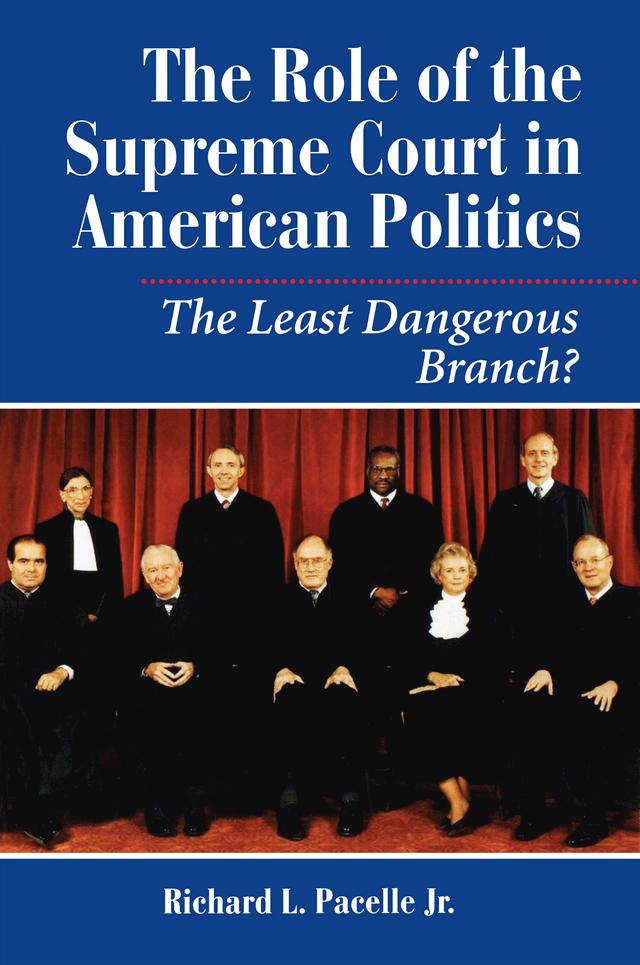
When the Supreme Court's effectively decided the presidential election of 2000, it decision illustrated a classic question in American politics: what is the appropriate role for the Supreme Court? The dilemma is between judicial activism, the Court's willingness to make significant changes in public policy, and judicial restraint, the Court's willingness to confine the use and extent of its power. While the Framers of the Constitution felt that the judiciary would be the "least dangerous branch" of government, many have come to the conclusion that courts govern America, a notion at odds with democratic government.Richard Pacelle traces the historical ebb and flow of the Court's role in the critical issues of American politics: slavery, free speech, religion, abortion, and affirmative action. Pacelle examines the arguments for judicial restraint, including that unelected judges making policy runs against democratic principles, and the arguments for judicial activism, including the important role the court has played as a protector of minority rights. Pacelle suggests that there needs to be a balance between judicial activism and restraint in light of the constraints on the institution and its power. Stimulating and sure to generate discussion, The Supreme Court in American Politics is a concise supplemental text for American Government and Judicial Politics course.
Betala smidigt med kort, Klarna, Apple Pay eller Google Pay. Är du inte nöjd har du alltid 14 dagars ångerrätt. Läs mer i våra villkor. Har du några frågor, mejla oss på hello@memmo.org.
Memmo gör det enklare att plugga – var du än är i världen. Hos oss samlar du kursböcker och smarta studieverktyg på ett och samma ställe: sammanfattningar, quiz, poddar och flashcards. Och så Ted, din studiekompis som svarar på allt du undrar. Över 50 000 studenter pluggar redan här – byggt för att du ska lära dig snabbare och stressa mindre.
Du kanske också gillar
Köp boken0