
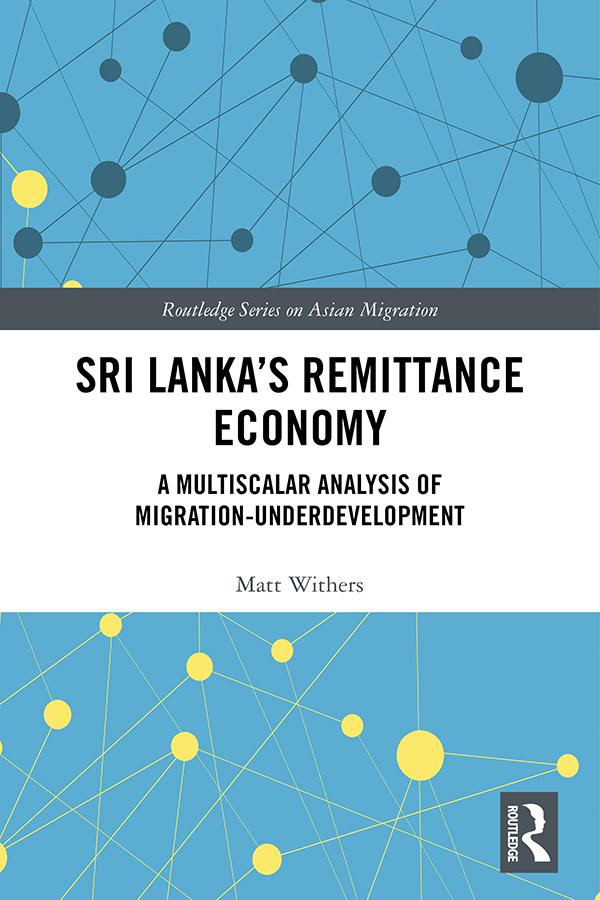
Employing a multiscalar approach to migration outcomes, spanning individual households, local communities, the macroeconomy and global patterns of capital accumulation, this book demonstrates how cumulatively causal processes at structural, institutional and agency levels have forged a precariously remittance-dependent economy in Sri Lanka.
This book combines historical-structural analysis with qualitative research to contend that remittance inflows have reinforced patterns of uneven development in Sri Lanka. At the heart of this argument is a bold critique of remittance capital that inverts the migration–development nexus which has come to dominate international policymaking, with implications for Sri Lanka and other ‘remittance economies’ throughout the Global South. The author contends that temporary labour migration from Sri Lanka is a process of ‘migration-underdevelopment’, in which remittance inflows – ubiquitously considered a key source of capital for developing economies – are reinforcing of uneven development at multiple scales and produce unsustainable development outcomes.
Offering a uniquely systematic critique of remittances as a source of developmental capital for countries of origin, such as Sri Lanka, this book will be of interest to academics in the field of development studies, migration studies and Asian studies.
Betala smidigt med kort, Klarna, Apple Pay eller Google Pay. Är du inte nöjd har du alltid 14 dagars ångerrätt. Läs mer i våra villkor. Har du några frågor, mejla oss på hello@memmo.org.
Memmo gör det enklare att plugga – var du än är i världen. Hos oss samlar du kursböcker och smarta studieverktyg på ett och samma ställe: sammanfattningar, quiz, poddar och flashcards. Och så Ted, din studiekompis som svarar på allt du undrar. Över 50 000 studenter pluggar redan här – byggt för att du ska lära dig snabbare och stressa mindre.