
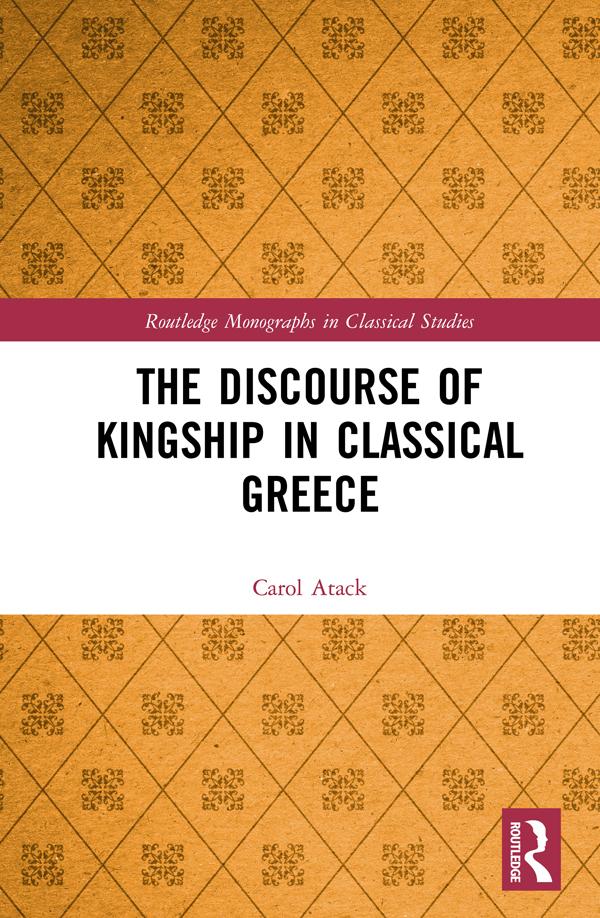
This book examines how ancient authors explored ideas of kingship as a political role fundamental to the construction of civic unity, the use of kingship stories to explain the past and present unity of the polis and the distinctive function or status attributed to kings in such accounts.
It explores the notion of kingship offered by historians such as Herodotus, as well as dramatists writing for the Athenian stage, paying particular attention to dramatic depictions of the unique capabilities of Theseus in uniting the city in the figure of the ‘democratic king’. It also discusses kingship in Greek philosophy: the Socratics’ identification of an ‘art of kingship’, and Xenophon and Isocrates’ model of ‘virtue monarchy’. In turn, these allow a rereading of explorations of kingship and excellence in Plato’s later political thought, seen as a critique of these models, and also in Aristotle’s account of total kingship or pambasileia, treated here as a counterfactual device developed to explore the epistemic benefits of democracy.
This book offers a fascinating insight into the institution of monarchy in classical Greek thought and society, both for those working on Greek philosophy and politics, and also for students of the history of political thought.
Betala smidigt med kort, Klarna, Apple Pay eller Google Pay. Är du inte nöjd har du alltid 14 dagars ångerrätt. Läs mer i våra villkor. Har du några frågor, mejla oss på hello@memmo.org.
Memmo gör det enklare att plugga – var du än är i världen. Hos oss samlar du kursböcker och smarta studieverktyg på ett och samma ställe: sammanfattningar, quiz, poddar och flashcards. Och så Ted, din studiekompis som svarar på allt du undrar. Över 50 000 studenter pluggar redan här – byggt för att du ska lära dig snabbare och stressa mindre.