
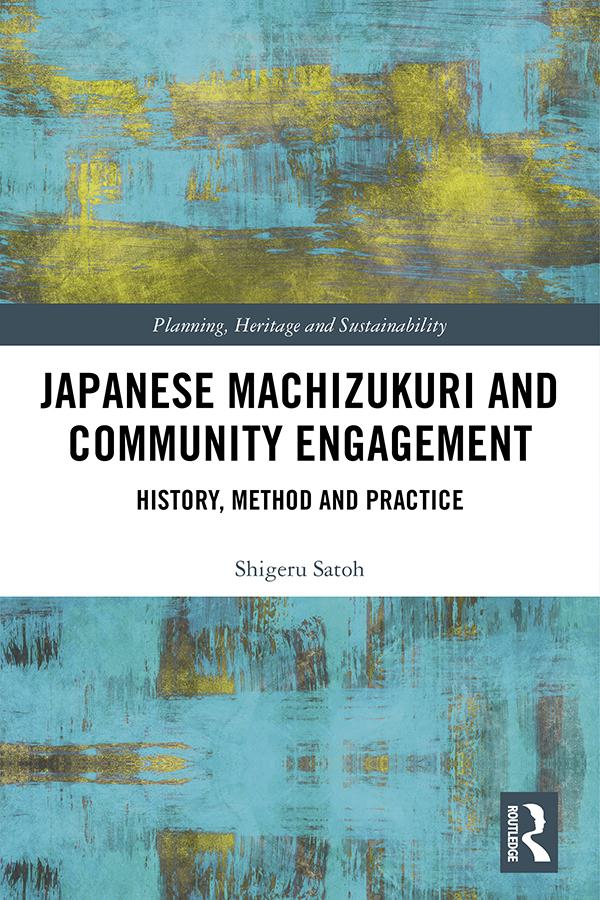
Over the past few decades, Japan has faced severe earthquake disasters, an increasing aging population, declining birth rates, and widening social disparities. These issues have served to highlight gaps left by top-down governance approaches and the urgent need to create resilient societies using more traditional models.
Japanese “machizukuri” has developed to become an exceptional example of bottom-up creative approaches based on collective action and use of local resources. Since its evolution in the 1960s, machizukuri has come to define diverse and creative community-driven management models, by which local communities are enabled to actively tackle problem-solving.
Including contributions from experts directly engaged in the process, this book explores the original development of machizukuri in Japan, its diffusion through East Asia and the positive outcomes of this transfer. Combining theoretical explanations with practical case studies, from pre-disaster planning in Tokyo, to the revitalization of historic towns and rural areas around Japan, the book looks at specific solutions, tools, and links between academics, communities, organizations, governmental bodies, and the private sector. It will appeal to researchers in planning, community engagement, architecture, urban design, and sustainable development.
Betala smidigt med kort, Klarna, Apple Pay eller Google Pay. Är du inte nöjd har du alltid 14 dagars ångerrätt. Läs mer i våra villkor. Har du några frågor, mejla oss på hello@memmo.org.
Memmo gör det enklare att plugga – var du än är i världen. Hos oss samlar du kursböcker och smarta studieverktyg på ett och samma ställe: sammanfattningar, quiz, poddar och flashcards. Och så Ted, din studiekompis som svarar på allt du undrar. Över 75 000 studenter pluggar redan här – byggt för att du ska lära dig snabbare och stressa mindre.