
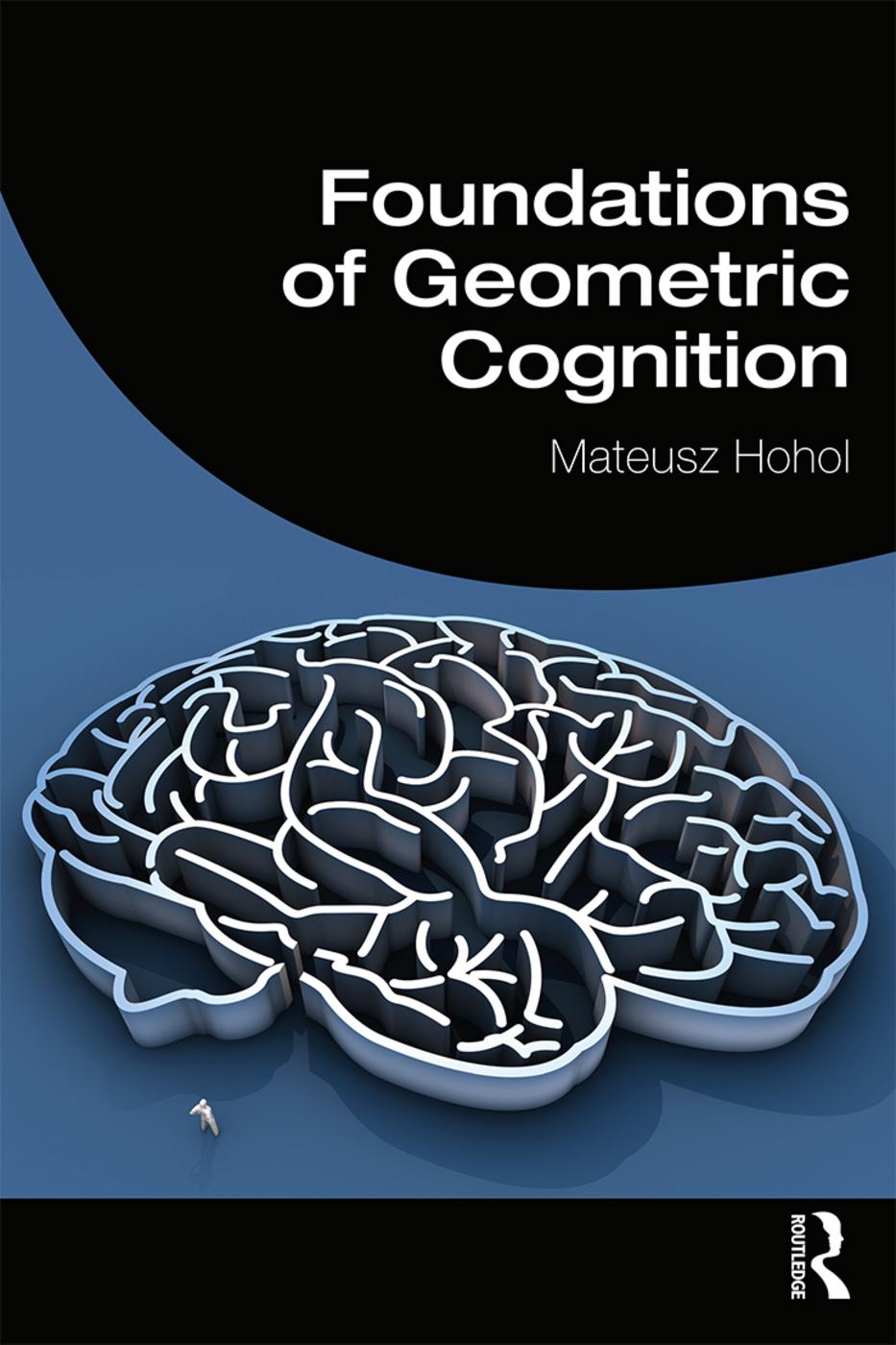
The cognitive foundations of geometry have puzzled academics for a long time, and even today are mostly unknown to many scholars, including mathematical cognition researchers.
Foundations of Geometric Cognition shows that basic geometric skills are deeply hardwired in the visuospatial cognitive capacities of our brains, namely spatial navigation and object recognition. These capacities, shared with non-human animals and appearing in early stages of the human ontogeny, cannot, however, fully explain a uniquely human form of geometric cognition. In the book, Hohol argues that Euclidean geometry would not be possible without the human capacity to create and use abstract concepts, demonstrating how language and diagrams provide cognitive scaffolding for abstract geometric thinking, within a context of a Euclidean system of thought.
Taking an interdisciplinary approach and drawing on research from diverse fields including psychology, cognitive science, and mathematics, this book is a must-read for cognitive psychologists and cognitive scientists of mathematics, alongside anyone interested in mathematical education or the philosophical and historical aspects of geometry.
Betala smidigt med kort, Klarna, Apple Pay eller Google Pay. Är du inte nöjd har du alltid 14 dagars ångerrätt. Läs mer i våra villkor. Har du några frågor, mejla oss på hello@memmo.org.
Memmo gör det enklare att plugga – var du än är i världen. Hos oss samlar du kursböcker och smarta studieverktyg på ett och samma ställe: sammanfattningar, quiz, poddar och flashcards. Och så Ted, din studiekompis som svarar på allt du undrar. Över 50 000 studenter pluggar redan här – byggt för att du ska lära dig snabbare och stressa mindre.