
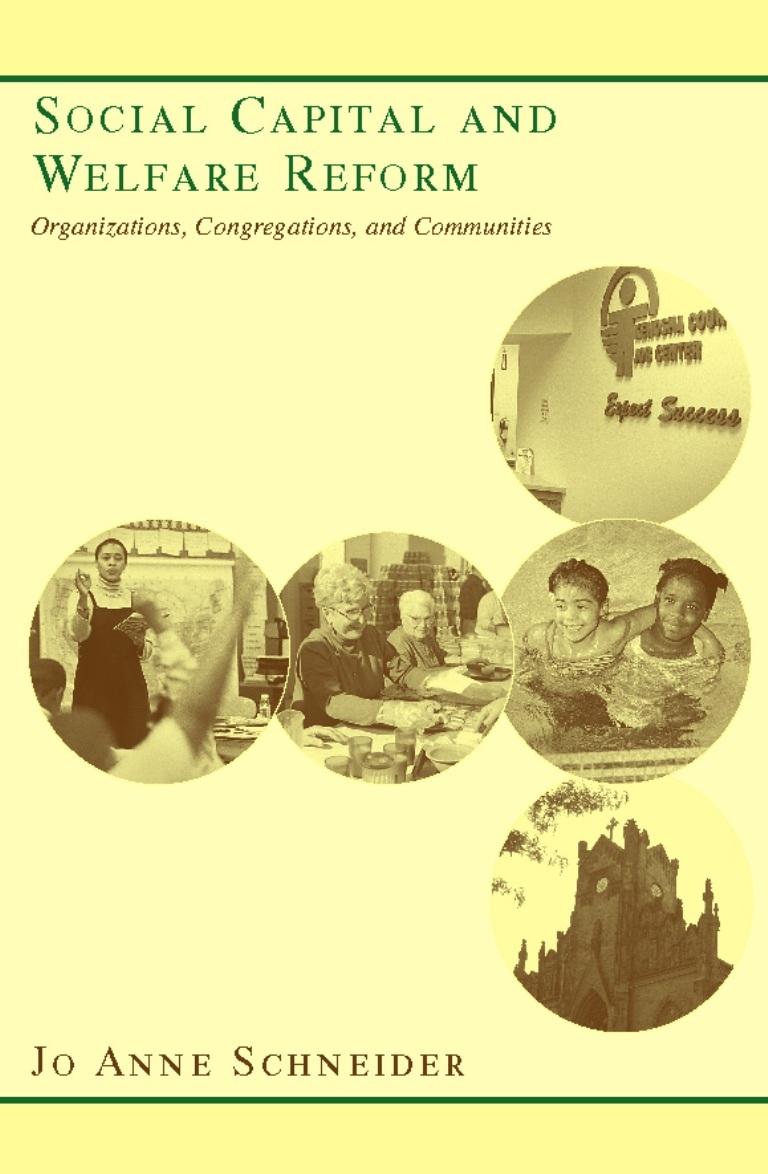
In this groundbreaking study, Jo Anne Schneider considers the reasons behind the limited success of most welfare reform initiatives and offers evidence-based recommendations for enhancing the effectiveness of welfare policy.
Schneider draws on her rich and nuanced ethnographic studies of Philadelphia, Milwaukee, and Kenosha, Wisconsin to clarify the role of social capital for both individuals and institutions. She shows that the social relationships and patterns of trust that enable people to gain access to resources like government services, organization funding, and jobs are crucial in helping families achieve their goals. Schneider examines the complex ways in which social capital functions in conjunction with economic, human, and cultural capital, and explores social capital dynamics among government, nonprofits, and congregations that together provide the welfare support system.
Social Capital and Welfare Reform is compulsory reading for researchers and students in social work, sociology, anthropology, public policy, education, community psychology, social psychiatry, and non-profit and public administration as well as policy makers interested in welfare reform, poverty, and nonprofits.
Betala smidigt med kort, Klarna, Apple Pay eller Google Pay. Är du inte nöjd har du alltid 14 dagars ångerrätt. Läs mer i våra villkor. Har du några frågor, mejla oss på hello@memmo.org.
Memmo gör det enklare att plugga – var du än är i världen. Hos oss samlar du kursböcker och smarta studieverktyg på ett och samma ställe: sammanfattningar, quiz, poddar och flashcards. Och så Ted, din studiekompis som svarar på allt du undrar. Över 50 000 studenter pluggar redan här – byggt för att du ska lära dig snabbare och stressa mindre.