
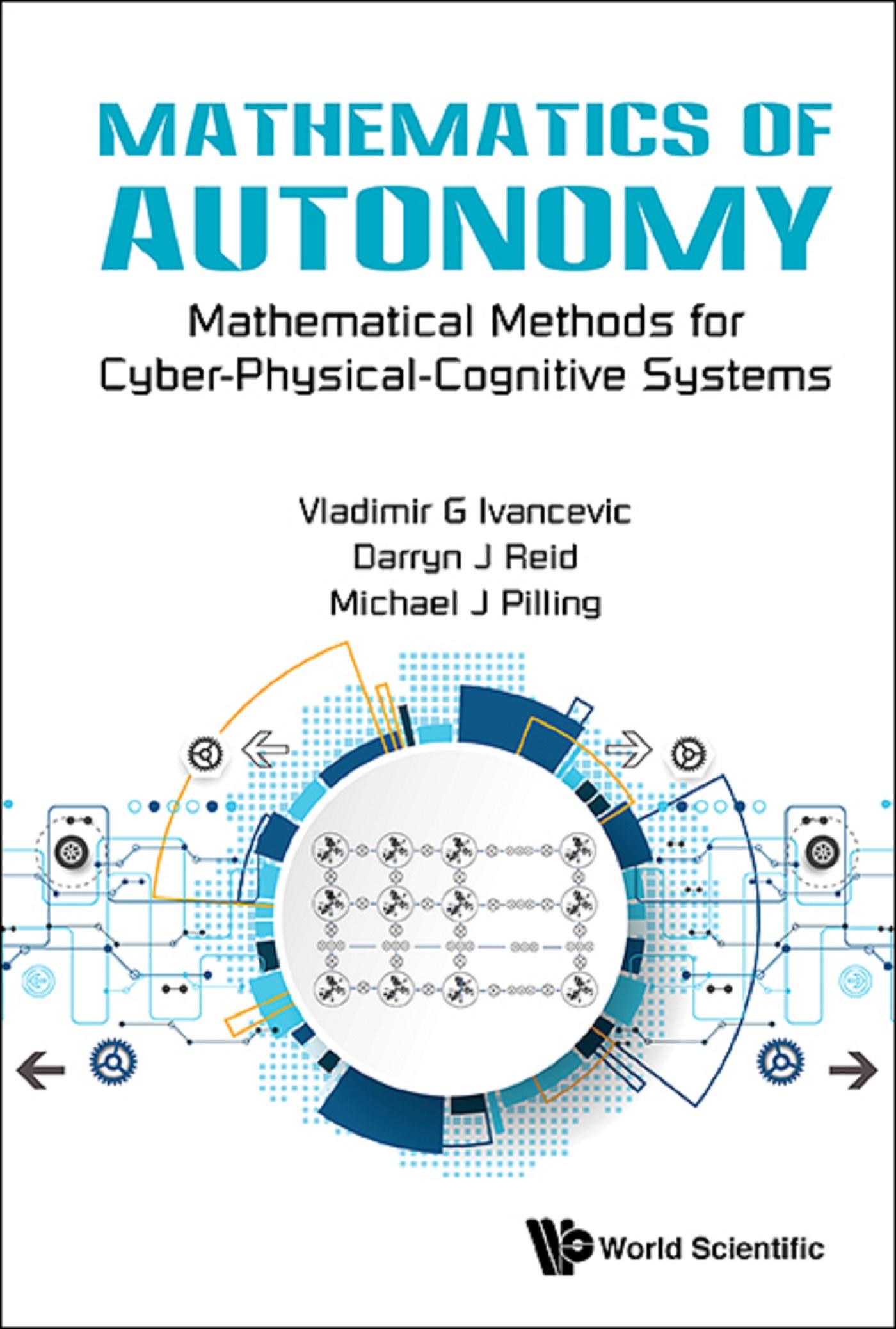
Mathematics of Autonomy provides solid mathematical foundations for building useful Autonomous Systems. It clarifies what makes a system autonomous rather than simply automated, and reveals the inherent limitations of systems currently incorrectly labeled as autonomous in reference to the specific and strong uncertainty that characterizes the environments they operate in. Such complex real-world environments demand truly autonomous solutions to provide the flexibility and robustness needed to operate well within them.This volume embraces hybrid solutions to demonstrate extending the classes of uncertainty autonomous systems can handle. In particular, it combines physical-autonomy (robots), cyber-autonomy (agents) and cognitive-autonomy (cyber and embodied cognition) to produce a rigorous subset of trusted autonomy: Cyber-Physical-Cognitive autonomy (CPC-autonomy).The body of the book alternates between underlying theory and applications of CPC-autonomy including 'Autonomous Supervision of a Swarm of Robots' , 'Using Wind Turbulence against a Swarm of UAVs' and 'Unique Super-Dynamics for All Kinds of Robots (UAVs, UGVs, UUVs and USVs)' to illustrate how to effectively construct Autonomous Systems using this model. It avoids the wishful thinking that characterizes much discussion related to autonomy, discussing the hard limits and challenges of real autonomous systems. In so doing, it clarifies where more work is needed, and also provides a rigorous set of tools to tackle some of the problem space.
Płać wygodnie kartą, Klarną, Apple Pay lub Google Pay. Nie jesteś zadowolony? Zawsze masz 14-dniową gwarancję zwrotu pieniędzy. Więcej przeczytasz w naszych warunkach. Masz pytania? Napisz do nas na hello@memmo.org.
Memmo ułatwia naukę – gdziekolwiek jesteś na świecie. U nas znajdziesz podręczniki i sprytne narzędzia do nauki w jednym miejscu: streszczenia, quizy, podcasty i fiszki. A do tego Ted, Twój kumpel do nauki, który odpowie na wszystko, co Cię nurtuje. Ponad 50 000 studentów już tu się uczy – stworzone, byś uczył się szybciej i mniej stresował.
Może Ci się spodobać
Kup książkę0