
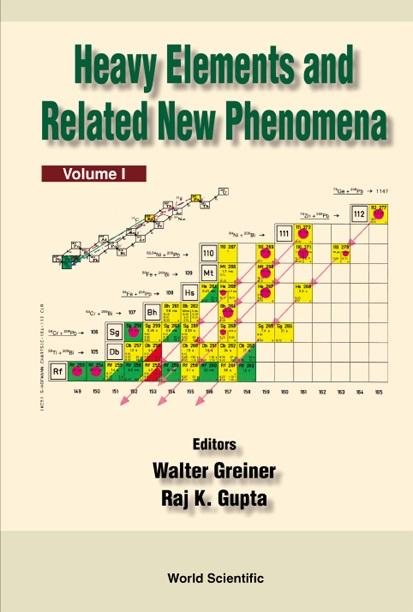
This book reviews recent developments in the field of superheavy elements and the related phenomena of fission, cluster radioactivity, and drip line physics. Both the experimental and theoretical aspects are dealt with in detail. For the production of new elements in the laboratory, the process of cold compound nucleus formation is found to be most favorable both theoretically and experimentally. However, experimentally, hot fusion of nuclei has also been used. Both the physical and chemical methods of synthesizing new elements are discussed. The theoretical approaches considered here are those of the quantum-mechanical fragmentation theory, the self-consistent Hartree-Fock theory, and the relativistic mean field theory. Fission, a process inverse to the fusion of two nuclei, is also observed to be most favourably a cold phenomenon. Other important results are bi-modal fission and high n-multiplicity fission, which leads to the hyperdeformed scission mode. Cluster radioactivity is discussed both as a heavy cluster emission process and as super-asymmetric fission. The theory as well as the present experimental status are reviewed. Physics at drip lines is interesting not only for their structural properties but also for their use in the fusion of two nuclei; both aspects are discussed.
Płać wygodnie kartą, Klarną, Apple Pay lub Google Pay. Nie jesteś zadowolony? Zawsze masz 14-dniową gwarancję zwrotu pieniędzy. Więcej przeczytasz w naszych warunkach. Masz pytania? Napisz do nas na hello@memmo.org.
Memmo ułatwia naukę – gdziekolwiek jesteś na świecie. U nas znajdziesz podręczniki i sprytne narzędzia do nauki w jednym miejscu: streszczenia, quizy, podcasty i fiszki. A do tego Ted, Twój kumpel do nauki, który odpowie na wszystko, co Cię nurtuje. Ponad 50 000 studentów już tu się uczy – stworzone, byś uczył się szybciej i mniej stresował.
Może Ci się spodobać
Kup książkę0