
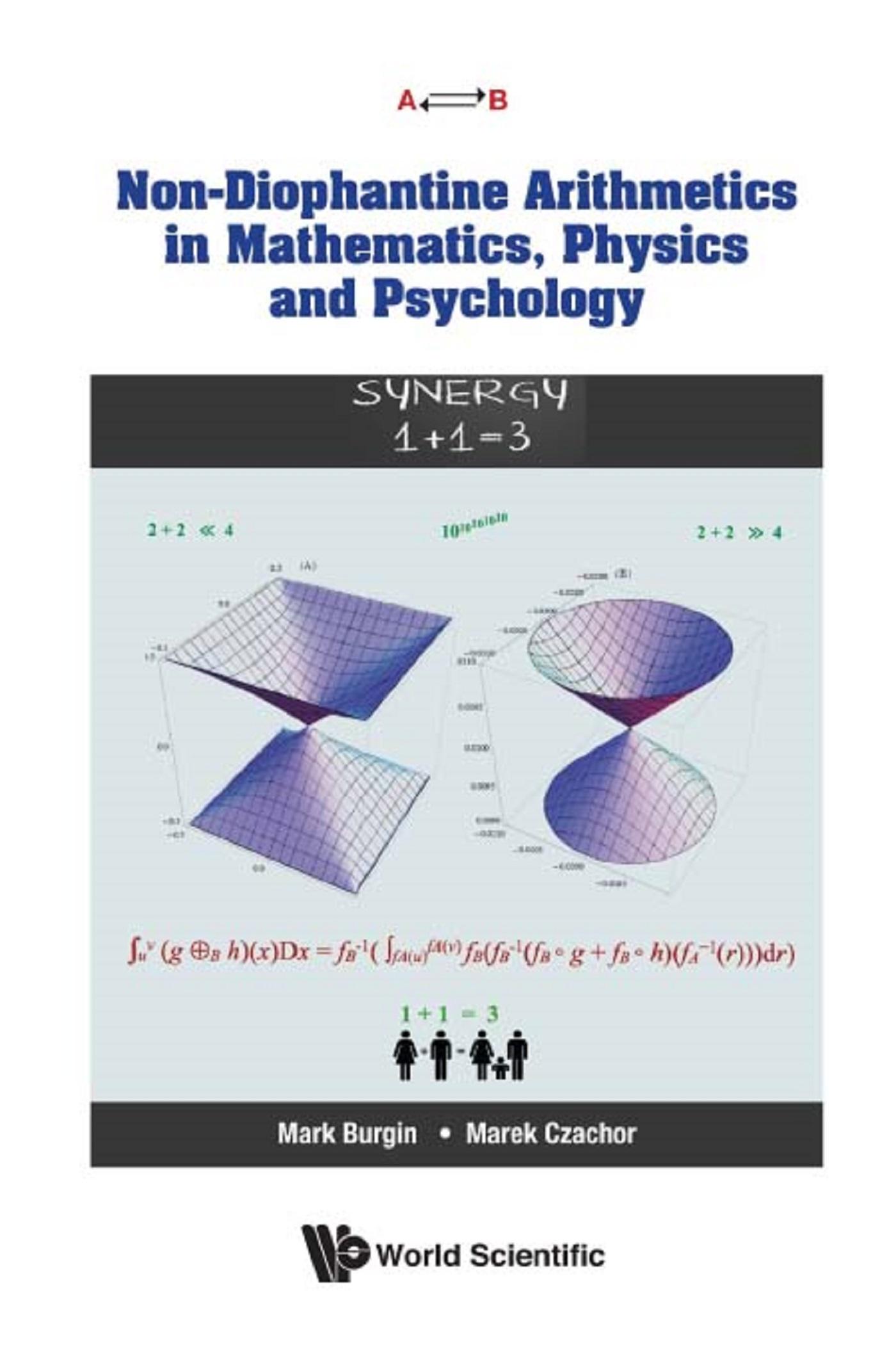
For a long time, all thought there was only one geometry — Euclidean geometry. Nevertheless, in the 19th century, many non-Euclidean geometries were discovered. It took almost two millennia to do this. This was the major mathematical discovery and advancement of the 19th century, which changed understanding of mathematics and the work of mathematicians providing innovative insights and tools for mathematical research and applications of mathematics.A similar event happened in arithmetic in the 20th century. Even longer than with geometry, all thought there was only one conventional arithmetic of natural numbers — the Diophantine arithmetic, in which 2+2=4 and 1+1=2. It is natural to call the conventional arithmetic by the name Diophantine arithmetic due to the important contributions to arithmetic by Diophantus. Nevertheless, in the 20th century, many non-Diophantine arithmetics were discovered, in some of which 2+2=5 or 1+1=3. It took more than two millennia to do this. This discovery has even more implications than the discovery of new geometries because all people use arithmetic.This book provides a detailed exposition of the theory of non-Diophantine arithmetics and its various applications. Reading this book, the reader will see that on the one hand, non-Diophantine arithmetics continue the ancient tradition of operating with numbers while on the other hand, they introduce extremely original and innovative ideas.
Płać wygodnie kartą, Klarną, Apple Pay lub Google Pay. Nie jesteś zadowolony? Zawsze masz 14-dniową gwarancję zwrotu pieniędzy. Więcej przeczytasz w naszych warunkach. Masz pytania? Napisz do nas na hello@memmo.org.
Memmo ułatwia naukę – gdziekolwiek jesteś na świecie. U nas znajdziesz podręczniki i sprytne narzędzia do nauki w jednym miejscu: streszczenia, quizy, podcasty i fiszki. A do tego Ted, Twój kumpel do nauki, który odpowie na wszystko, co Cię nurtuje. Ponad 50 000 studentów już tu się uczy – stworzone, byś uczył się szybciej i mniej stresował.
Może Ci się spodobać
Kup książkę0