
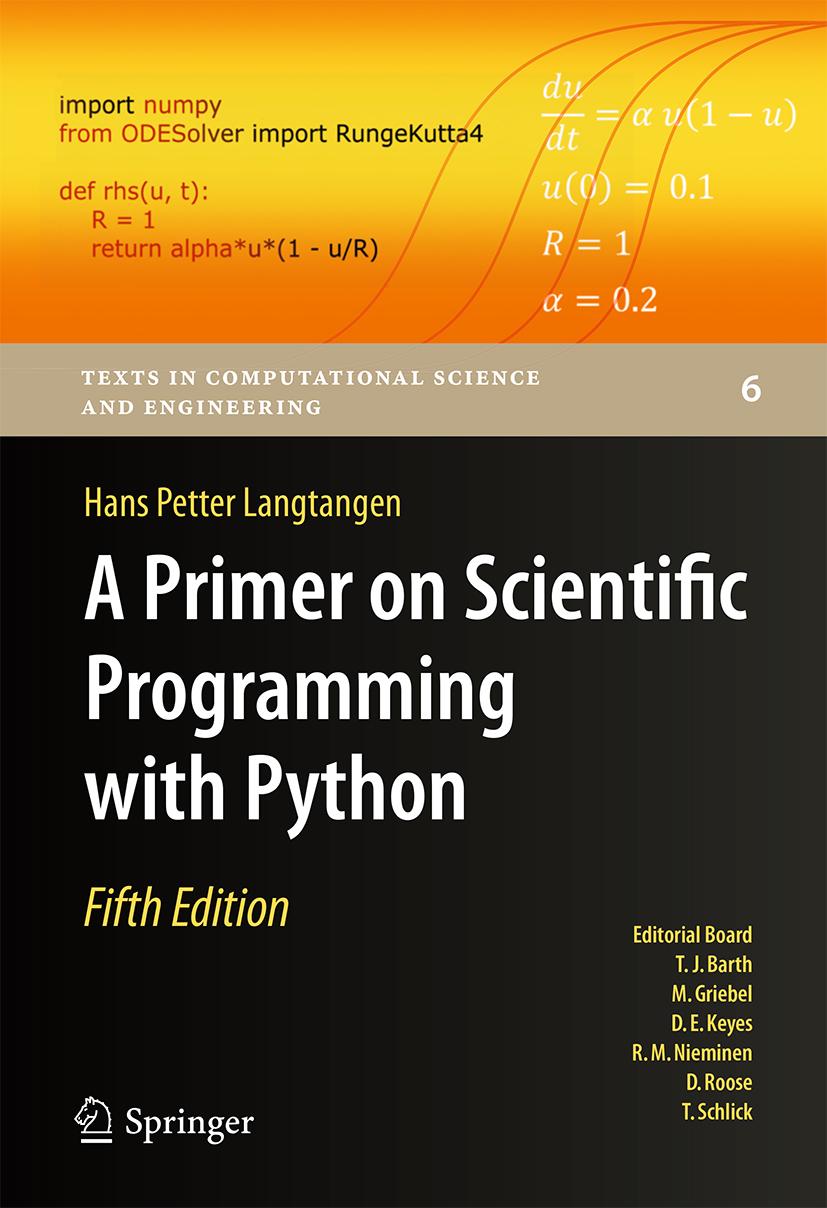
The book serves as a first introduction to computer programming of scientific applications, using the high-level Python language. The exposition is example and problem-oriented, where the applications are taken from mathematics, numerical calculus, statistics, physics, biology and finance. The book teaches "Matlab-style" and procedural programming as well as object-oriented programming. High school mathematics is a required background and it is advantageous to study classical and numerical one-variable calculus in parallel with reading this book. Besides learning how to program computers, the reader will also learn how to solve mathematical problems, arising in various branches of science and engineering, with the aid of numerical methods and programming. By blending programming, mathematics and scientific applications, the book lays a solid foundation for practicing computational science.
From the reviews: Langtangen … does an excellent job of introducing programming as a set of skills in problem solving. He guides the reader into thinking properly about producing program logic and data structures for modeling real-world problems using objects and functions and embracing the object-oriented paradigm. … Summing Up: Highly recommended.
F. H. Wild III, Choice, Vol. 47 (8), April 2010
Those of us who have learned scientific programming in Python ‘on the streets’ could be a little jealous of students who have the opportunity to take a course out of Langtangen’s Primer.”
John D. Cook, The Mathematical Association of America, September 2011
This book goes through Python in particular, and programming in general, via tasks that scientists will likely perform. It contains valuable information for students new to scientific computing and would be the perfect bridge between an introduction to programming and an advanced course on numerical methods or computational science.
Alex Small,IEEE, CiSE Vol. 14 (2), March /April 2012
“This fourth edition is a wonderful, inclusive textbook that covers pretty much everything one needs to know to go from zero to fairly sophisticated scientific programming in Python…”
Joan Horvath, Computing Reviews, March 2015
Płać wygodnie kartą, Klarną, Apple Pay lub Google Pay. Nie jesteś zadowolony? Zawsze masz 14-dniową gwarancję zwrotu pieniędzy. Więcej przeczytasz w naszych warunkach. Masz pytania? Napisz do nas na hello@memmo.org.
Memmo ułatwia naukę – gdziekolwiek jesteś na świecie. U nas znajdziesz podręczniki i sprytne narzędzia do nauki w jednym miejscu: streszczenia, quizy, podcasty i fiszki. A do tego Ted, Twój kumpel do nauki, który odpowie na wszystko, co Cię nurtuje. Ponad 50 000 studentów już tu się uczy – stworzone, byś uczył się szybciej i mniej stresował.