
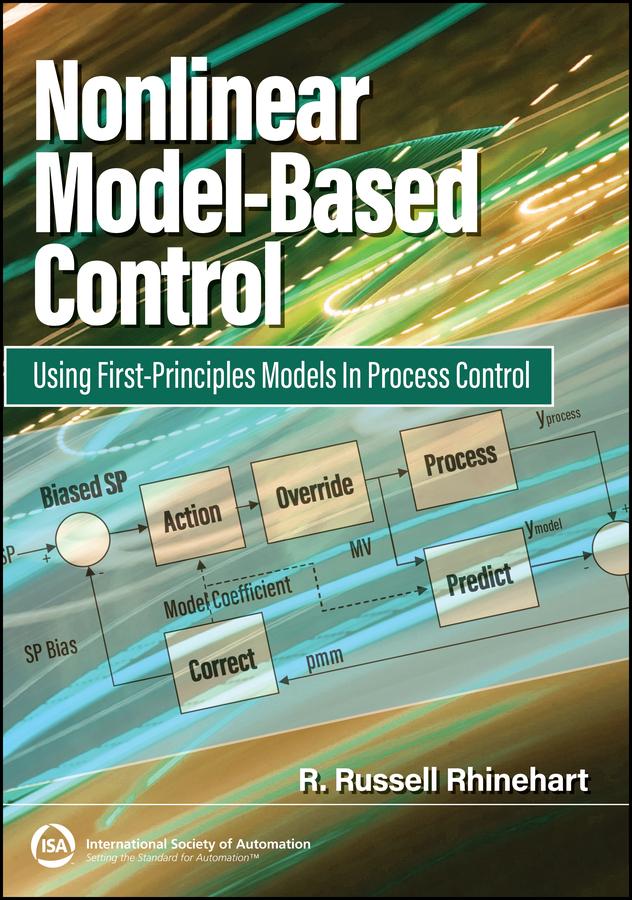
Nonlinear Model-Based Control: Using First-Principles Models in Process Control
First-principles models (engineering models) are used in industry for process design, troubleshooting, training, online analysis and supervisory optimization. The author's vision is to use them for control.
Why? They effectively handle nonlinearity, nonstationary behavior and interacting variables with just one tuning coefficient per controlled variable (CV). Using optimization, the controller can handle constraints and shape the manipulated variables to achieve desired controlled variable trajectories. Using first-principles models for control can also enhance the operational staff's understanding of the process, support auxiliary process management, and keep the mathematics at the engineers' comfort level. In addition, unifying all models across diverse process management operations ensures continuity and compatibility.
The book explains four control techniques using first-principles models that have been credibly demonstrated for industrial practice: generic model control, process-model-based control, predictive functional control and horizon predictive control. It illustrates their applications and discusses the pros and cons of each. To provide a better understanding of first-principles models, the book includes examples of setting up functions for controllers and discusses inherent properties such as ease of tuning, the handling of nonlinearity and interaction, feedforward constraints and the range of operation.
Płać wygodnie kartą, Klarną, Apple Pay lub Google Pay. Nie jesteś zadowolony? Zawsze masz 14-dniową gwarancję zwrotu pieniędzy. Więcej przeczytasz w naszych warunkach. Masz pytania? Napisz do nas na hello@memmo.org.
Memmo ułatwia naukę – gdziekolwiek jesteś na świecie. U nas znajdziesz podręczniki i sprytne narzędzia do nauki w jednym miejscu: streszczenia, quizy, podcasty i fiszki. A do tego Ted, Twój kumpel do nauki, który odpowie na wszystko, co Cię nurtuje. Ponad 50 000 studentów już tu się uczy – stworzone, byś uczył się szybciej i mniej stresował.