
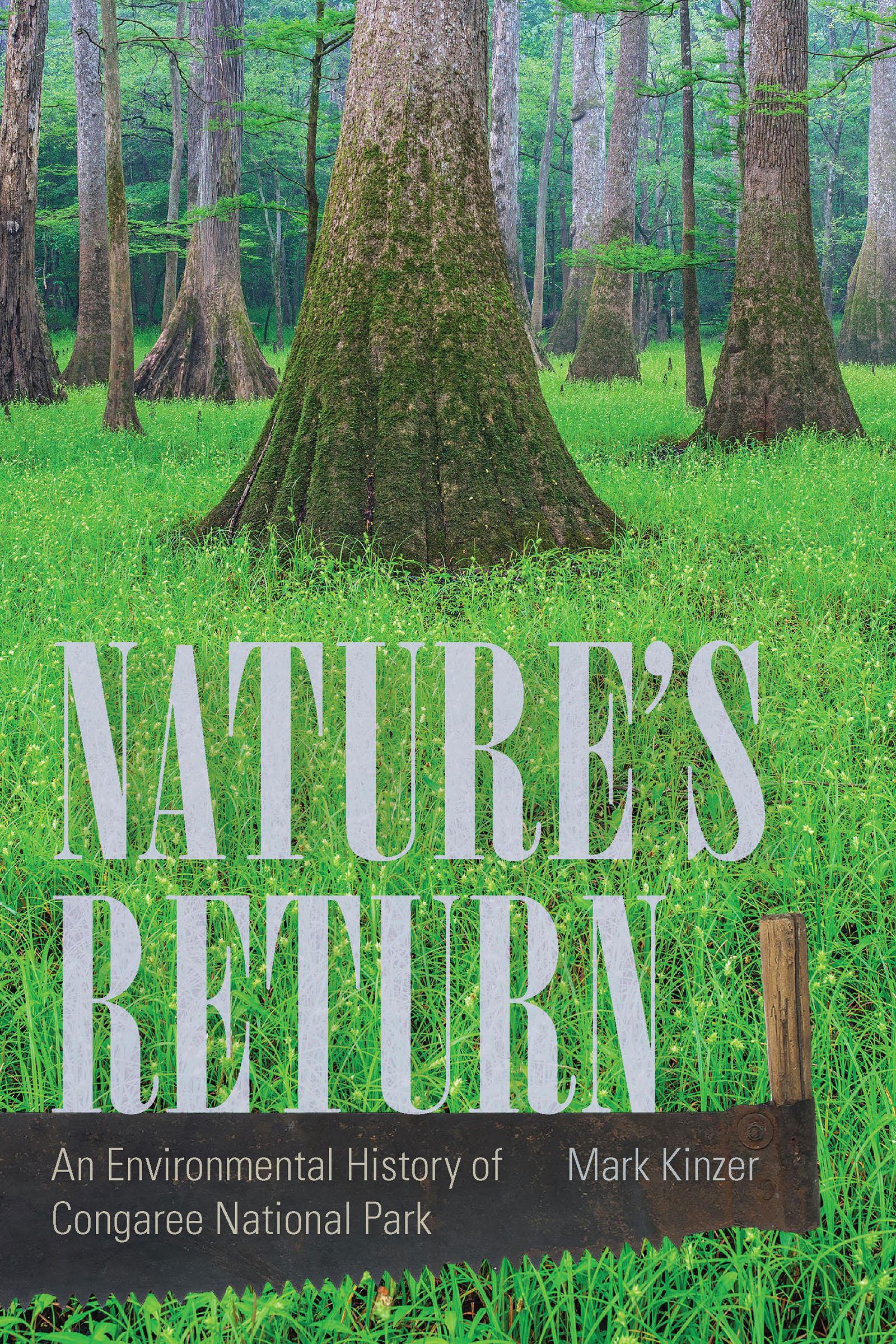
From exploitation to preservation, the complex history of South Carolina's only national park
Located at the confluence of the Congaree and Wateree Rivers in central South Carolina, Congaree National Park protects the nation's largest intact expanse of old-growth bottomland hardwood forest. Modern visitors to the park enjoy a pristine landscape that seems ancient and untouched by human hands, but in truth its history is far different. In Nature's Return, Mark Kinzer examines the successive waves of inhabitants, visitors, and landowners of this region by synthesizing information from property and census records, studies of forest succession, tree-ring analyses, slave narratives, and historical news accounts.
Established in 1976, Congaree National Park contains within its boundaries nearly twenty-seven thousand acres of protected uplands, floodplains, and swamps. Once exploited by humans for farming, cattle grazing, plantation agriculture, and logging, the park area is now used gently for recreation and conservation. Although the impact of farming, grazing, and logging in the park was far less extensive than in other river swamps across the Southeast, it is still evident to those who know where to look.
Cultivated in corn and cotton during the nineteenth century, the land became the site of extensive logging operations soon after the Civil War, a practice that continued intermittently into the late twentieth century. From burning canebrakes to clearing fields and logging trees, inhabitants of the lower Congaree valley have modified the floodplain environment both to ensure their survival and, over time, to generate wealth. In this they behaved no differently than people living along other major rivers in the South Atlantic Coastal Plain.
Today Congaree National Park is a forest of vast flats and winding sloughs where champion trees dot the landscape. Indeed its history of human use and conservation make it a valuable laboratory for the study not only of flora and fauna but also of anthropology and modern history. As the impact of human disturbance fades, the Congaree's stature as one of the most important natural areas in the eastern United States only continues to grow.
Płać wygodnie kartą, Klarną, Apple Pay lub Google Pay. Nie jesteś zadowolony? Zawsze masz 14-dniową gwarancję zwrotu pieniędzy. Więcej przeczytasz w naszych warunkach. Masz pytania? Napisz do nas na hello@memmo.org.
Memmo ułatwia naukę – gdziekolwiek jesteś na świecie. U nas znajdziesz podręczniki i sprytne narzędzia do nauki w jednym miejscu: streszczenia, quizy, podcasty i fiszki. A do tego Ted, Twój kumpel do nauki, który odpowie na wszystko, co Cię nurtuje. Ponad 50 000 studentów już tu się uczy – stworzone, byś uczył się szybciej i mniej stresował.