
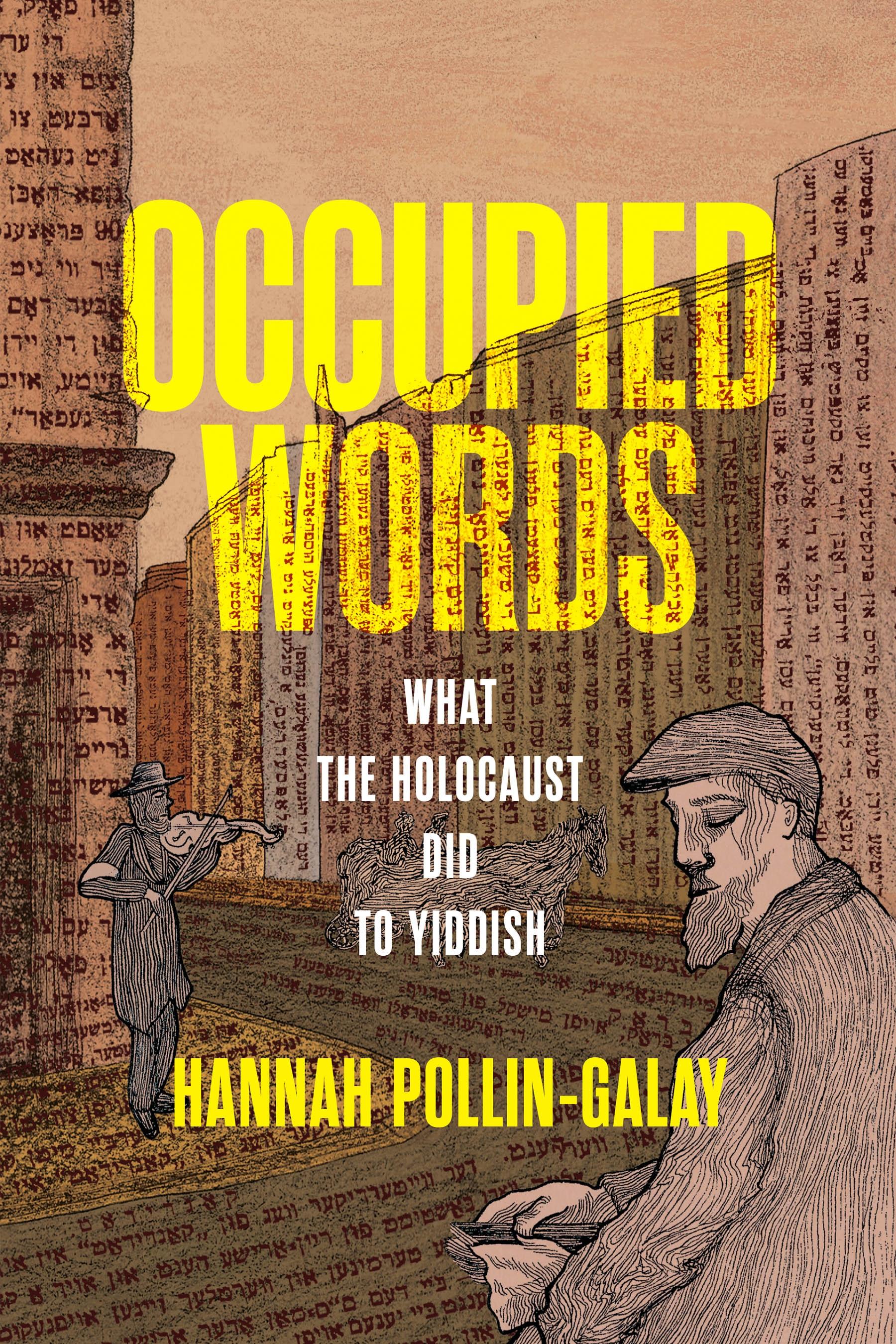
How Yiddish changed to express and memorialize the trauma of the Holocaust
The Holocaust radically altered the way many East European Jews spoke Yiddish. Finding prewar language incapable of describing the imprisonment, death, and dehumanization of the Shoah, prisoners added or reinvented thousands of Yiddish words and phrases to describe their new reality. These crass, witty, and sometimes beautiful Yiddish words – Khurbn Yiddish, or “Yiddish of the Holocaust” – puzzled and intrigued the East European Jews who were experiencing the metamorphosis of their own tongue in real time. Sensing that Khurbn Yiddish words harbored profound truths about what Jews endured during the Holocaust, some Yiddish speakers threw themselves into compiling dictionaries and glossaries to document and analyze these new words. Others incorporated Khurbn Yiddish into their poetry and prose. In Occupied Words, Hannah Pollin-Galay explores Khurbn Yiddish as a form of Holocaust memory and as a testament to the sensation of speech under genocidal conditions.
Occupied Words investigates Khurbn Yiddish through the lenses of cultural history, philology, and literary interpretation. Analyzing fragments of language consciousness left behind from the camps and ghettos alongside the postwar journeys of three intellectuals—Nachman Blumental, Israel Kaplan and Elye Spivak—Pollin-Galay seeks to understand why people chose Yiddish lexicography as a means of witnessing the Holocaust. She then turns to the Khurbn Yiddish words themselves, focusing on terms related to theft, the German-Yiddish encounter and the erotic female body. Here, the author unearths new perspectives on how Jews experienced daily life under Nazi occupation, while raising questions about language and victimhood. Lastly, the book explores how writers turned ghetto and camp slang into art—highlighting the poetry and fiction of K. Tzetnik (Yehiel Di-Nur) and Chava Rosenfarb. Ultimately, Occupied Words speaks to broader debates about cultural genocide, asking how we might rethink the concept of genocide through the framework of language.
Płać wygodnie kartą, Klarną, Apple Pay lub Google Pay. Nie jesteś zadowolony? Zawsze masz 14-dniową gwarancję zwrotu pieniędzy. Więcej przeczytasz w naszych warunkach. Masz pytania? Napisz do nas na hello@memmo.org.
Memmo ułatwia naukę – gdziekolwiek jesteś na świecie. U nas znajdziesz podręczniki i sprytne narzędzia do nauki w jednym miejscu: streszczenia, quizy, podcasty i fiszki. A do tego Ted, Twój kumpel do nauki, który odpowie na wszystko, co Cię nurtuje. Ponad 50 000 studentów już tu się uczy – stworzone, byś uczył się szybciej i mniej stresował.