
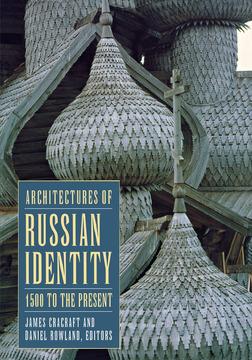
From the royal pew of Ivan the Terrible, to Catherine the Great's use of landscape, to the struggles between the Orthodox Church and preservationists in post-Soviet Yaroslavl—across five centuries of Russian history, Russian leaders have used architecture to project unity, identity, and power. Church architecture has inspired national cohesion and justified political control while representing the claims of religion in brick, wood, and stone. The architectural vocabulary of the Soviet state celebrated industrialization, mechanization, and communal life. Buildings and landscapes have expressed utopian urges as well as lofty spiritual goals. Country houses and memorials have encoded their own messages.
In Architectures of Russian Identity, James Cracraft and Daniel Rowland gather a group of authors from a wide variety of backgrounds—including history and architectural history, linguistics, literary studies, geography, and political science—to survey the political and symbolic meanings of many different kinds of structures. Fourteen heavily illustrated chapters demonstrate the remarkable fertility of the theme of architecture, broadly defined, for a range of fields dealing with Russia and its surrounding territories. The authors engage key terms in contemporary historiography—identity, nationality, visual culture—and assess the applications of each in Russian contexts.
Płać wygodnie kartą, Klarną, Apple Pay lub Google Pay. Nie jesteś zadowolony? Zawsze masz 14-dniową gwarancję zwrotu pieniędzy. Więcej przeczytasz w naszych warunkach. Masz pytania? Napisz do nas na hello@memmo.org.
Memmo ułatwia naukę – gdziekolwiek jesteś na świecie. U nas znajdziesz podręczniki i sprytne narzędzia do nauki w jednym miejscu: streszczenia, quizy, podcasty i fiszki. A do tego Ted, Twój kumpel do nauki, który odpowie na wszystko, co Cię nurtuje. Ponad 50 000 studentów już tu się uczy – stworzone, byś uczył się szybciej i mniej stresował.