
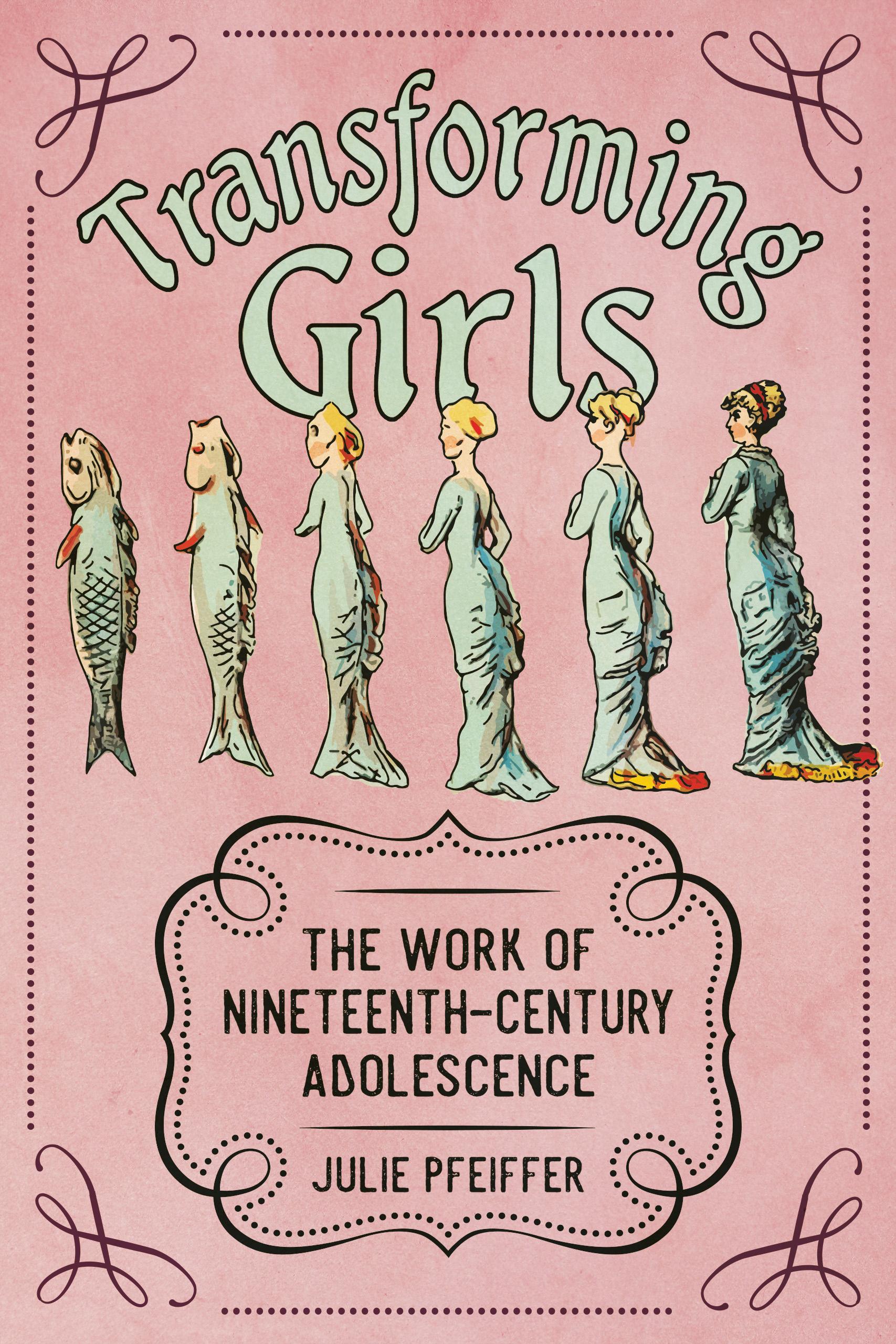
Transforming Girls: The Work of Nineteenth-Century Adolescence explores the paradox of the nineteenth-century girls’ book. On the one hand, early novels for adolescent girls rely on gender binaries and suggest that girls must accommodate and support a patriarchal framework to be happy. On the other, they provide access to imagined worlds in which teens are at the center. The early girls’ book frames female adolescence as an opportunity for productive investment in the self. This is a space where mentors who trust themselves, the education they provide, and the girl’s essentially good nature neutralize the girl’s own anxieties about maturity.
These mid-nineteenth-century novels focus on female adolescence as a social category in unexpected ways. They draw not on a twentieth-century model of the alienated adolescent, but on a model of collaborative growth. The purpose of these novels is to approach adolescence—a category that continues to engage and perplex us—from another perspective, one in which fluid identity and the deliberate construction of a self are celebrated. They provide alternatives to cultural beliefs about what it was like to be a white, middle-class girl in the nineteenth century and challenge the assumption that the evolution of the girls’ book is always a movement towards less sexist, less restrictive images of girls.
Drawing on forgotten bestsellers in the United States and Germany (where this genre is referred to as Backfischliteratur), Transforming Girls offers insightful readings that call scholars to reexamine the history of the girls’ book. It also outlines an alternate model for imagining adolescence and supporting adolescent girls. The awkward adolescent girl—so popular in mid-nineteenth-century fiction for girls—remains a valuable resource for understanding contemporary girls and stories about them.
These mid-nineteenth-century novels focus on female adolescence as a social category in unexpected ways. They draw not on a twentieth-century model of the alienated adolescent, but on a model of collaborative growth. The purpose of these novels is to approach adolescence—a category that continues to engage and perplex us—from another perspective, one in which fluid identity and the deliberate construction of a self are celebrated. They provide alternatives to cultural beliefs about what it was like to be a white, middle-class girl in the nineteenth century and challenge the assumption that the evolution of the girls’ book is always a movement towards less sexist, less restrictive images of girls.
Drawing on forgotten bestsellers in the United States and Germany (where this genre is referred to as Backfischliteratur), Transforming Girls offers insightful readings that call scholars to reexamine the history of the girls’ book. It also outlines an alternate model for imagining adolescence and supporting adolescent girls. The awkward adolescent girl—so popular in mid-nineteenth-century fiction for girls—remains a valuable resource for understanding contemporary girls and stories about them.
Płać wygodnie kartą, Klarną, Apple Pay lub Google Pay. Nie jesteś zadowolony? Zawsze masz 14-dniową gwarancję zwrotu pieniędzy. Więcej przeczytasz w naszych warunkach. Masz pytania? Napisz do nas na hello@memmo.org.
Memmo ułatwia naukę – gdziekolwiek jesteś na świecie. U nas znajdziesz podręczniki i sprytne narzędzia do nauki w jednym miejscu: streszczenia, quizy, podcasty i fiszki. A do tego Ted, Twój kumpel do nauki, który odpowie na wszystko, co Cię nurtuje. Ponad 50 000 studentów już tu się uczy – stworzone, byś uczył się szybciej i mniej stresował.
Może Ci się spodobać
Kup książkę0