
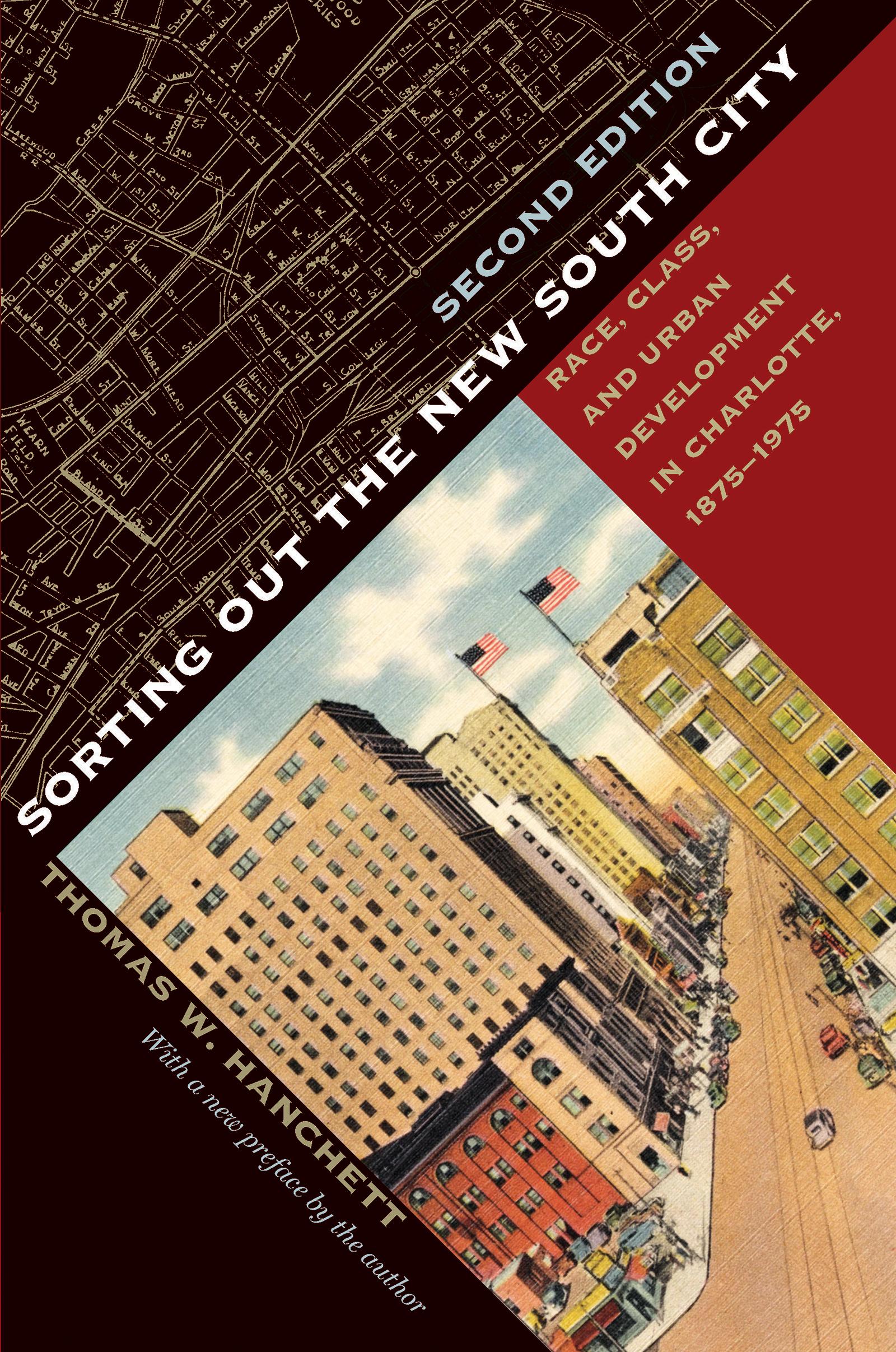
One of the largest and fastest-growing cities in the South, Charlotte, North Carolina, came of age in the New South decades of the late nineteenth and early twentieth centuries, transforming itself from a rural courthouse village to the trading and financial hub of America’s premier textile manufacturing region. In this book, Thomas W. Hanchett traces the city’s spatial evolution over the course of a century, exploring the interplay of national trends and local forces that shaped Charlotte and, by extension, other New South urban centers.
Hanchett argues that racial and economic segregation are not age-old givens but products of a decades-long process. Well after the Civil War, Charlotte’s whites and blacks, workers and business owners, lived in intermingled neighborhoods. The rise of large manufacturing enterprises in the 1880s and 1890s brought social and political upheaval, however, and the city began to sort out into a “checkerboard” of distinct neighborhoods segregated by both race and class. When urban renewal and other federal funds became available in the mid-twentieth century, local leaders used the money to complete the sorting-out process, creating a “sector” pattern in which wealthy whites increasingly lived on one side of town and blacks on the other. A new preface by the author confronts the contemporary implications of Charlotte’s resegregation and prospects for its reversal.
Hanchett argues that racial and economic segregation are not age-old givens but products of a decades-long process. Well after the Civil War, Charlotte’s whites and blacks, workers and business owners, lived in intermingled neighborhoods. The rise of large manufacturing enterprises in the 1880s and 1890s brought social and political upheaval, however, and the city began to sort out into a “checkerboard” of distinct neighborhoods segregated by both race and class. When urban renewal and other federal funds became available in the mid-twentieth century, local leaders used the money to complete the sorting-out process, creating a “sector” pattern in which wealthy whites increasingly lived on one side of town and blacks on the other. A new preface by the author confronts the contemporary implications of Charlotte’s resegregation and prospects for its reversal.
Płać wygodnie kartą, Klarną, Apple Pay lub Google Pay. Nie jesteś zadowolony? Zawsze masz 14-dniową gwarancję zwrotu pieniędzy. Więcej przeczytasz w naszych warunkach. Masz pytania? Napisz do nas na hello@memmo.org.
Memmo ułatwia naukę – gdziekolwiek jesteś na świecie. U nas znajdziesz podręczniki i sprytne narzędzia do nauki w jednym miejscu: streszczenia, quizy, podcasty i fiszki. A do tego Ted, Twój kumpel do nauki, który odpowie na wszystko, co Cię nurtuje. Ponad 50 000 studentów już tu się uczy – stworzone, byś uczył się szybciej i mniej stresował.
Może Ci się spodobać
Kup książkę0