
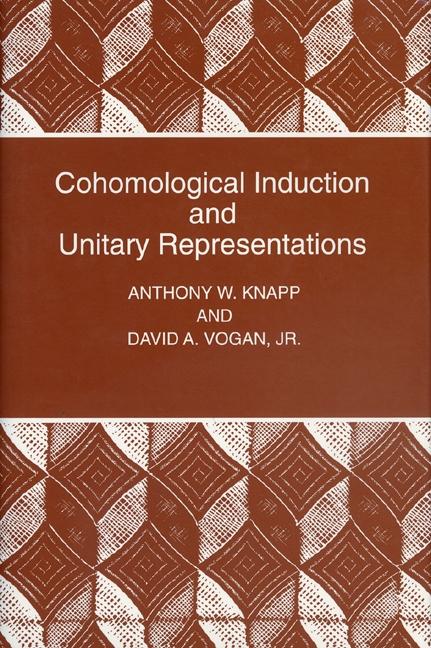
This book offers a systematic treatment--the first in book form--of the development and use of cohomological induction to construct unitary representations. George Mackey introduced induction in 1950 as a real analysis construction for passing from a unitary representation of a closed subgroup of a locally compact group to a unitary representation of the whole group. Later a parallel construction using complex analysis and its associated co-homology theories grew up as a result of work by Borel, Weil, Harish-Chandra, Bott, Langlands, Kostant, and Schmid. Cohomological induction, introduced by Zuckerman, is an algebraic analog that is technically more manageable than the complex-analysis construction and leads to a large repertory of irreducible unitary representations of reductive Lie groups.
The book, which is accessible to students beyond the first year of graduate school, will interest mathematicians and physicists who want to learn about and take advantage of the algebraic side of the representation theory of Lie groups. Cohomological Induction and Unitary Representations develops the necessary background in representation theory and includes an introductory chapter of motivation, a thorough treatment of the "translation principle," and four appendices on algebra and analysis.
Płać wygodnie kartą, Klarną, Apple Pay lub Google Pay. Nie jesteś zadowolony? Zawsze masz 14-dniową gwarancję zwrotu pieniędzy. Więcej przeczytasz w naszych warunkach. Masz pytania? Napisz do nas na hello@memmo.org.
Memmo ułatwia naukę – gdziekolwiek jesteś na świecie. U nas znajdziesz podręczniki i sprytne narzędzia do nauki w jednym miejscu: streszczenia, quizy, podcasty i fiszki. A do tego Ted, Twój kumpel do nauki, który odpowie na wszystko, co Cię nurtuje. Ponad 50 000 studentów już tu się uczy – stworzone, byś uczył się szybciej i mniej stresował.