
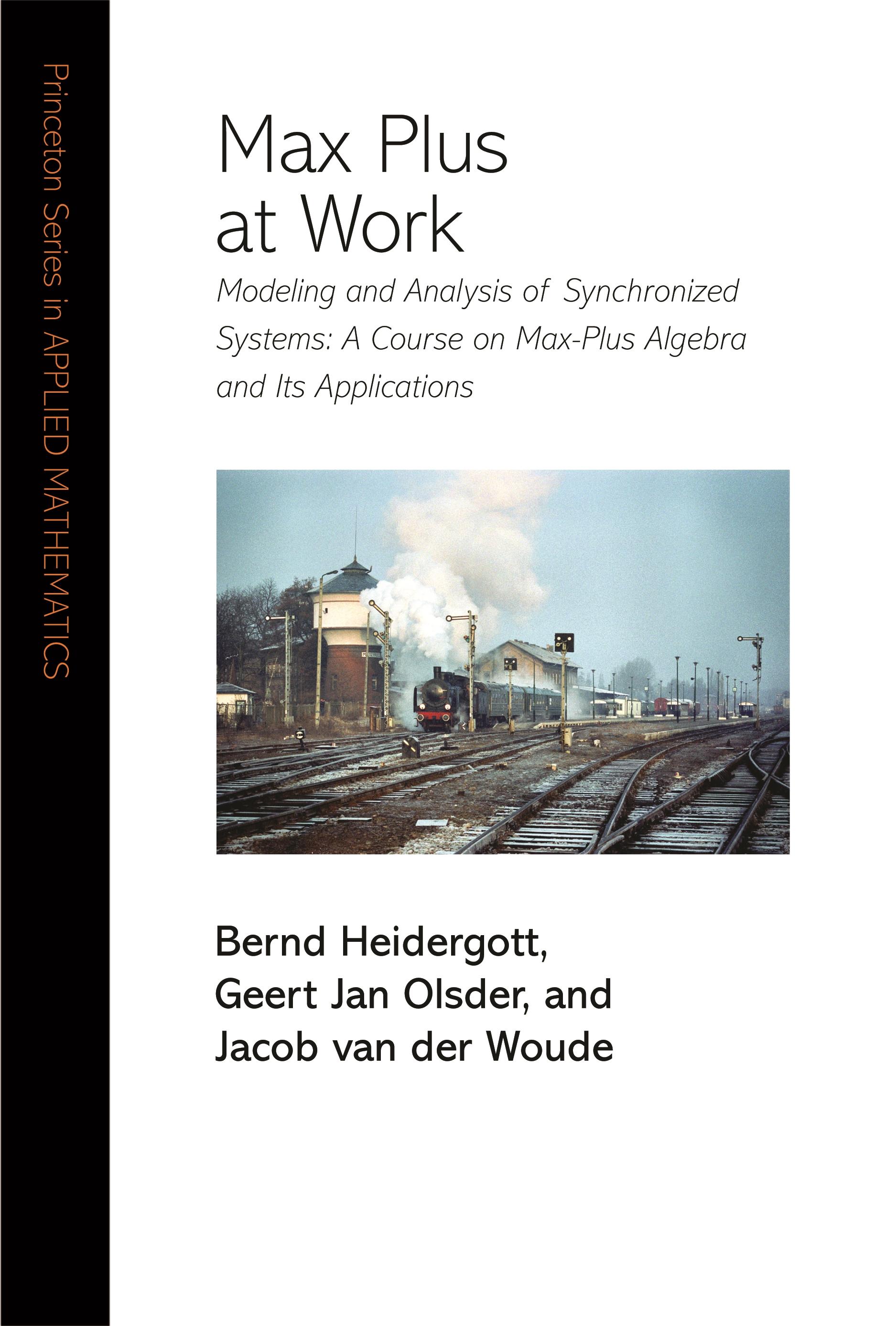
Trains pull into a railroad station and must wait for each other before leaving again in order to let passengers change trains. How do mathematicians then calculate a railroad timetable that accurately reflects their comings and goings? One approach is to use max-plus algebra, a framework used to model Discrete Event Systems, which are well suited to describe the ordering and timing of events. This is the first textbook on max-plus algebra, providing a concise and self-contained introduction to the topic.
Applications of max-plus algebra abound in the world around us. Traffic systems, computer communication systems, production lines, and flows in networks are all based on discrete even systems, and thus can be conveniently described and analyzed by means of max-plus algebra.
The book consists of an introduction and thirteen chapters in three parts. Part One explores the introduction of max-plus algebra and of system descriptions based upon it. Part Two deals with a real application, namely the design of timetables for railway networks. Part Three examines various extensions, such as stochastic systems and min-max-plus systems. The text is suitable for last-year undergraduates in mathematics, and each chapter provides exercises, notes, and a reference section.
Płać wygodnie kartą, Klarną, Apple Pay lub Google Pay. Nie jesteś zadowolony? Zawsze masz 14-dniową gwarancję zwrotu pieniędzy. Więcej przeczytasz w naszych warunkach. Masz pytania? Napisz do nas na hello@memmo.org.
Memmo ułatwia naukę – gdziekolwiek jesteś na świecie. U nas znajdziesz podręczniki i sprytne narzędzia do nauki w jednym miejscu: streszczenia, quizy, podcasty i fiszki. A do tego Ted, Twój kumpel do nauki, który odpowie na wszystko, co Cię nurtuje. Ponad 50 000 studentów już tu się uczy – stworzone, byś uczył się szybciej i mniej stresował.