
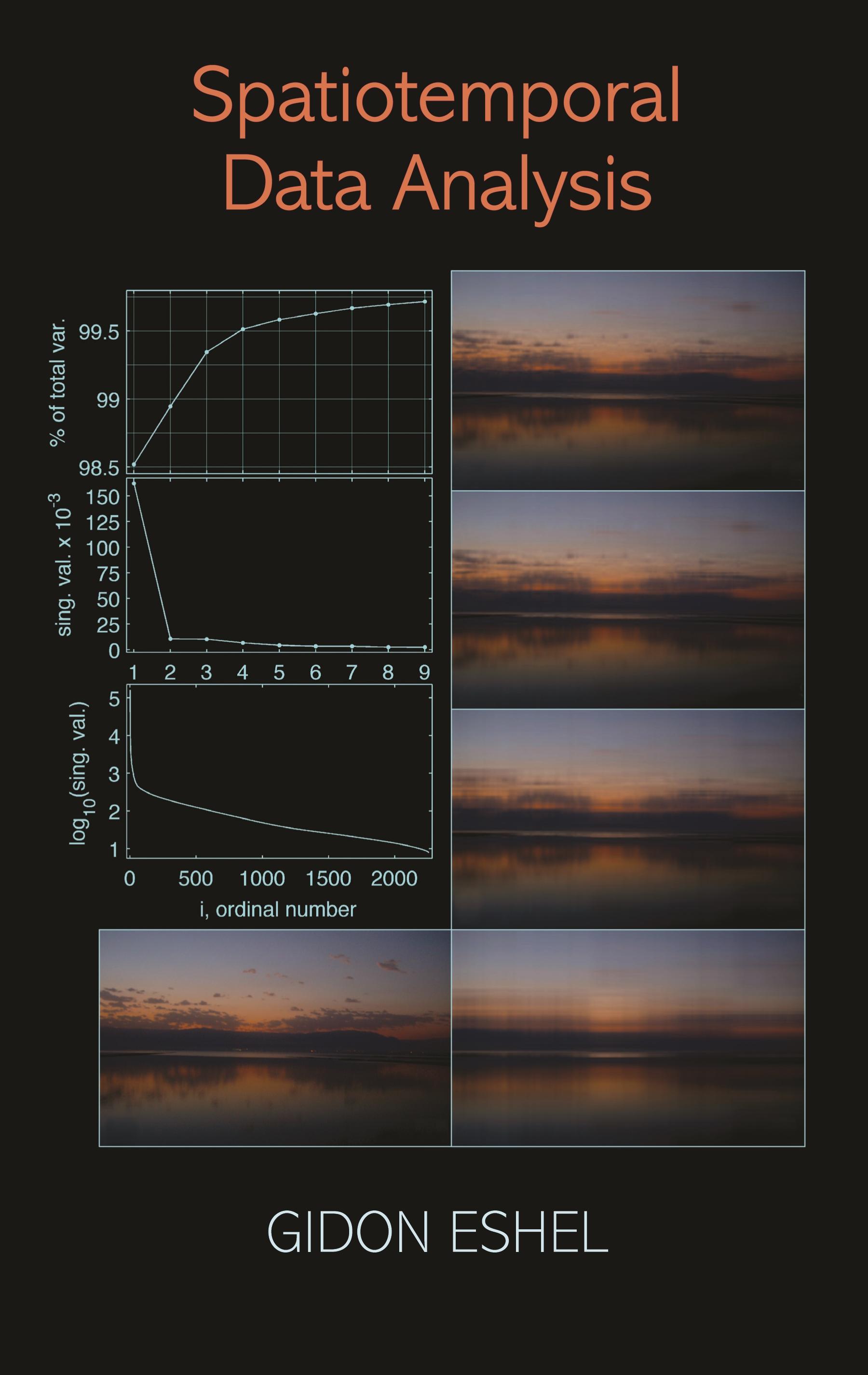
A severe thunderstorm morphs into a tornado that cuts a swath of destruction through Oklahoma. How do we study the storm's mutation into a deadly twister? Avian flu cases are reported in China. How do we characterize the spread of the flu, potentially preventing an epidemic? The way to answer important questions like these is to analyze the spatial and temporal characteristics--origin, rates, and frequencies--of these phenomena. This comprehensive text introduces advanced undergraduate students, graduate students, and researchers to the statistical and algebraic methods used to analyze spatiotemporal data in a range of fields, including climate science, geophysics, ecology, astrophysics, and medicine.
Gidon Eshel begins with a concise yet detailed primer on linear algebra, providing readers with the mathematical foundations needed for data analysis. He then fully explains the theory and methods for analyzing spatiotemporal data, guiding readers from the basics to the most advanced applications. This self-contained, practical guide to the analysis of multidimensional data sets features a wealth of real-world examples as well as sample homework exercises and suggested exams.
Płać wygodnie kartą, Klarną, Apple Pay lub Google Pay. Nie jesteś zadowolony? Zawsze masz 14-dniową gwarancję zwrotu pieniędzy. Więcej przeczytasz w naszych warunkach. Masz pytania? Napisz do nas na hello@memmo.org.
Memmo ułatwia naukę – gdziekolwiek jesteś na świecie. U nas znajdziesz podręczniki i sprytne narzędzia do nauki w jednym miejscu: streszczenia, quizy, podcasty i fiszki. A do tego Ted, Twój kumpel do nauki, który odpowie na wszystko, co Cię nurtuje. Ponad 50 000 studentów już tu się uczy – stworzone, byś uczył się szybciej i mniej stresował.