
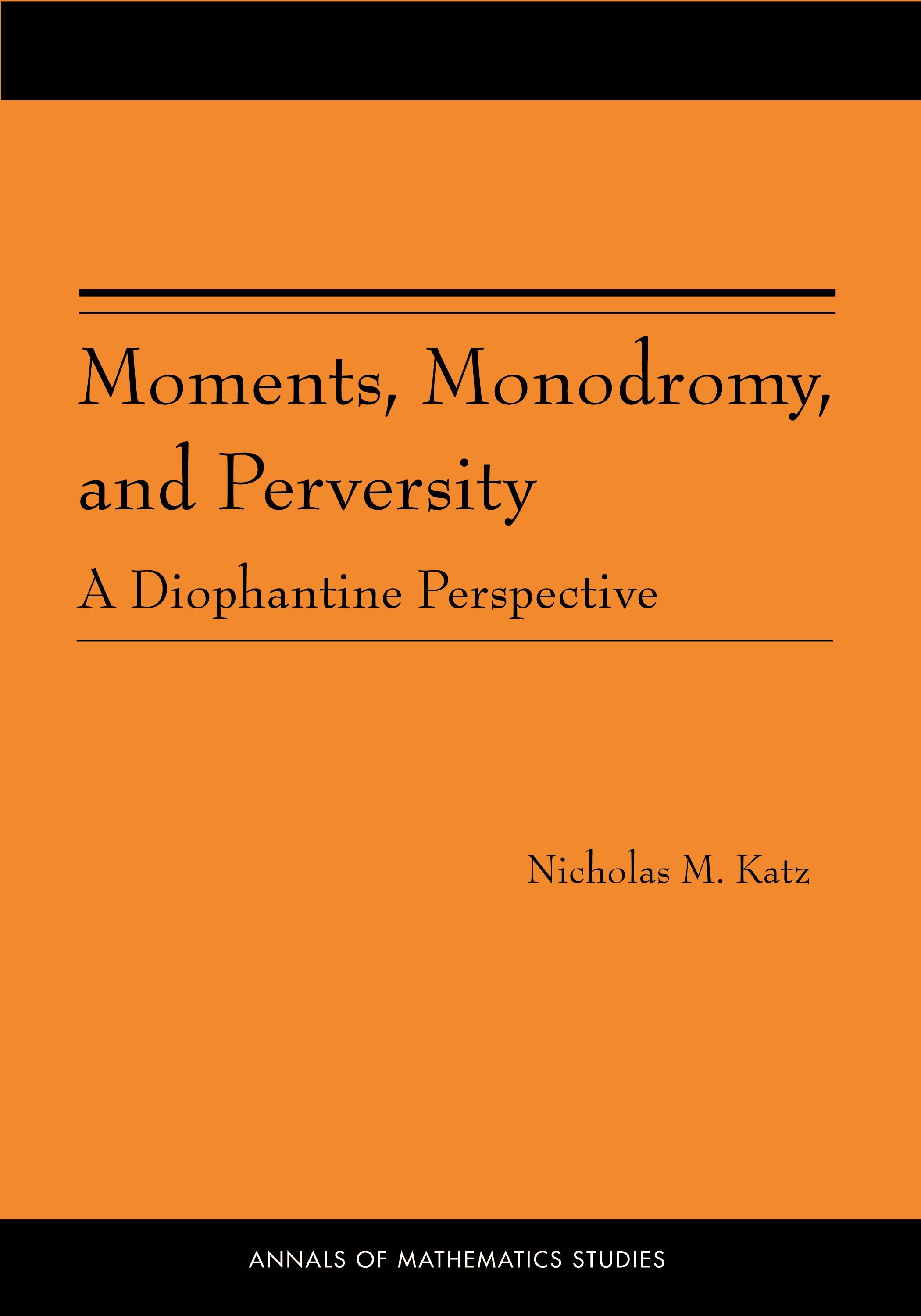
It is now some thirty years since Deligne first proved his general equidistribution theorem, thus establishing the fundamental result governing the statistical properties of suitably "pure" algebro-geometric families of character sums over finite fields (and of their associated L-functions). Roughly speaking, Deligne showed that any such family obeys a "generalized Sato-Tate law," and that figuring out which generalized Sato-Tate law applies to a given family amounts essentially to computing a certain complex semisimple (not necessarily connected) algebraic group, the "geometric monodromy group" attached to that family.
Up to now, nearly all techniques for determining geometric monodromy groups have relied, at least in part, on local information. In Moments, Monodromy, and Perversity, Nicholas Katz develops new techniques, which are resolutely global in nature. They are based on two vital ingredients, neither of which existed at the time of Deligne's original work on the subject. The first is the theory of perverse sheaves, pioneered by Goresky and MacPherson in the topological setting and then brilliantly transposed to algebraic geometry by Beilinson, Bernstein, Deligne, and Gabber. The second is Larsen's Alternative, which very nearly characterizes classical groups by their fourth moments. These new techniques, which are of great interest in their own right, are first developed and then used to calculate the geometric monodromy groups attached to some quite specific universal families of (L-functions attached to) character sums over finite fields.
Płać wygodnie kartą, Klarną, Apple Pay lub Google Pay. Nie jesteś zadowolony? Zawsze masz 14-dniową gwarancję zwrotu pieniędzy. Więcej przeczytasz w naszych warunkach. Masz pytania? Napisz do nas na hello@memmo.org.
Memmo ułatwia naukę – gdziekolwiek jesteś na świecie. U nas znajdziesz podręczniki i sprytne narzędzia do nauki w jednym miejscu: streszczenia, quizy, podcasty i fiszki. A do tego Ted, Twój kumpel do nauki, który odpowie na wszystko, co Cię nurtuje. Ponad 50 000 studentów już tu się uczy – stworzone, byś uczył się szybciej i mniej stresował.