
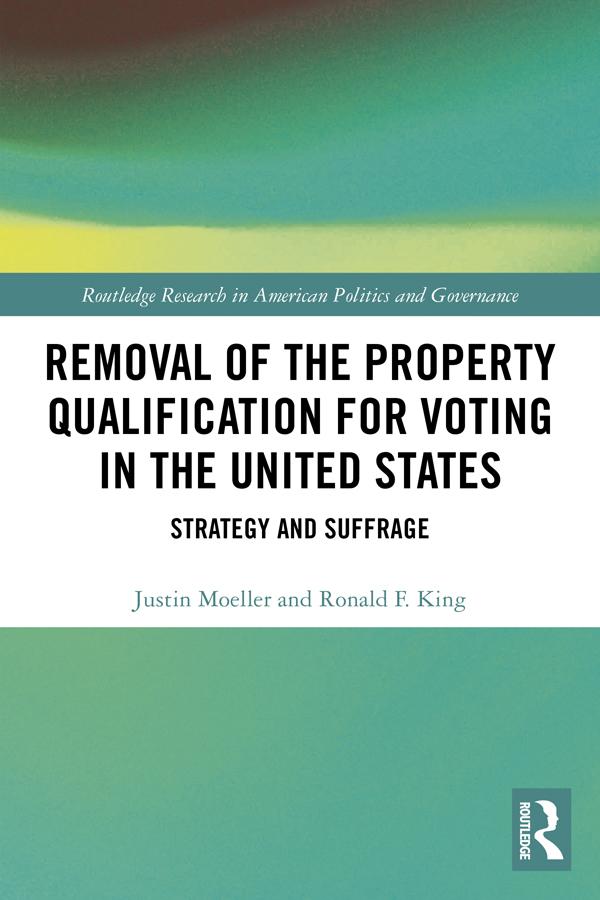
In Colonial America, democracy was centered in provincial assemblies and based on the collection of neighbors whose freehold ownership made them permanent stakeholders in the community. The removal of the property qualification for voting in the United States occurred over three-quarters of a century and was among the more important events in the history of democratization, functioning to shift voting from a corporate privilege toward a human right.
Moving beyond the standard histories of property standard histories of property qualification removal, Justin Moeller and Ronald F. King adopt the theories and methods of social science to discover underlying patterns and regularities, attempting a more systematic understanding of subject. While no historical event has a single cause, party consolidation and party competition provided a necessary mechanism, making background factors politically relevant. No change in franchise rules could occur without the explicit consent of incumbent politicians, always sensitive to the anticipated impact. Moeller and King argue that political parties acted strategically, accepting or rejecting removal of the property qualification as a means of advancing their electoral position. The authors identify four different variants of the strategic calculation variable, significantly helping to explain both the temporal differences across states and the pattern of contestation with each state individually.
Płać wygodnie kartą, Klarną, Apple Pay lub Google Pay. Nie jesteś zadowolony? Zawsze masz 14-dniową gwarancję zwrotu pieniędzy. Więcej przeczytasz w naszych warunkach. Masz pytania? Napisz do nas na hello@memmo.org.
Memmo ułatwia naukę – gdziekolwiek jesteś na świecie. U nas znajdziesz podręczniki i sprytne narzędzia do nauki w jednym miejscu: streszczenia, quizy, podcasty i fiszki. A do tego Ted, Twój kumpel do nauki, który odpowie na wszystko, co Cię nurtuje. Ponad 50 000 studentów już tu się uczy – stworzone, byś uczył się szybciej i mniej stresował.