
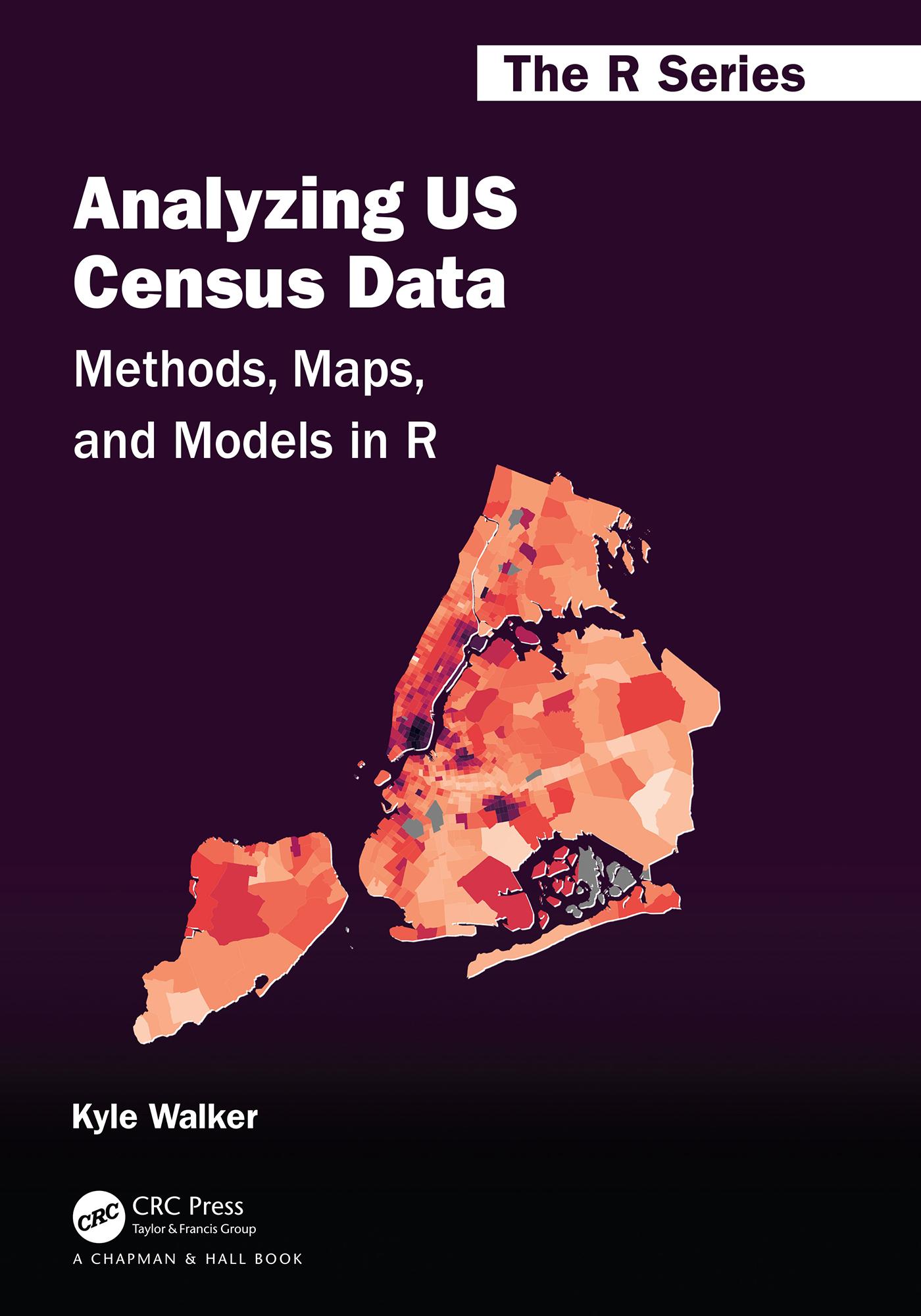
Census data is widely used by practitioners to understand demographic change, allocate resources, address inequalities, and make sound business decisions. Until recently, projects using US Census data have required proficiency with multiple web interfaces and software platforms to prepare, map, and present data products. This book introduces readers to tools in the R programming language for accessing and analyzing Census data and shows how to carry out demographic analyses in a single computing environment.
Chapters in this book cover the following key topics:
• Rapidly acquiring data from the decennial US Census and American Community Survey using R, then analyzing these datasets using tidyverse tools;
• Visualizing US Census data with a wide range of methods including charts in ggplot2 as well as both static and interactive maps;
• Using R as a geographic information system (GIS) to manage, analyze, and model spatial demographic data from the US Census;
• Working with and modeling individual-level microdata from the American Community Survey’s PUMS datasets;
• Applying these tools and workflows to the analysis of historical Census data, other US government datasets, and international Census data from countries like Canada, Brazil, Kenya, and Mexico.
Płać wygodnie kartą, Klarną, Apple Pay lub Google Pay. Nie jesteś zadowolony? Zawsze masz 14-dniową gwarancję zwrotu pieniędzy. Więcej przeczytasz w naszych warunkach. Masz pytania? Napisz do nas na hello@memmo.org.
Memmo ułatwia naukę – gdziekolwiek jesteś na świecie. U nas znajdziesz podręczniki i sprytne narzędzia do nauki w jednym miejscu: streszczenia, quizy, podcasty i fiszki. A do tego Ted, Twój kumpel do nauki, który odpowie na wszystko, co Cię nurtuje. Ponad 50 000 studentów już tu się uczy – stworzone, byś uczył się szybciej i mniej stresował.