
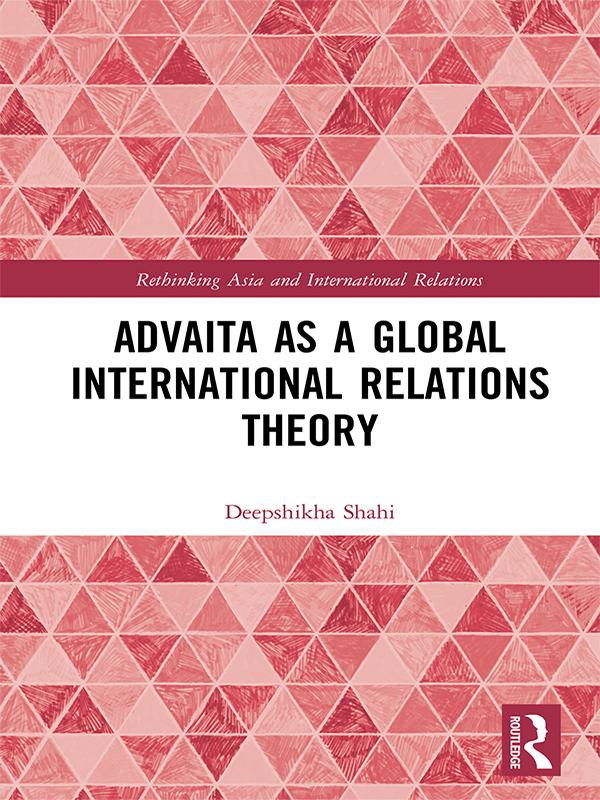
The academic discipline of International Relations strives to attain a ‘global’ spirit to narrow the cognitive gaps between the West and the Rest. On the one hand, there is the hegemonic presence of mainstream universalist Eurocentric IR theories, and on the other the counter-hegemonic presence of particularist Post-colonial and De-colonial non-Eurocentric IR theories. Nevertheless, both theoretical traditions endorse ‘epistemological dualism’ that essentially separates the ‘theorizing-subject’ from the ‘theorized-object’; thereby failing to bridge the gaps.
This book uses the monist schema of ‘subject-object merger’ in the ancient Indian philosophy of Advaita to inaugurate a Global IR theory. In the global theoretical schema of Advaitic monism, the apparent particularist reality is supplemented (not contradicted) with the hidden universalist reality – the net result of which is a reconciliation of dualism with monism at the theoretical-practical level. The possibilities of this reconciliation have not been estimated at either level and as such, this untapped intellectual strategy stands to enrich both Eurocentric IR and non-Eurocentric IR. Shahi establishes Advaita as an alternative epistemological-methodological tool to re-imagine the complex realities of contemporary international politics.
This fully fledged Global International Relations Theory will appeal to students of international relations, political theory, administrative theory and philosophy.
Płać wygodnie kartą, Klarną, Apple Pay lub Google Pay. Nie jesteś zadowolony? Zawsze masz 14-dniową gwarancję zwrotu pieniędzy. Więcej przeczytasz w naszych warunkach. Masz pytania? Napisz do nas na hello@memmo.org.
Memmo ułatwia naukę – gdziekolwiek jesteś na świecie. U nas znajdziesz podręczniki i sprytne narzędzia do nauki w jednym miejscu: streszczenia, quizy, podcasty i fiszki. A do tego Ted, Twój kumpel do nauki, który odpowie na wszystko, co Cię nurtuje. Ponad 50 000 studentów już tu się uczy – stworzone, byś uczył się szybciej i mniej stresował.