
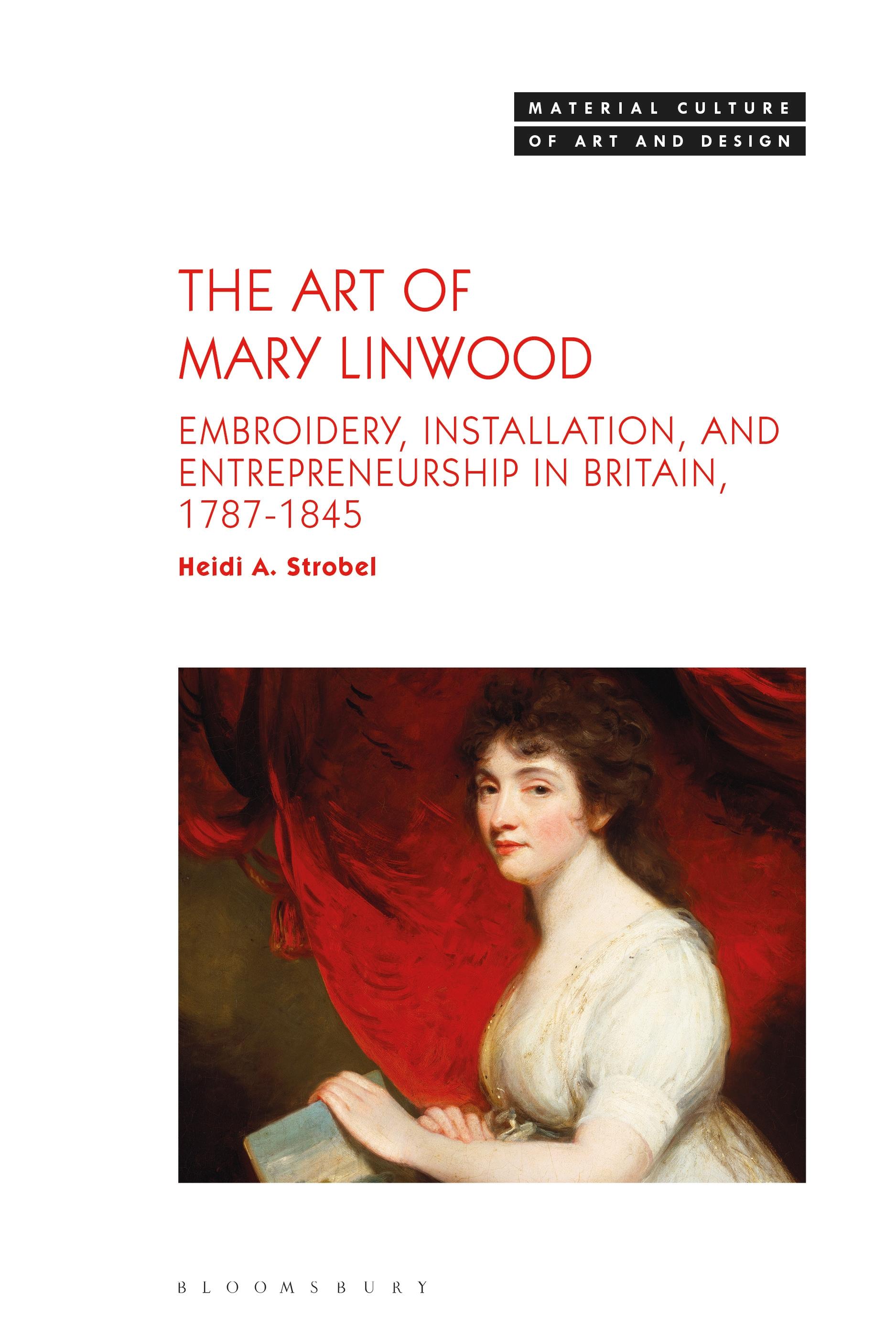
The Art of Mary Linwood is the first book on Leicester textile artist Mary Linwood (1755-1845) and catalogue of her work.
When British textile artist and gallery owner Mary Linwood died in 1845 just shy of 90 years old, her estate was worth the equivalent of £5,199,822 in today's currency. As someone who made, but did not sell, embroidered replicas of famous artworks after artists such as Gainsborough, Reynolds, Stubbs, and Morland, how did she accumulate so much money? A pioneering woman in the male-dominated art world of late Georgian Britain, Linwood established her own London gallery in 1798 that featured copies of well-known paintings by these popular artists.
Featuring props and specially designed rooms for her replicas, she ensured that her visitors had an entertaining, educational, and kinetic tour, similar to what Madame Tussaud would do one generation later. The gallery's focus on picturesque painters provided her London visitors with an idyllic imaginary journey through the countryside. Its emphasis on quintessentially British artists provided a unifying focus for a country that had recently emerged from the threat of Napoleonic invasion.
This book brings to the fore Linwood's gallery guides and previously unpublished letters to her contemporaries, such as Birmingham inventor Matthew Boulton and Queen Charlotte. It also includes the first and only catalogue of Linwood's extant and destroyed works. By examining Linwood's replicas and their accompanying objects through the lens of material culture, the book provides a much-needed contribution to the scholarship on women and cultural agency in the early 19th century.
When British textile artist and gallery owner Mary Linwood died in 1845 just shy of 90 years old, her estate was worth the equivalent of £5,199,822 in today's currency. As someone who made, but did not sell, embroidered replicas of famous artworks after artists such as Gainsborough, Reynolds, Stubbs, and Morland, how did she accumulate so much money? A pioneering woman in the male-dominated art world of late Georgian Britain, Linwood established her own London gallery in 1798 that featured copies of well-known paintings by these popular artists.
Featuring props and specially designed rooms for her replicas, she ensured that her visitors had an entertaining, educational, and kinetic tour, similar to what Madame Tussaud would do one generation later. The gallery's focus on picturesque painters provided her London visitors with an idyllic imaginary journey through the countryside. Its emphasis on quintessentially British artists provided a unifying focus for a country that had recently emerged from the threat of Napoleonic invasion.
This book brings to the fore Linwood's gallery guides and previously unpublished letters to her contemporaries, such as Birmingham inventor Matthew Boulton and Queen Charlotte. It also includes the first and only catalogue of Linwood's extant and destroyed works. By examining Linwood's replicas and their accompanying objects through the lens of material culture, the book provides a much-needed contribution to the scholarship on women and cultural agency in the early 19th century.
Płać wygodnie kartą, Klarną, Apple Pay lub Google Pay. Nie jesteś zadowolony? Zawsze masz 14-dniową gwarancję zwrotu pieniędzy. Więcej przeczytasz w naszych warunkach. Masz pytania? Napisz do nas na hello@memmo.org.
Memmo ułatwia naukę – gdziekolwiek jesteś na świecie. U nas znajdziesz podręczniki i sprytne narzędzia do nauki w jednym miejscu: streszczenia, quizy, podcasty i fiszki. A do tego Ted, Twój kumpel do nauki, który odpowie na wszystko, co Cię nurtuje. Ponad 50 000 studentów już tu się uczy – stworzone, byś uczył się szybciej i mniej stresował.