
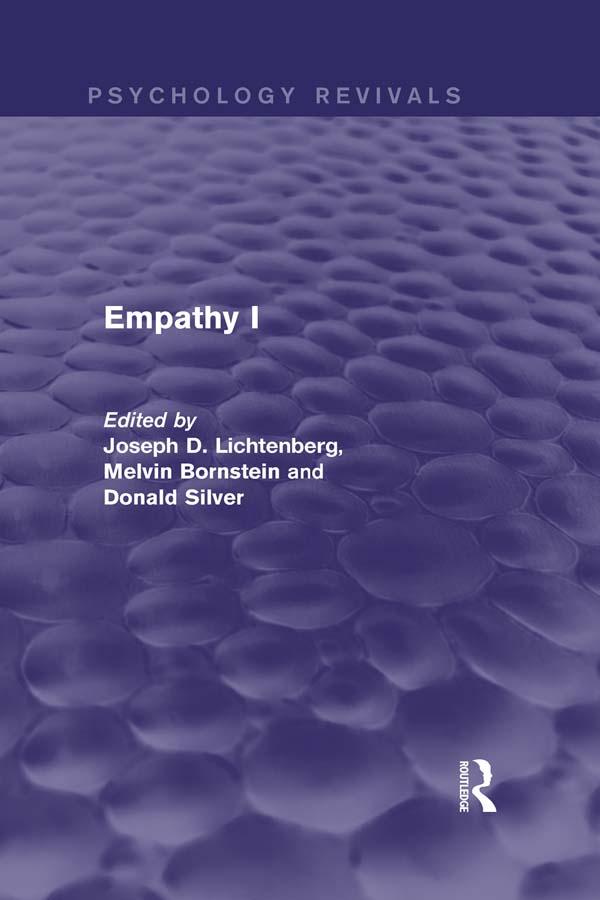
When the late Heinz Kohut defined psychoanalysis as the science of empathy and introspection, he sparked a debate that has animated psychoanalytic discourse ever since. What is the relationship of empathy to psychoanalysis? Is it a constituent of analytical technique, an integral aspect of the therapeutic action of analysis, or simply a metaphor for a mode of observation better understood via ‘classical’ theory and terminology? The dialogue about empathy, which is really a dialogue about the nature of the analytic process, continues in this two-volume set, originally published in 1984.
In Volume I, several illuminating attempts to define empathy are followed by Kohut’s essay, ‘Introspection, Empathy, and the Semicircle of Mental Health.’ Kohut’s paper, in turn, ushers in a series of original contributions on ‘Empathy as a Perspective in Psychoanalysis.’ The volume ends with five papers which strive to demarcate an empathic approach to various areas of artistic endeavour, including the appreciation of visual art.
Volume II continues the dialogue with a series of developmental studies which explore the role of empathy in early child care at the same time as they chart the emergence of the young child’s capacity to empathize. In the concluding section, ‘Empathy in Psychoanalytic Work,’ contributors and discussants return to the arena of technique. They not only theorize about empathy in relation to analytic understanding and communication, but address issues of nosology, considering how the empathic vantage point may be utilized in the treatment of patients with borderline and schizophrenic pathology.
In their critical attention to the many dimensions of empathy – philosophical, developmental, therapeutic, artistic – the contributors collectively bear witness to the fact that Kohut has helped to shape new questions, but not set limits to the search for answers. The product of their efforts is an anatomical exploration of a topic whose relevance for psychoanalysis and psychotherapy is only beginning to be understood.
Płać wygodnie kartą, Klarną, Apple Pay lub Google Pay. Nie jesteś zadowolony? Zawsze masz 14-dniową gwarancję zwrotu pieniędzy. Więcej przeczytasz w naszych warunkach. Masz pytania? Napisz do nas na hello@memmo.org.
Memmo ułatwia naukę – gdziekolwiek jesteś na świecie. U nas znajdziesz podręczniki i sprytne narzędzia do nauki w jednym miejscu: streszczenia, quizy, podcasty i fiszki. A do tego Ted, Twój kumpel do nauki, który odpowie na wszystko, co Cię nurtuje. Ponad 50 000 studentów już tu się uczy – stworzone, byś uczył się szybciej i mniej stresował.