
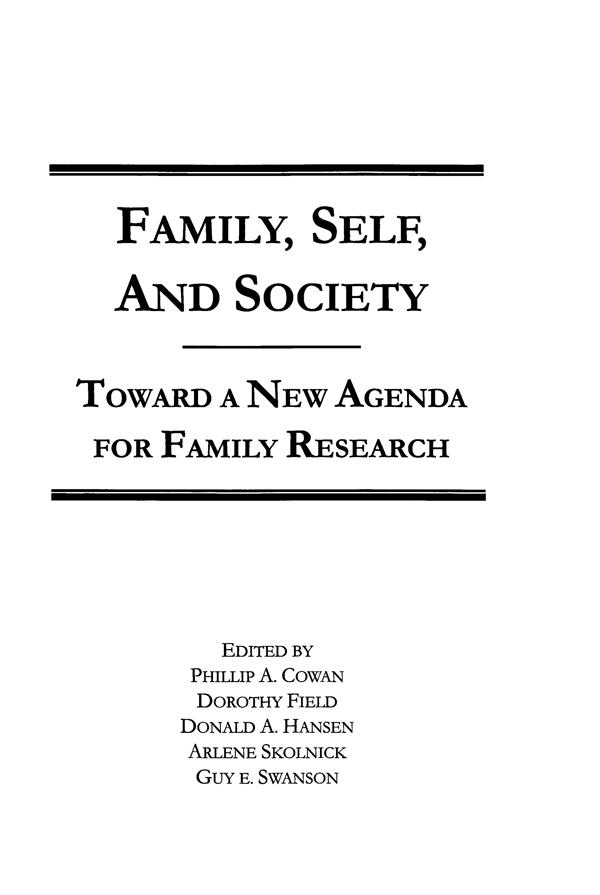
Any agenda for family research in the 1990s must take seriously a contextual approach to the study of family relationships. The editors and contributors to this volume believe that the richness in family studies over the next decade will come from considering the diversity of family forms -- different ethnic groups and cultures, different stages of family life, as well as different historical cohorts. Their goal is to make more explicit how we think about families in order to study them and understand them. To illustrate the need for diversity in family studies, examples are presented from new and old families, majority and minority families, American and Japanese families, and intact and divorcing families. This variety is intended to push the limits of current thinking, not only for researchers but also for all who are struggling to live with and work with families in a time when family life is valued but fragmented and relatively unsupported by society's institutions. Students and researchers interested in family development from the viewpoint of any of the social sciences will find this book of value.
Płać wygodnie kartą, Klarną, Apple Pay lub Google Pay. Nie jesteś zadowolony? Zawsze masz 14-dniową gwarancję zwrotu pieniędzy. Więcej przeczytasz w naszych warunkach. Masz pytania? Napisz do nas na hello@memmo.org.
Memmo ułatwia naukę – gdziekolwiek jesteś na świecie. U nas znajdziesz podręczniki i sprytne narzędzia do nauki w jednym miejscu: streszczenia, quizy, podcasty i fiszki. A do tego Ted, Twój kumpel do nauki, który odpowie na wszystko, co Cię nurtuje. Ponad 50 000 studentów już tu się uczy – stworzone, byś uczył się szybciej i mniej stresował.