
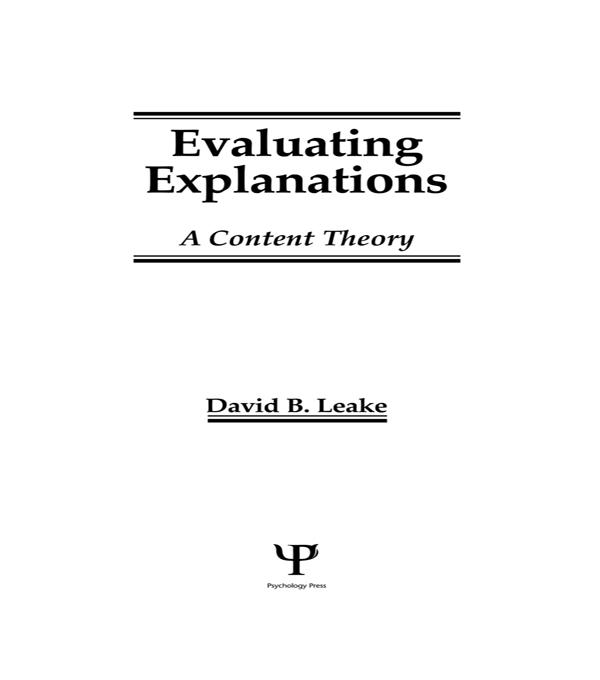
Psychology and philosophy have long studied the nature and role of explanation. More recently, artificial intelligence research has developed promising theories of how explanation facilitates learning and generalization. By using explanations to guide learning, explanation-based methods allow reliable learning of new concepts in complex situations, often from observing a single example.
The author of this volume, however, argues that explanation-based learning research has neglected key issues in explanation construction and evaluation. By examining the issues in the context of a story understanding system that explains novel events in news stories, the author shows that the standard assumptions do not apply to complex real-world domains. An alternative theory is presented, one that demonstrates that context -- involving both explainer beliefs and goals -- is crucial in deciding an explanation's goodness and that a theory of the possible contexts can be used to determine which explanations are appropriate. This important view is demonstrated with examples of the performance of ACCEPTER, a computer system for story understanding, anomaly detection, and explanation evaluation.
Płać wygodnie kartą, Klarną, Apple Pay lub Google Pay. Nie jesteś zadowolony? Zawsze masz 14-dniową gwarancję zwrotu pieniędzy. Więcej przeczytasz w naszych warunkach. Masz pytania? Napisz do nas na hello@memmo.org.
Memmo ułatwia naukę – gdziekolwiek jesteś na świecie. U nas znajdziesz podręczniki i sprytne narzędzia do nauki w jednym miejscu: streszczenia, quizy, podcasty i fiszki. A do tego Ted, Twój kumpel do nauki, który odpowie na wszystko, co Cię nurtuje. Ponad 50 000 studentów już tu się uczy – stworzone, byś uczył się szybciej i mniej stresował.