
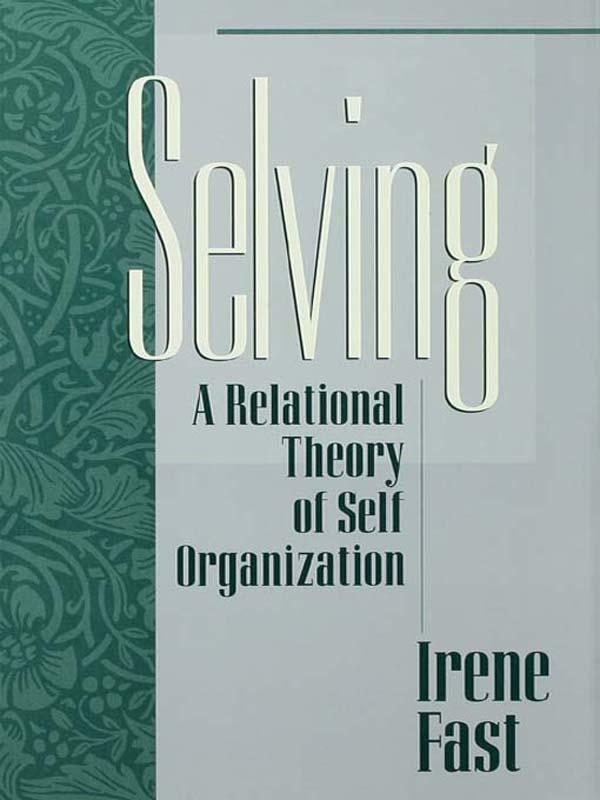
In Selving: A Relational Theory of Self Organization, Irene Fast invokes the basic distinction between the self as "me" and the self as "I" in order to develop a contemporary theory of the self as subject. In a return to Freud's clinical finding that all psychological processes are personally motivated, she elaborates a notion of the "I-self" that is intrinsically dynamic and relational. Within this conception, our perceiving, thinking, feeling, and acting are not what our self does; rather, they are what our self is.
According to Fast, the basic unit of the dynamic I-self --of selving --is a scheme of personally motivated interaction between self and nonself. This notion, which comprehends development (and developmental failure) as a product of integration and differentiation among discrete I-schemes, provides a radically new framework for understanding those dynamic phenomena that Freud included within his structural model of the mind and that contemporary theorists have addressed within object relational perspectives. Via the notion of selving, Fast likewise brings fresh insight to a host of issues that have engaged psychoanalysts and developmental psychologists in recent years. These topics include the place of bodily experience in a relational model of mind, the organization of self as simultaneously individual and relational, the formulation of a constructivist model of psychic structure, among others.
Selving is not only a lucid demonstration of how a relational theory of self can reorder clinical observations in conceptually and therapeutically illuminating ways. It is also a convincing demonstration of how a constructivist model emphasizing the interactive nature of meaning-making provides bridges to Piagetian theory, developmental research, and observational infancy studies.
Płać wygodnie kartą, Klarną, Apple Pay lub Google Pay. Nie jesteś zadowolony? Zawsze masz 14-dniową gwarancję zwrotu pieniędzy. Więcej przeczytasz w naszych warunkach. Masz pytania? Napisz do nas na hello@memmo.org.
Memmo ułatwia naukę – gdziekolwiek jesteś na świecie. U nas znajdziesz podręczniki i sprytne narzędzia do nauki w jednym miejscu: streszczenia, quizy, podcasty i fiszki. A do tego Ted, Twój kumpel do nauki, który odpowie na wszystko, co Cię nurtuje. Ponad 50 000 studentów już tu się uczy – stworzone, byś uczył się szybciej i mniej stresował.