
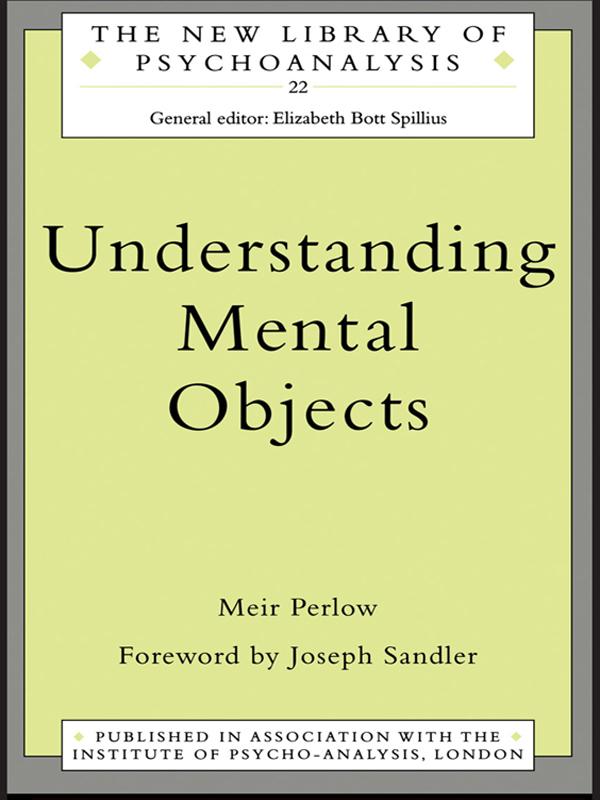
The ways in which an individual (the subject) relates to and perceives other people (his or her 'objects') has always been a preoccupation of psychoanalysis and in recent years a plethora of concepts has grown up in the literature. In this ground-breaking study, Meir Perlow sets out to clarify the changing meanings of the different concepts from context to context, discussing in depth the theoretical issues underlying them.
The book begins with an historical survey of how mental objects have been understood in the various 'schools' of psychoanalysis as they have developed. These include Freud and his associates, the object-relations approaches of Klein, Fairbairn and Bion, orientations derived from ego psychology such as those of Schafer and Kernberg, and the self orientation of Winnicott and Kohut. In Part Two the author discusses the conceptual and clinical issues involved in the major differences between the concepts. Finally, in Part Three he delineates three basic meanings of the concepts of mental objects as they have emerged in the literature and shows how they are related to ongoing issues in contemporary psychoanalysis.
This long overdue clarification of a complex area, with its wide ranging and imaginative grasp of the different theories about objects, will be an invaluable reference for all psychoanalysts and psychologists.
Płać wygodnie kartą, Klarną, Apple Pay lub Google Pay. Nie jesteś zadowolony? Zawsze masz 14-dniową gwarancję zwrotu pieniędzy. Więcej przeczytasz w naszych warunkach. Masz pytania? Napisz do nas na hello@memmo.org.
Memmo ułatwia naukę – gdziekolwiek jesteś na świecie. U nas znajdziesz podręczniki i sprytne narzędzia do nauki w jednym miejscu: streszczenia, quizy, podcasty i fiszki. A do tego Ted, Twój kumpel do nauki, który odpowie na wszystko, co Cię nurtuje. Ponad 50 000 studentów już tu się uczy – stworzone, byś uczył się szybciej i mniej stresował.