
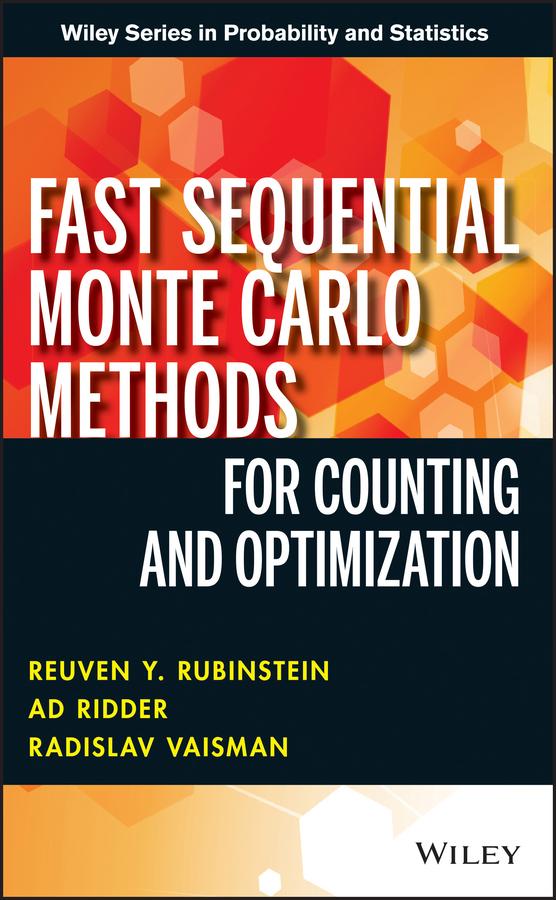
A comprehensive account of the theory and application of Monte Carlo methods
Based on years of research in efficient Monte Carlo methods for estimation of rare-event probabilities, counting problems, and combinatorial optimization, Fast Sequential Monte Carlo Methods for Counting and Optimization is a complete illustration of fast sequential Monte Carlo techniques. The book provides an accessible overview of current work in the field of Monte Carlo methods, specifically sequential Monte Carlo techniques, for solving abstract counting and optimization problems.
Written by authorities in the field, the book places emphasis on cross-entropy, minimum cross-entropy, splitting, and stochastic enumeration. Focusing on the concepts and application of Monte Carlo techniques, Fast Sequential Monte Carlo Methods for Counting and Optimization includes:
- Detailed algorithms needed to practice solving real-world problems
- Numerous examples with Monte Carlo method produced solutions within the 1-2% limit of relative error
- A new generic sequential importance sampling algorithm alongside extensive numerical results
- An appendix focused on review material to provide additional background information
Fast Sequential Monte Carlo Methods for Counting and Optimization is an excellent resource for engineers, computer scientists, mathematicians, statisticians, and readers interested in efficient simulation techniques. The book is also useful for upper-undergraduate and graduate-level courses on Monte Carlo methods.
Płać wygodnie kartą, Klarną, Apple Pay lub Google Pay. Nie jesteś zadowolony? Zawsze masz 14-dniową gwarancję zwrotu pieniędzy. Więcej przeczytasz w naszych warunkach. Masz pytania? Napisz do nas na hello@memmo.org.
Memmo ułatwia naukę – gdziekolwiek jesteś na świecie. U nas znajdziesz podręczniki i sprytne narzędzia do nauki w jednym miejscu: streszczenia, quizy, podcasty i fiszki. A do tego Ted, Twój kumpel do nauki, który odpowie na wszystko, co Cię nurtuje. Ponad 50 000 studentów już tu się uczy – stworzone, byś uczył się szybciej i mniej stresował.