
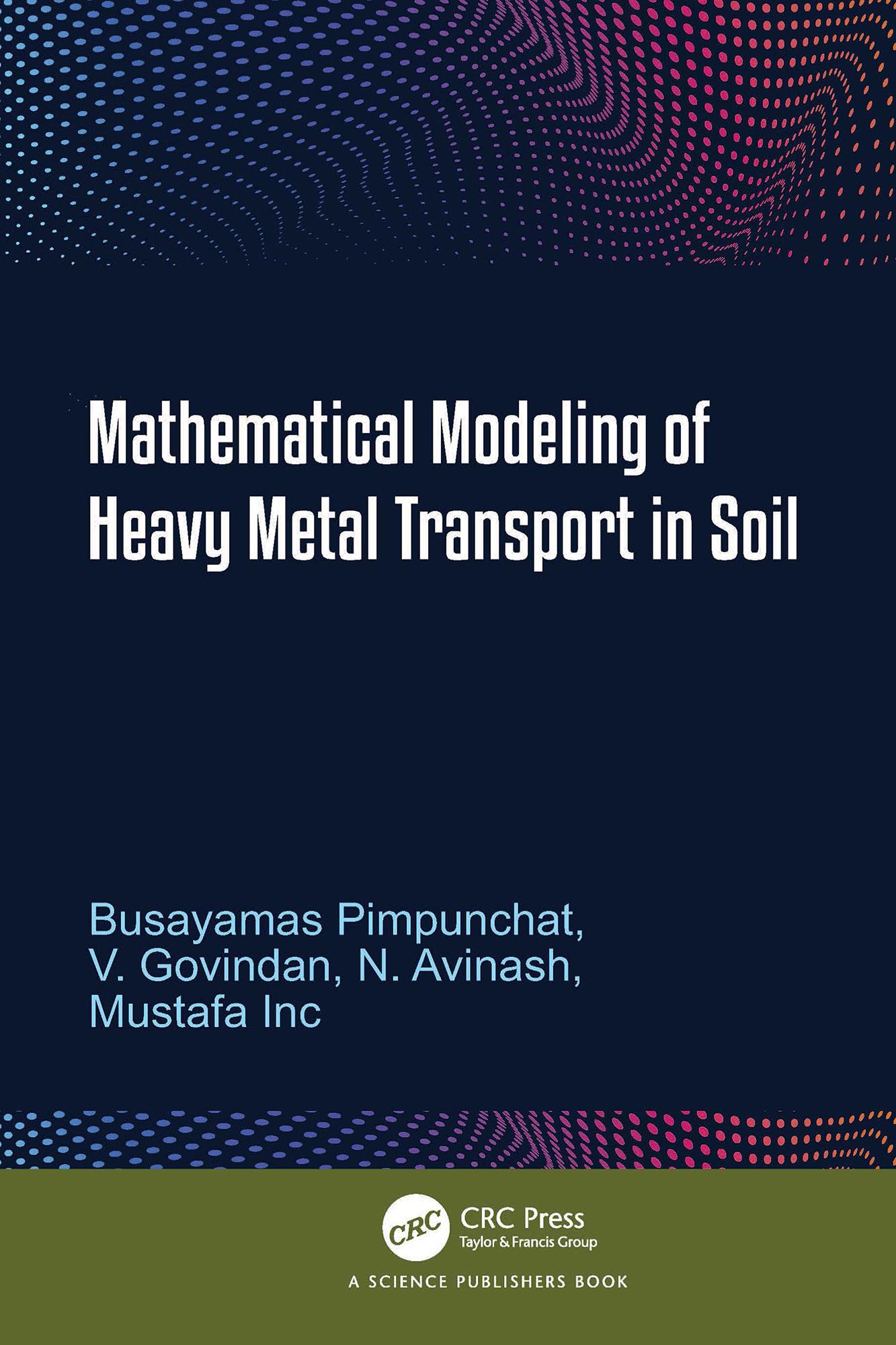
This monograph provides a comprehensive mathematical framework for modeling heavy metal transport in soil. Drawing on advection-diffusion equations, exponential decay models, and advanced numerical techniques, the book bridges theoretical mathematics with practical applications in environmental science and policy. Through detailed derivations, simulations, and case studies it demonstrates how predictive models can forecast plume migration, optimize remediation, and quantify climate change impacts.
Key innovations include stochastic uncertainty analysis, machine learning integration for parameter estimation, and scalable frameworks for site-to-regional assessments. The text explores real-world implications, from cost reductions in cleanup (up to 31% savings) to environmental justice considerations, equipping readers with tools to mitigate risks to human health and ecosystems.
Intended for environmental scientists, mathematicians, engineers, and policymakers, this work synthesizes decades of research while proposing forward-looking scenarios, such as microplastic-metal interactions and real-time sensor assimilation. With rigorous analytical solutions, computational efficiency (O (n log n) complexity), and interdisciplinary connections to hydrogeology and soil chemistry, it offers a robust toolkit for sustainable soil management. Ultimately, the book transforms abstract equations into actionable strategies for a cleaner planet, emphasizing mathematics as a language of environmental hope and stewardship.
Płać wygodnie kartą, Klarną, Apple Pay lub Google Pay. Nie jesteś zadowolony? Zawsze masz 14-dniową gwarancję zwrotu pieniędzy. Więcej przeczytasz w naszych warunkach. Masz pytania? Napisz do nas na hello@memmo.org.
Memmo ułatwia naukę – gdziekolwiek jesteś na świecie. U nas znajdziesz podręczniki i sprytne narzędzia do nauki w jednym miejscu: streszczenia, quizy, podcasty i fiszki. A do tego Ted, Twój kumpel do nauki, który odpowie na wszystko, co Cię nurtuje. Ponad 50 000 studentów już tu się uczy – stworzone, byś uczył się szybciej i mniej stresował.