
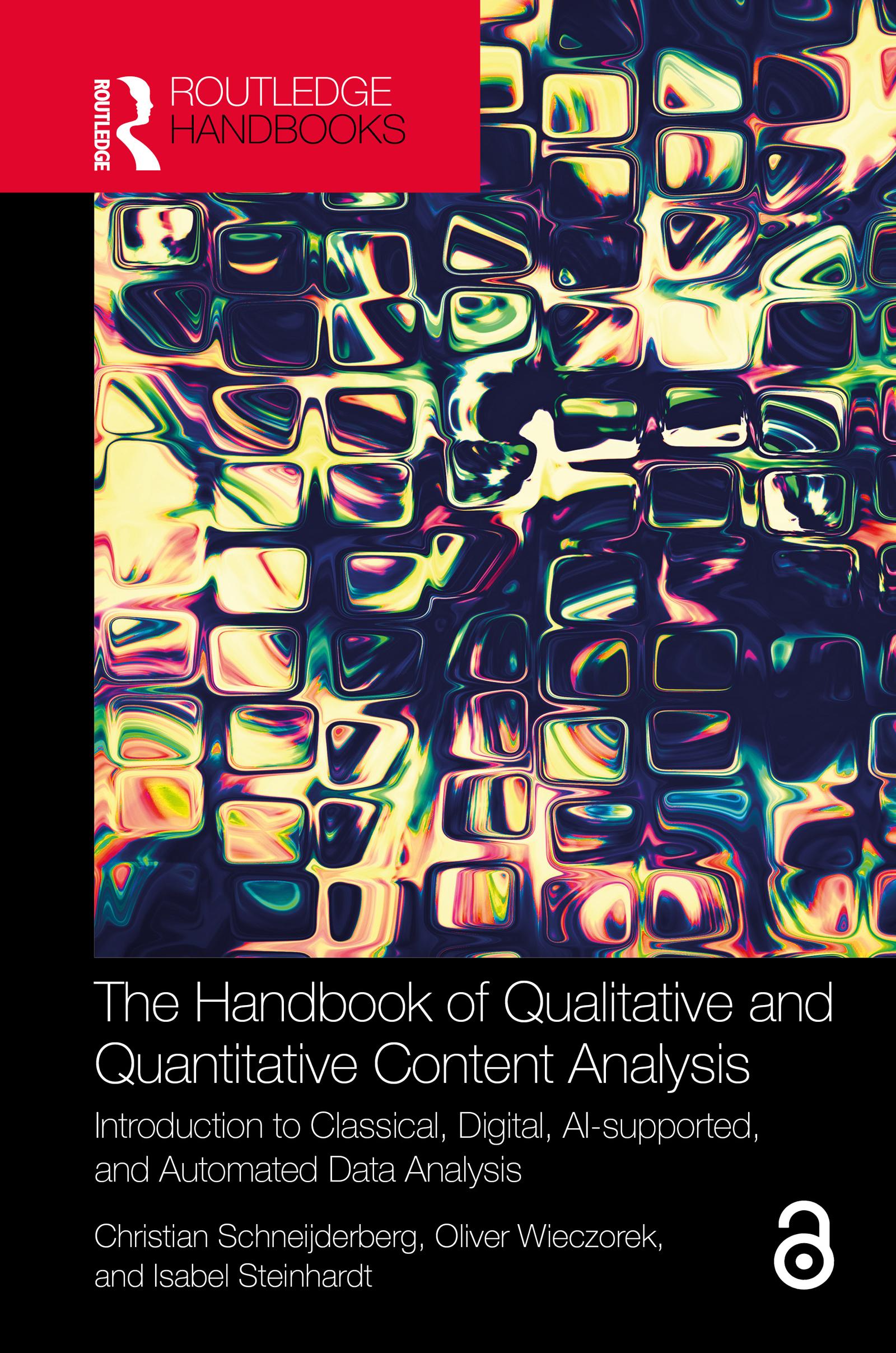
Translated from German, The Handbook of Qualitative and Quantitative Content Analysis is a comprehensive handbook which offers an application-orientated introduction to qualitative and quantitative content analysis methods.
The book provides explanations for beginners from bachelor level onwards on how to select an appropriate qualitative or quantitative content analysis method and how to use the chosen method(s) depending on research interest and amount of data. Part 1 defines the basics of qualitative and quantitative content analysis and empirical research, including research quality conventions and how to do interpretation; Part 2 is a practical guide to classical qualitative content analysis and semi-automated quantitative content analysis; and Part 3 introduces Python alongside automated techniques such as correspondence analysis, semantic network analysis, sentiment analysis, and topic modelling using generative and deep learning algorithms. Each of these sections are enriched with extensive examples and cover a range of software applications, including AntConc, MAXQDA, Python, and VosViewer.
This is the ideal resource for anyone interested in content analysis research methods across the social sciences, humanities, and data sciences.
The Open Access version of this book, available at http://www.taylorfrancis.com, has been made available under a Creative Commons [Attribution-Non Commercial-No Derivatives (CC BY-NC-ND)] 4.0 license.
Płać wygodnie kartą, Klarną, Apple Pay lub Google Pay. Nie jesteś zadowolony? Zawsze masz 14-dniową gwarancję zwrotu pieniędzy. Więcej przeczytasz w naszych warunkach. Masz pytania? Napisz do nas na hello@memmo.org.
Memmo ułatwia naukę – gdziekolwiek jesteś na świecie. U nas znajdziesz podręczniki i sprytne narzędzia do nauki w jednym miejscu: streszczenia, quizy, podcasty i fiszki. A do tego Ted, Twój kumpel do nauki, który odpowie na wszystko, co Cię nurtuje. Ponad 50 000 studentów już tu się uczy – stworzone, byś uczył się szybciej i mniej stresował.