
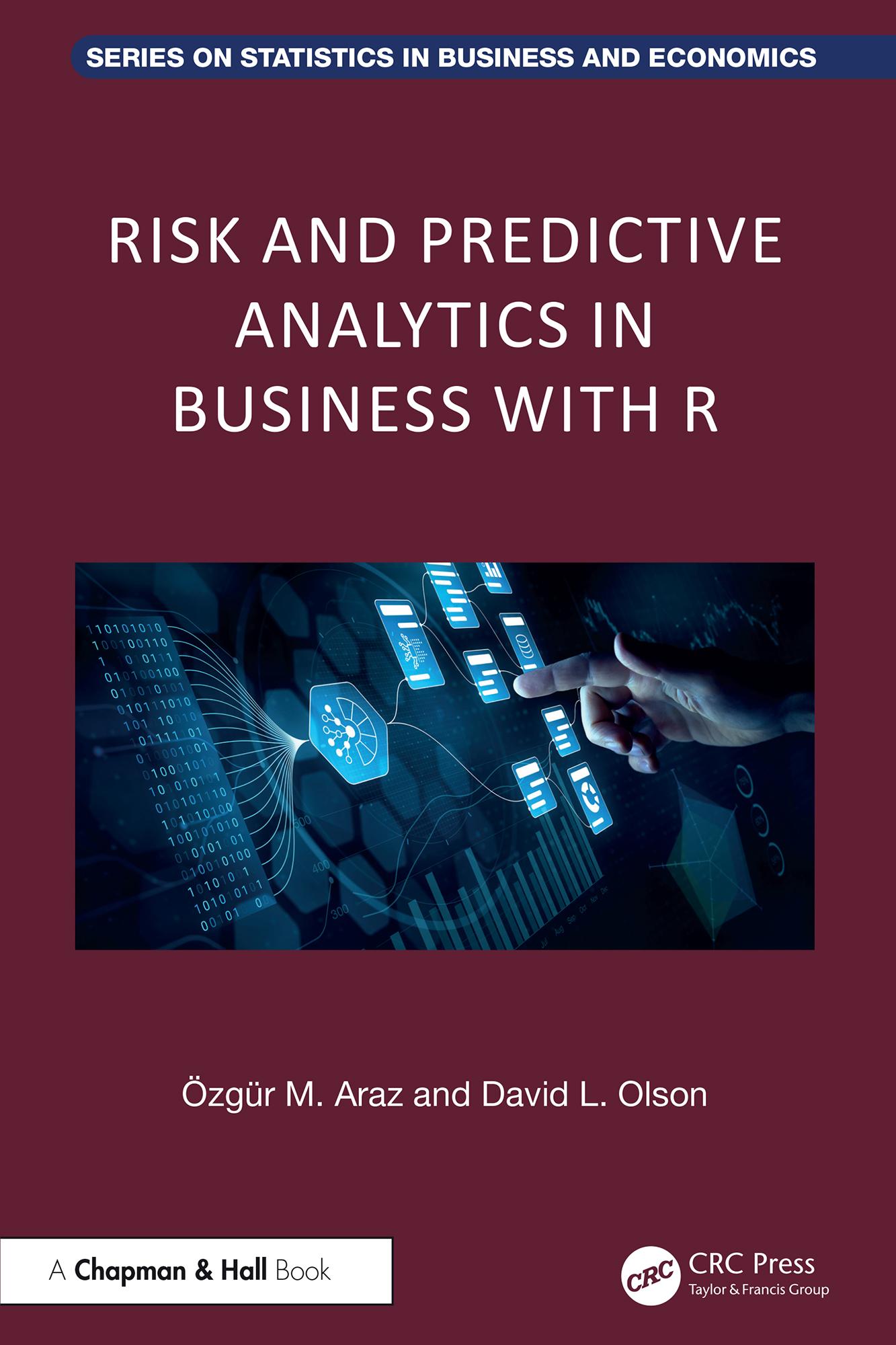
Supply chain operations face many risks, including political, environmental, and economic. The past five years have seen major challenges, from pandemic, impacts of global warming, wars, and tariff impositions. In this rapidly changing world, risks appear in every aspect of operations. This book presents data mining and analytics tools with R programming as well as a brief presentation of Monte Carlo simulation that can be used to anticipate and manage these risks. RStudio software and R programming language are widely used in data mining. For Monte Carlo simulation applications we cover Crystal Ball software, one of a number of commercially available Monte Carlo simulation tools.
Chapter 1 of this book deals with classification of risks. It includes a typical supply chain example published in academic literature. Chapter 2 gives a brief introduction to R programming. It is not intended to be comprehensive, but sufficient for a user to get started using this free open source and highly popular analytics tool. Chapter 3 discusses risks commonly found in finance, to include basic data mining tools applied to analysis of credit card fraud data. Like the other datasets used in the book, this data comes from the Kaggle.com site, a free site loaded with realistic datasets.
The remainder of the book covers risk analytics tools. Chapter 4 presents R association rule modeling using a supply chain related dataset. Chapter 5 presents Monte Carlo simulation of some supply chain risk situations. Chapter 6 gives both time series and multiple regression prediction models as well as autoregressive integrated moving average (ARIMA; Box-Jenkins) models in SAS and R. Chapter 7 covers classification models demonstrated with credit risk data. Chapter 8 deals with fraud detection and the common problem of modeling imbalanced datasets. Chapter 9 introduces Naïve Bayes modeling with categorical data using an employee attrition dataset.
Features:
- Overview of predictive analytics presented in an understandable manner
- Presentation of useful business applications of predictive data mining
- Coverage of risk management in finance, insurance, and supply chain contexts
- Presentation of predictive models
- Demonstration of using these predictive models in R
- Screenshots enabling readers to develop their own models
The purpose of the book is to present tools useful to analyze risks, especially those faced in supply chain management and finance.
Płać wygodnie kartą, Klarną, Apple Pay lub Google Pay. Nie jesteś zadowolony? Zawsze masz 14-dniową gwarancję zwrotu pieniędzy. Więcej przeczytasz w naszych warunkach. Masz pytania? Napisz do nas na hello@memmo.org.
Memmo ułatwia naukę – gdziekolwiek jesteś na świecie. U nas znajdziesz podręczniki i sprytne narzędzia do nauki w jednym miejscu: streszczenia, quizy, podcasty i fiszki. A do tego Ted, Twój kumpel do nauki, który odpowie na wszystko, co Cię nurtuje. Ponad 50 000 studentów już tu się uczy – stworzone, byś uczył się szybciej i mniej stresował.