
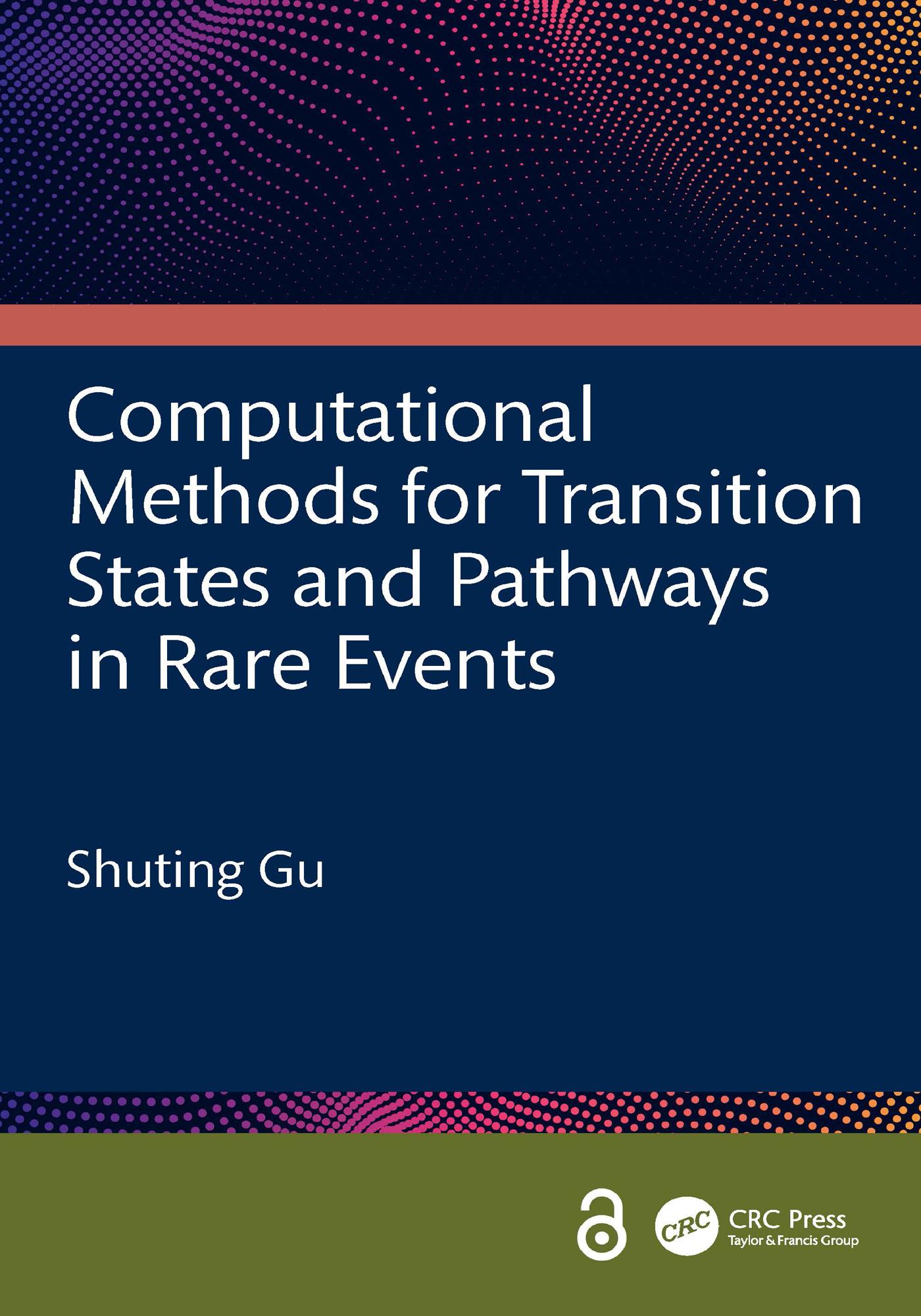
Based on the calculation of transition states and the identification of transition paths, this book aims to provide a comprehensive guide to understanding and simulating rare events.
The author introduces both fundamental concepts of transition states and pathways and advanced computational techniques, focusing on Gentlest Ascent Dynamics (GAD) and its variants. In particular, she explores enhanced numerical methods such as the convex splitting method and the Scalar Auxiliary Variable (SAV) approach within the Iterative Minimization Formulation (IMF). In addition, the book applies these methods to real-world problems, highlighting the string method and the geometric Minimum Action Method (gMAM) for computing transition paths.
The book is written for researchers and practitioners in fields such as applied mathematics, physics, chemistry, and computational science who are interested in the underlying mechanisms of rare events and their transition processes.
Chapters 3 and 4 of this book are each freely available as a downloadable Open Access PDF at http://www.taylorfrancis.com under a Creative Commons Attribution-Non Commercial-No Derivatives (CC-BY-NC-ND) 4.0 license.
Płać wygodnie kartą, Klarną, Apple Pay lub Google Pay. Nie jesteś zadowolony? Zawsze masz 14-dniową gwarancję zwrotu pieniędzy. Więcej przeczytasz w naszych warunkach. Masz pytania? Napisz do nas na hello@memmo.org.
Memmo ułatwia naukę – gdziekolwiek jesteś na świecie. U nas znajdziesz podręczniki i sprytne narzędzia do nauki w jednym miejscu: streszczenia, quizy, podcasty i fiszki. A do tego Ted, Twój kumpel do nauki, który odpowie na wszystko, co Cię nurtuje. Ponad 50 000 studentów już tu się uczy – stworzone, byś uczył się szybciej i mniej stresował.