
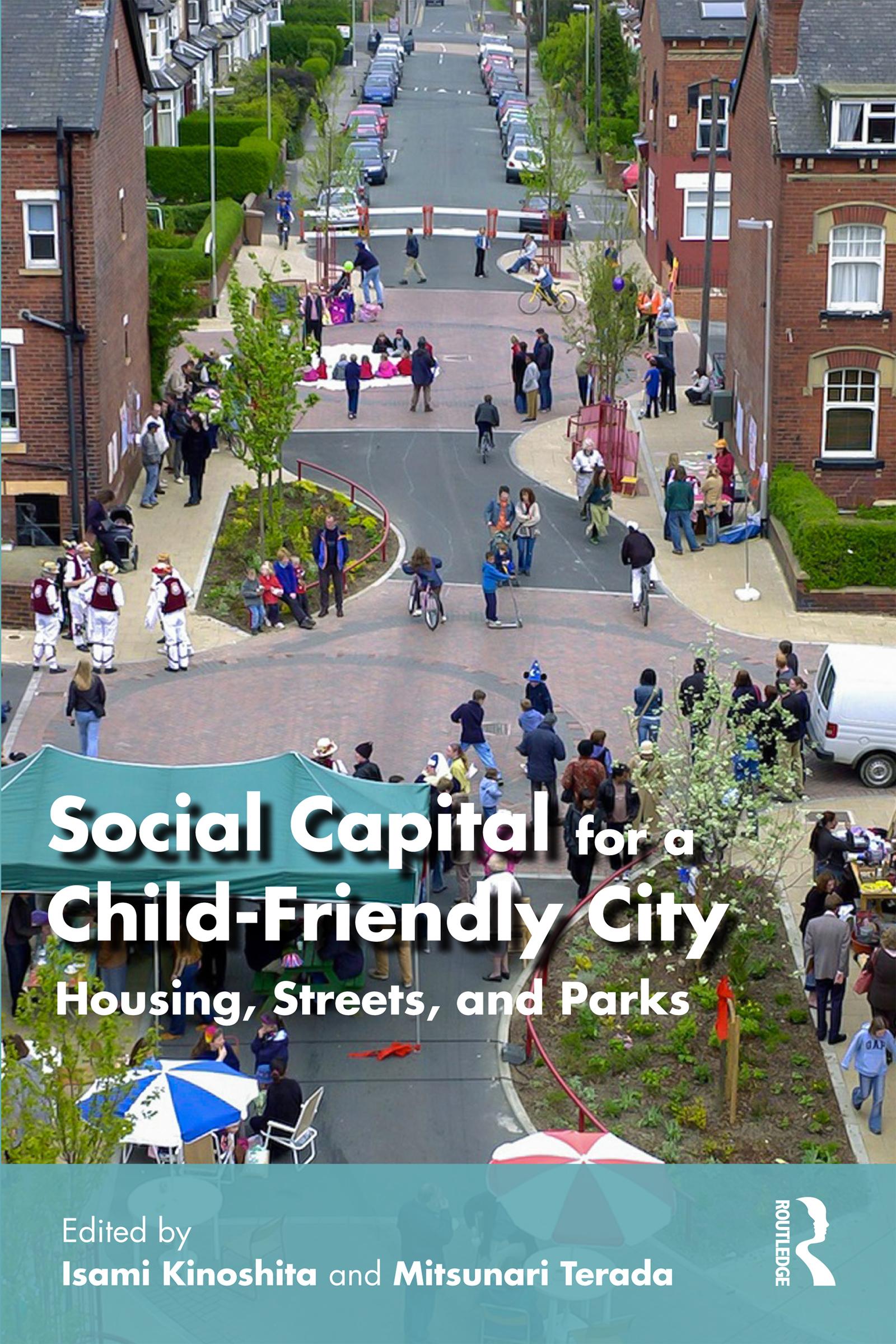
Social Capital for a Child-Friendly City argues for the importance of relationship networks (social capital) in children’s growth and socialization, and explores how child-friendly social capital can be cultivated through urban planning and community development. As outdoor play decreases and children spend more time online, Kinoshita and Terada return to John Dewey’s proposal that social capital is essential for nurturing the next generation and establish a democratic and sustainable society. The book features examples from Sweden, Finland, Germany, Switzerland, the UK, and Japan, exploring methods for cultivating social capital and spaces for children to play and develop in cooperative housing, outdoor play spaces, streets, parks, and neighbourhoods. We express our gratitude to Dr. Marketta Kytta, Professor of Aalto University, who gave valuable suggestions about the key term ‘bullerby’ and ‘social capital’.
This book will be of use to students and practitioners of urban planning and landscape architecture, as well as any community leaders or developers seeking to foster a nurturing environment where children can flourish.
Płać wygodnie kartą, Klarną, Apple Pay lub Google Pay. Nie jesteś zadowolony? Zawsze masz 14-dniową gwarancję zwrotu pieniędzy. Więcej przeczytasz w naszych warunkach. Masz pytania? Napisz do nas na hello@memmo.org.
Memmo ułatwia naukę – gdziekolwiek jesteś na świecie. U nas znajdziesz podręczniki i sprytne narzędzia do nauki w jednym miejscu: streszczenia, quizy, podcasty i fiszki. A do tego Ted, Twój kumpel do nauki, który odpowie na wszystko, co Cię nurtuje. Ponad 50 000 studentów już tu się uczy – stworzone, byś uczył się szybciej i mniej stresował.