
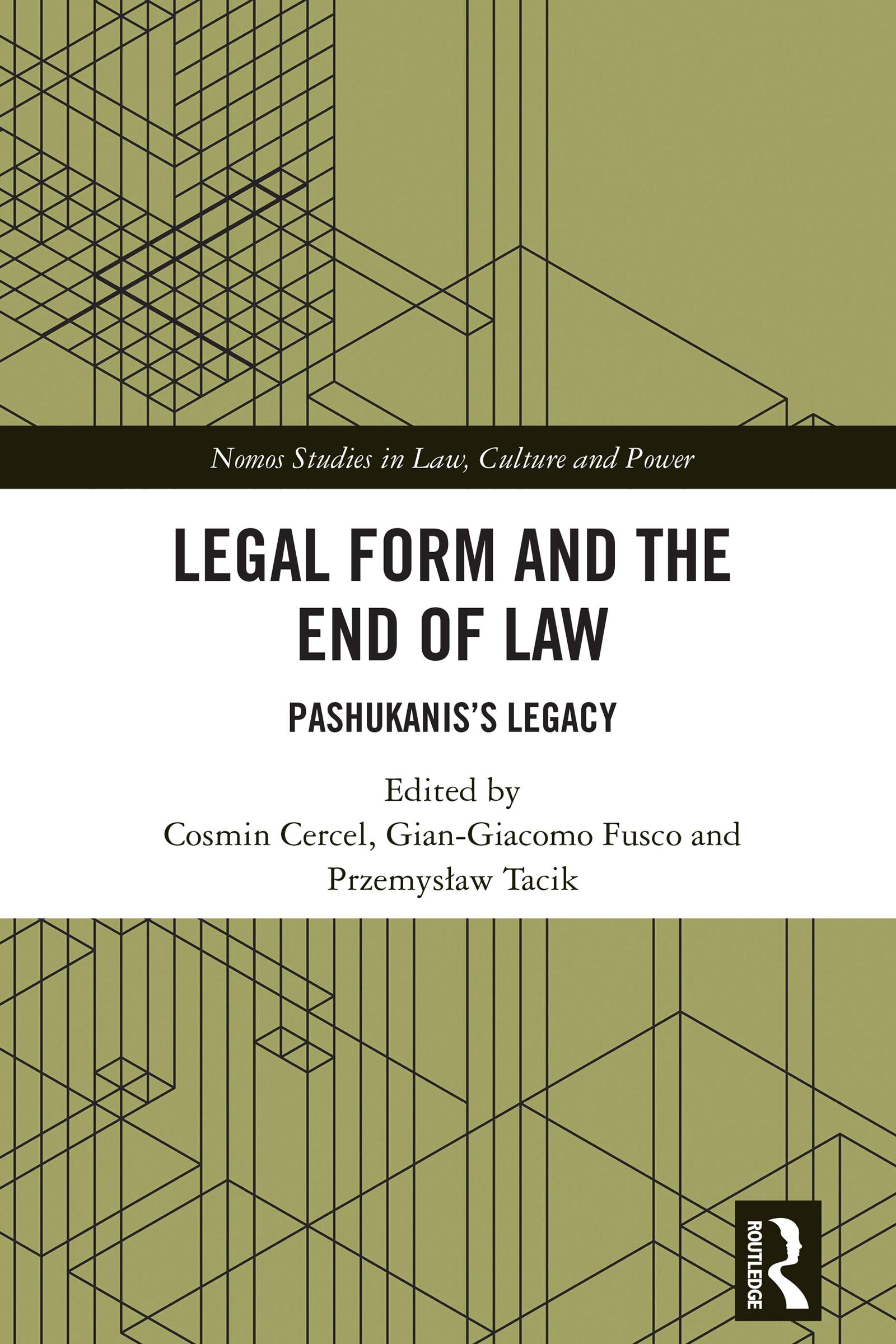
Following the 100th anniversary of Pashukanis’ General Theory of Law and Marxism (1924), this volume aims to breathe new life into the main category of Pashukanian legacy, the concept of legal form.
This book offers new, deeper and more general, ways in which the concept of legal form can be used to push forward Marxist – post-Marxist or hauntingly Marxist – legal theory. Accordingly, this book does not pledge allegiance to reconstructing and reconsidering the official interpretative legacy of the legal form. Instead, it mobilises the revolutionary conceptual potentialities that this term contains. When investigated thoroughly, and in many dimensions, the legal form becomes a privileged vantage point not only into the greatest law-related riddles of Marxism (such as the relation between economy and the state or withering away of statal apparatuses), but the whole of modernity as the epoch determined by – if not overlapping with – capitalism. This book aims to think with the legal form rather than explain this concept. In so doing, it offers a panoply of theoretical perspectives that address legal subjectivity, abstraction, autonomy of the law and, last but not least, withering away of the law.
This contemporary interrogation of the relevance of the concept of legal form will be of considerable interest to scholars and students of legal and political theory.
Płać wygodnie kartą, Klarną, Apple Pay lub Google Pay. Nie jesteś zadowolony? Zawsze masz 14-dniową gwarancję zwrotu pieniędzy. Więcej przeczytasz w naszych warunkach. Masz pytania? Napisz do nas na hello@memmo.org.
Memmo ułatwia naukę – gdziekolwiek jesteś na świecie. U nas znajdziesz podręczniki i sprytne narzędzia do nauki w jednym miejscu: streszczenia, quizy, podcasty i fiszki. A do tego Ted, Twój kumpel do nauki, który odpowie na wszystko, co Cię nurtuje. Ponad 50 000 studentów już tu się uczy – stworzone, byś uczył się szybciej i mniej stresował.