
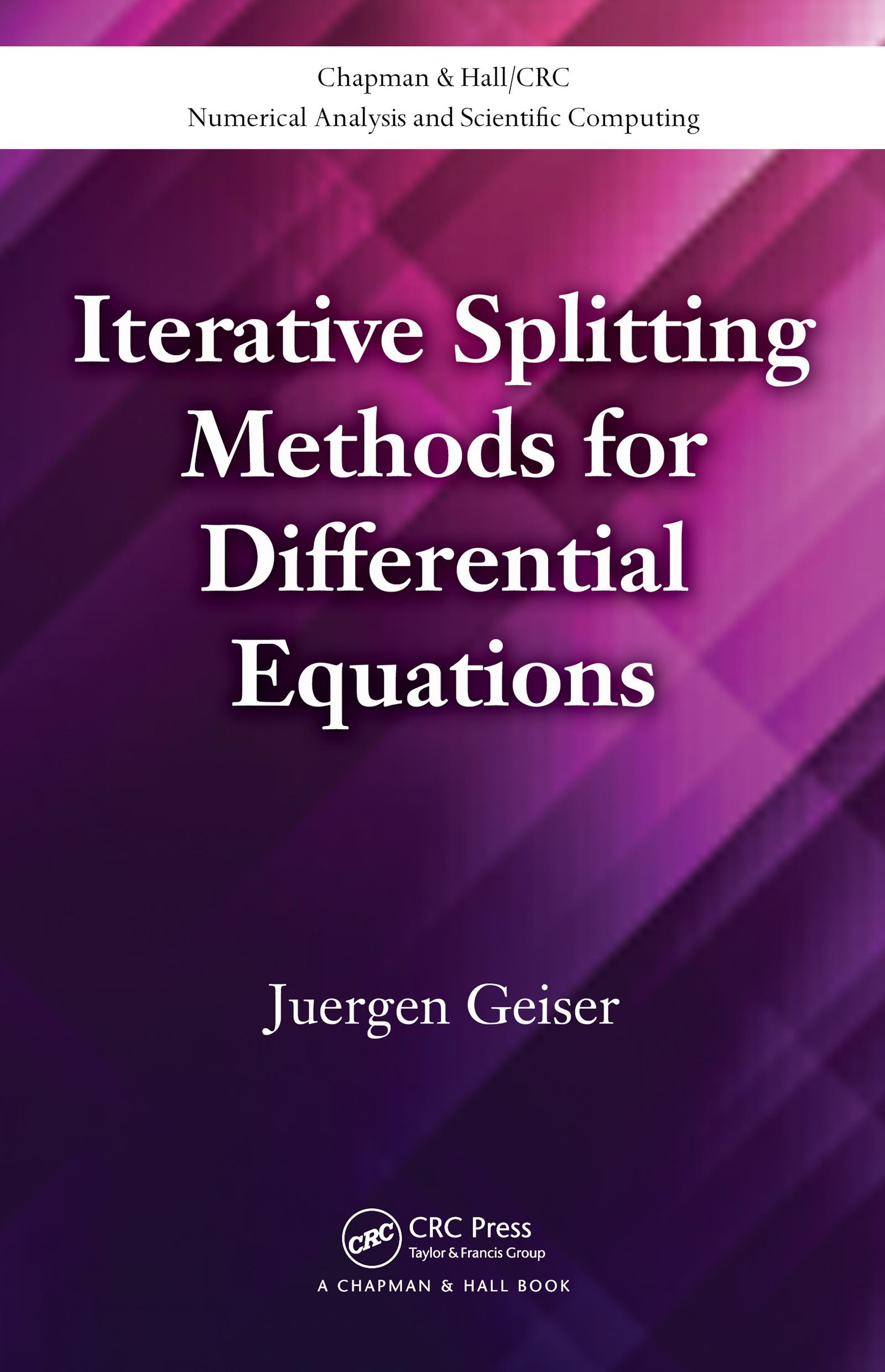
Iterative Splitting Methods for Differential Equations explains how to solve evolution equations via novel iterative-based splitting methods that efficiently use computational and memory resources. It focuses on systems of parabolic and hyperbolic equations, including convection-diffusion-reaction equations, heat equations, and wave equations.
In the theoretical part of the book, the author discusses the main theorems and results of the stability and consistency analysis for ordinary differential equations. He then presents extensions of the iterative splitting methods to partial differential equations and spatial- and time-dependent differential equations.
The practical part of the text applies the methods to benchmark and real-life problems, such as waste disposal, elastics wave propagation, and complex flow phenomena. The book also examines the benefits of equation decomposition. It concludes with a discussion on several useful software packages, including r3t and FIDOS.
Covering a wide range of theoretical and practical issues in multiphysics and multiscale problems, this book explores the benefits of using iterative splitting schemes to solve physical problems. It illustrates how iterative operator splitting methods are excellent decomposition methods for obtaining higher-order accuracy.
Płać wygodnie kartą, Klarną, Apple Pay lub Google Pay. Nie jesteś zadowolony? Zawsze masz 14-dniową gwarancję zwrotu pieniędzy. Więcej przeczytasz w naszych warunkach. Masz pytania? Napisz do nas na hello@memmo.org.
Memmo ułatwia naukę – gdziekolwiek jesteś na świecie. U nas znajdziesz podręczniki i sprytne narzędzia do nauki w jednym miejscu: streszczenia, quizy, podcasty i fiszki. A do tego Ted, Twój kumpel do nauki, który odpowie na wszystko, co Cię nurtuje. Ponad 50 000 studentów już tu się uczy – stworzone, byś uczył się szybciej i mniej stresował.