
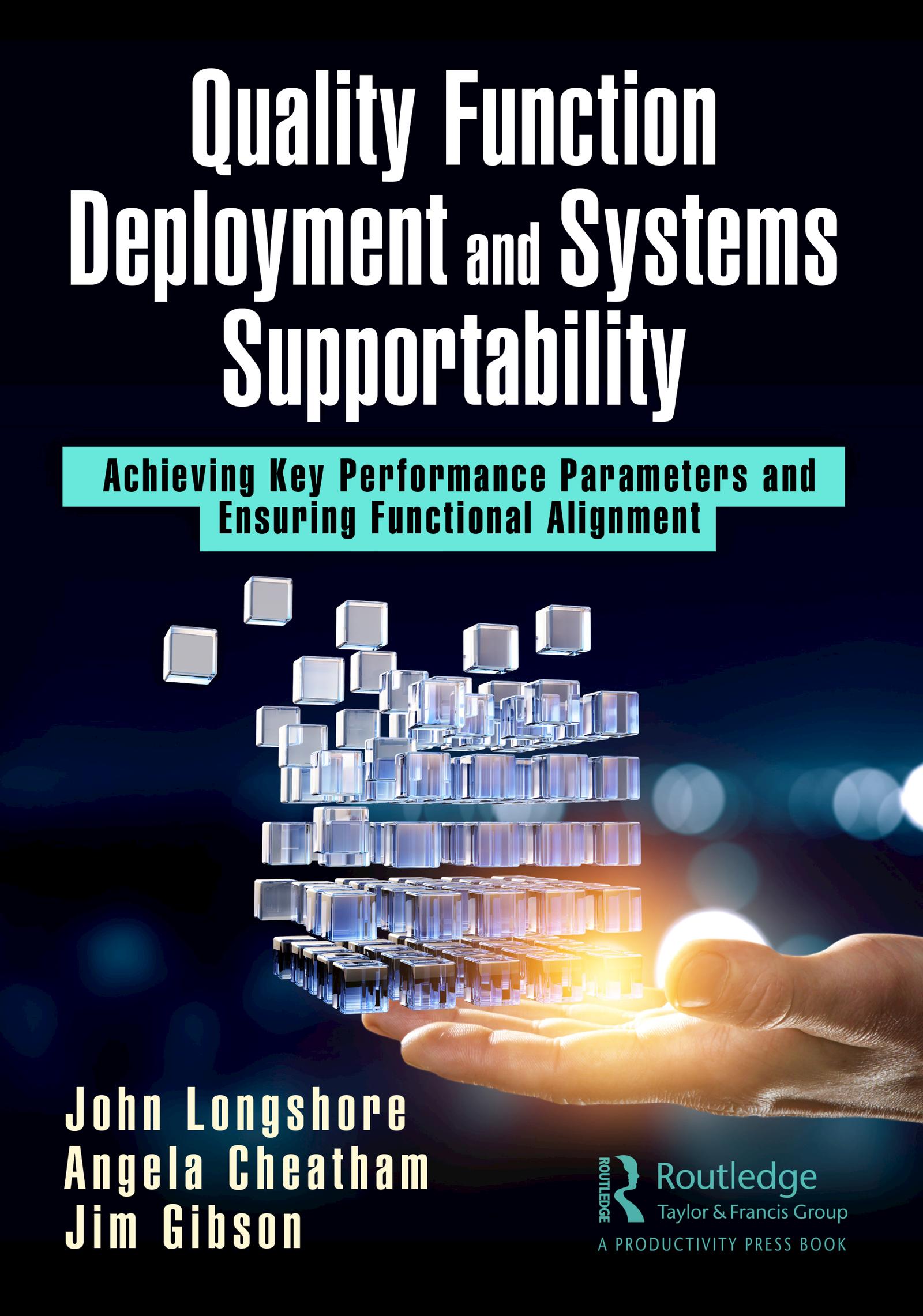
This book not only presents the overall development of quality function deployment (QFD) and what it has been used for to date but a new product support orientation by which it can be employed. It is product and service “system” focused and presents how blending the processes and elements of supportability and analysis into a QFD-modeled methodology can achieve optimal cost savings and performance efficiency and effectiveness. In addition, a working model is provided that will assist those that elect to use such an approach to current/new product and/or service development.
QFD is widely spreading throughout the world because of its outstanding usefulness. It is aimed to fulfill the customer’s expectation of a product or service design. Organizations of all sizes are using it to (1) save product and service design and development time, (2) focus on how the product or service might satisfy the customer and (3) improve communication at all levels of an organization during the development process.
Based on these three reasons, today's traditional QFD can be divided into three branches and analyzed. First, QFD can be implemented effectively for developing new products and designs by establishing the linkage between design stages through the manufacturing environment. However, research has found that traditional QFD is quite weak in implementing modifications to existing product and service design during its predicted lifecycle. Second, most research to this point has been squarely focused on the “voice of the customer” for prioritizing customer needs. While certainly needed, the “voice of the system” that is being used to produce the product/service and how they operate during its intended life cycle has been given less attention. Third, QFD is often viewed as overly labor-intensive and thus costly, and, because of its team-based development logic, manual in nature by those involved during its development and implementation.
Research has shown that life cycle sustainment planning and support for current or proposed products and/or services requires a seamless and balanced life cycle support methodology. To achieve this type of support, twelve functional elements have been identified that form the product support infrastructure. A new approach, one that views product support as an integrative activity where all twelve product support elements are assessed over the entire product and/or service life cycle is being deployed.
With this deployment comes a need to ensure Key Performance Parameters (KPPs) are achieved and functional alignment obtained by balancing supportability element cost and provisioning throughout the entire product and/or service lifecycle, not just during the development stage, and to view the system as the “customer” and thus listen to the “Voice of the System” when assessing supportability requirements. Quality Function Deployment (QFD) is such a tool.
This book contains four sections. Section 1 provides an initial overview of QFD origins, and history and highlights some of its use today. It addresses how QFD fits within the organization, increasing revenue, and reducing cost. It outlines a step-by-step strategy for successfully deploying QFD within the organization. Section 2 examines the evolving product and/or service requirement, creating the design solution using QFD, assessing supportability characteristics using QFD, and performing functional supportability analysis using QFD. Section 3 provides a guide for developing the life cycle supportability solution using QFD methodology on an ongoing basis, and managing processes throughout the systems lifecycle. Section 4 addresses using QFD in an imperfect world and will provide insight into how to use QFD beyond the standard “house of quality” concept.
Płać wygodnie kartą, Klarną, Apple Pay lub Google Pay. Nie jesteś zadowolony? Zawsze masz 14-dniową gwarancję zwrotu pieniędzy. Więcej przeczytasz w naszych warunkach. Masz pytania? Napisz do nas na hello@memmo.org.
Memmo ułatwia naukę – gdziekolwiek jesteś na świecie. U nas znajdziesz podręczniki i sprytne narzędzia do nauki w jednym miejscu: streszczenia, quizy, podcasty i fiszki. A do tego Ted, Twój kumpel do nauki, który odpowie na wszystko, co Cię nurtuje. Ponad 50 000 studentów już tu się uczy – stworzone, byś uczył się szybciej i mniej stresował.