
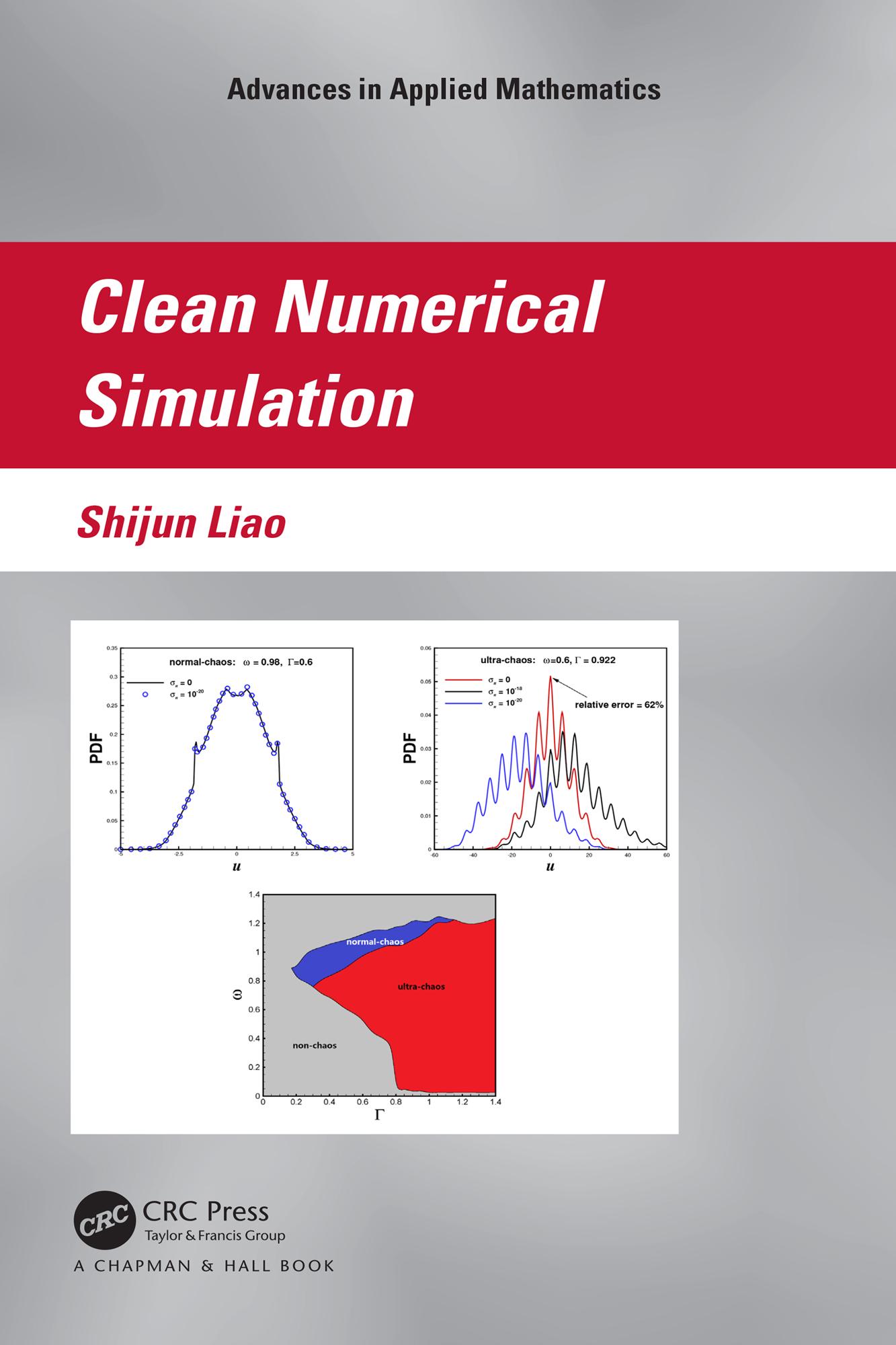
This book describes the basic principles of Clean Numerical Simulation (CNS) proposed by the author in 2009, as well as several of its applications. Unlike conventional algorithms, CNS gives in a sufficiently long interval of time a convergent chaotic trajectory whose numerical noise is much lower than the true physical solution, so that one can gain accurately. Thus, CNS provides for the first time an ability to check statistics stability of chaos, leading to a completely new concept of "ultra-chaos," which has both trajectory instability and statistics instability, and thus is of a higher disorder.
Notably, it is impossible to repeat experimental results of ultra-chaos even in the statistical sense. However, the reproducibility of physical experiments forms a cornerstone for modern science. Thus, ultra-chaos reveals an incompleteness of the modern science paradigm. In addition, it also reveals statistics stability as a precondition for use of conventional algorithms, including direct numerical simulation (DNS). In Clean Numerical Simulation, several conjectures and open problems are proposed, including a modified fourth Clay millennium problem.
Indeed, CNS opens the door for us to enter the "clean" numerical world of chaos and turbulence.
Płać wygodnie kartą, Klarną, Apple Pay lub Google Pay. Nie jesteś zadowolony? Zawsze masz 14-dniową gwarancję zwrotu pieniędzy. Więcej przeczytasz w naszych warunkach. Masz pytania? Napisz do nas na hello@memmo.org.
Memmo ułatwia naukę – gdziekolwiek jesteś na świecie. U nas znajdziesz podręczniki i sprytne narzędzia do nauki w jednym miejscu: streszczenia, quizy, podcasty i fiszki. A do tego Ted, Twój kumpel do nauki, który odpowie na wszystko, co Cię nurtuje. Ponad 50 000 studentów już tu się uczy – stworzone, byś uczył się szybciej i mniej stresował.